
AI Voice Agents: The Complete Guide for Enterprise Contact Centers

Alexander Teusz
Authors name: Alexander Teusz
Table of Content :
  • Intro

  • Key Takeaways

  • What is an AI voice agent?

  • How AI voice agents work

  • AI voice agents vs. IVR: what actually changes

  • Where enterprises deploy AI voice agents

  • Fitting voice AI into your existing contact center

  • Measuring value: containment, handle time, and experience

  • Multilingual and global service

  • Evaluating platforms and building the business case

  • Risks, limitations, and governance

  • Building the business case

  • Getting started: a pragmatic sequence

  • Frequently Asked Questions

  • Explore the Voice AI Agents Resource Center

Book a Demo
Get a demo of Cognigy.AI and discover the power of AI Agents for customer service

Intro

Phone calls remain the channel customers choose when the stakes are high: a canceled flight, a blocked card, an urgent claim. Yet for decades the first "voice" most callers met was a touch-tone IVR menu that made them work to reach help. AI voice agents change that model. They answer the call, understand the caller's own words, look up and update records in backend systems, and resolve a large share of calls without a human agent — escalating with full context when a person is needed.

This guide explains what AI voice agents are, how the underlying technology works, where they deliver measurable value, and how enterprises evaluate, deploy, and govern them. It is the hub of a 13-page resource center; each section links to a deeper spoke article.
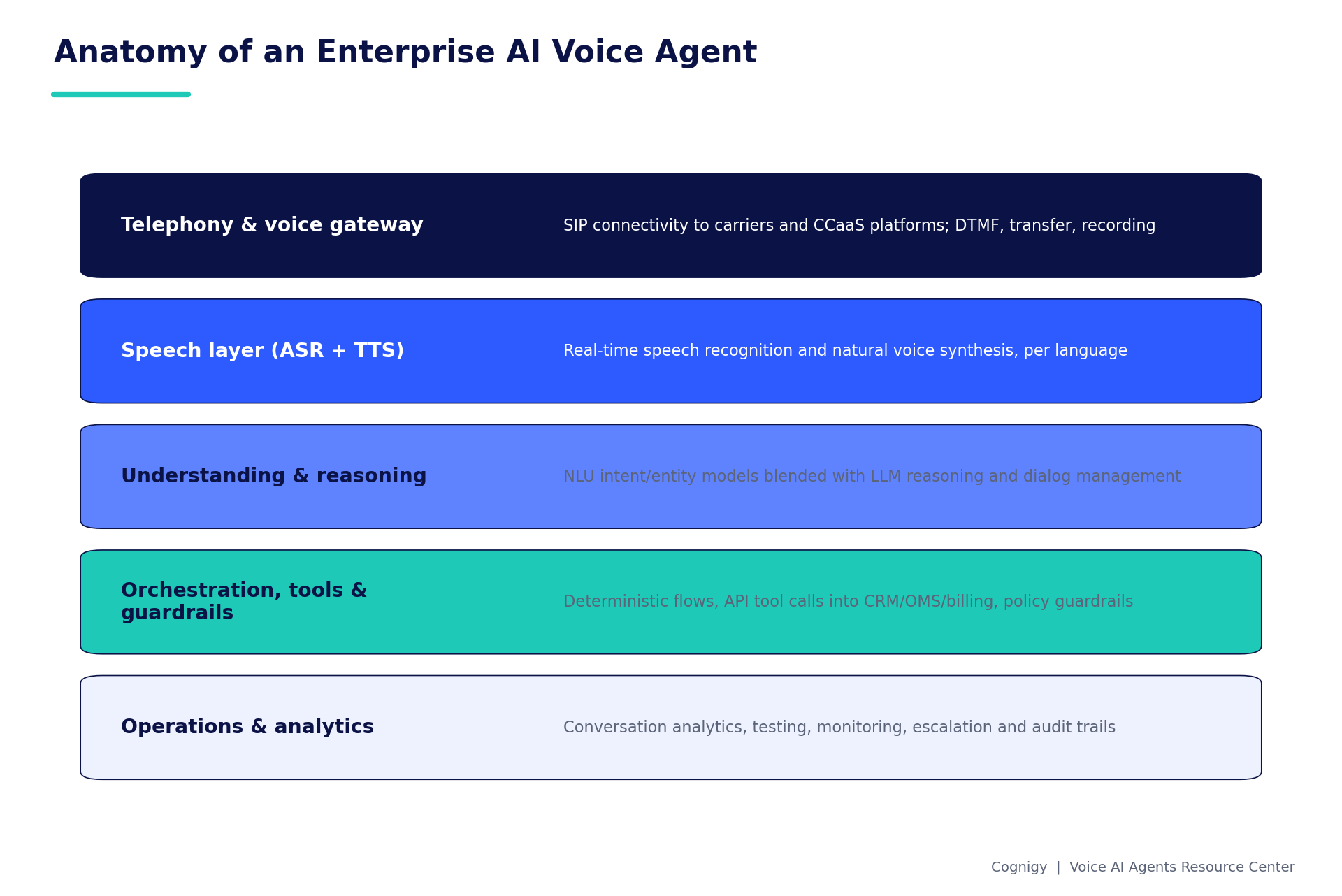
Layered diagram showing five stacked layers of an AI voice agent: telephony and voice gateway, speech layer with ASR and TTS, understanding and reasoning, orchestration with tools and guardrails, and operations and analytics.
Anatomy of an enterprise AI voice agent. The five capability layers of an enterprise AI voice agent, from telephony connectivity to operations and analytics.

Key Takeaways

  • AI voice agents are software programs that hold natural, spoken phone conversations with customers, using speech recognition, language understanding, and speech synthesis to resolve calls end to end.
  • Enterprises deploy them to replace rigid IVR menus, automate high-volume call types, and deliver 24/7 multilingual phone service that integrates with existing contact center platforms and backend systems.

What is an AI voice agent?

An AI voice agent is a software program that conducts spoken, two-way phone conversations with customers and completes tasks on their behalf. Unlike a traditional interactive voice response (IVR) system, which forces callers through predefined menu trees ("press 1 for billing"), an AI voice agent lets callers state their need in natural language, interprets the intent, and either resolves the request itself or routes the call intelligently.

Modern AI voice agents combine several distinct AI disciplines:

  • Conversational AI — understanding spoken or written human language and responding in kind, turn by turn.
  • Generative AI — producing fluent, context-aware responses using large language models (LLMs).
  • Agentic AI — reasoning through a goal, planning multi-step actions, and invoking tools such as APIs, CRM lookups, and payment systems to complete work.

The terms matter because they are not interchangeable. A voice bot or virtual agent may only answer scripted questions; an AI voice agent is expected to take actions — authenticate a caller, rebook a flight, file a first notice of loss — under governed, auditable conditions. For precise definitions of related terms, see what is a voice bot and Cognigy's guide to what AI agents are.

How AI voice agents work

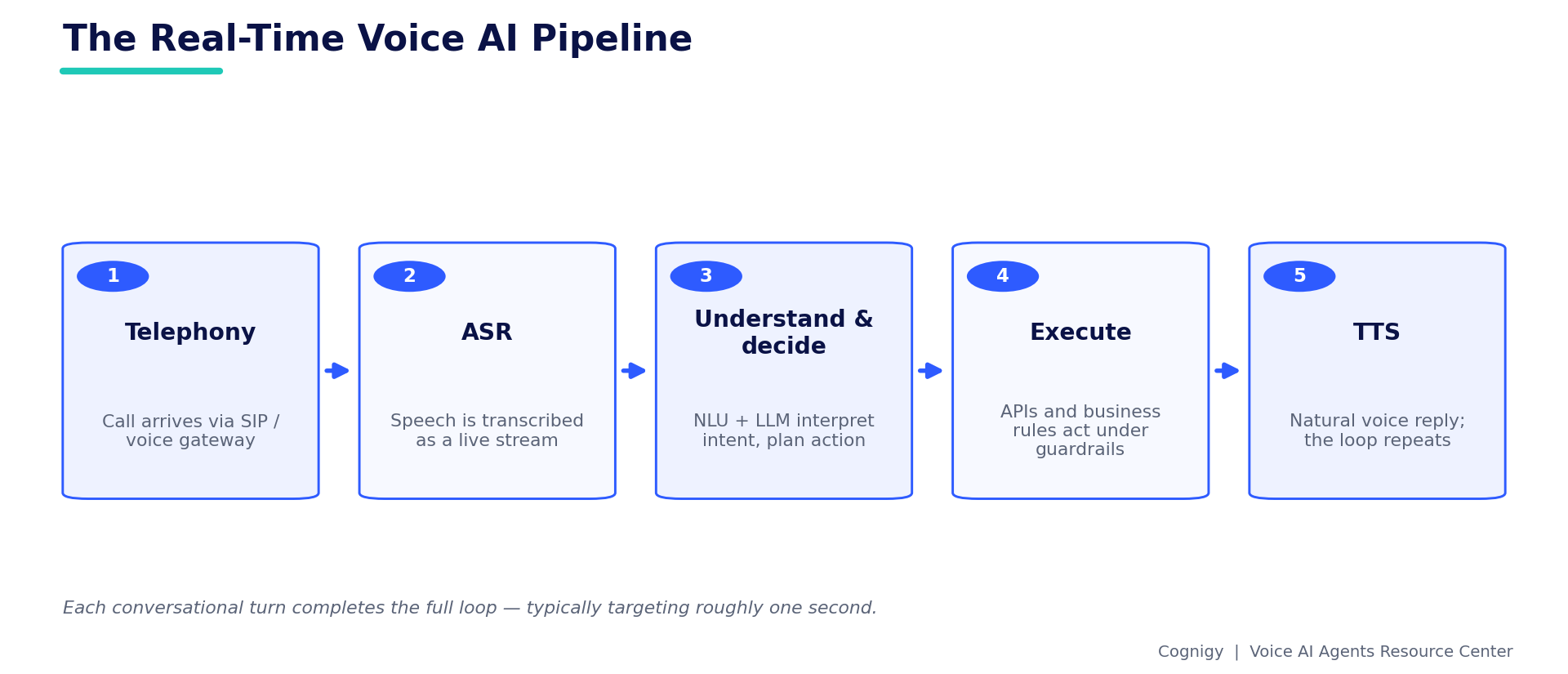
Every spoken exchange with an AI voice agent runs through a real-time pipeline, typically completing in under a second per conversational turn:

Five-step flow diagram: telephony, ASR, understand and decide, execute, TTS, connected by arrows to show one conversational turn.
The real-time voice AI pipeline. Each conversational turn flows through telephony, speech recognition, understanding, execution, and speech synthesis — typically in about one second.
  1. Telephony connection. The call reaches the agent through SIP trunking or a voice gateway connected to the enterprise's contact center (CCaaS) or carrier network.
  2. Automatic speech recognition (ASR), also called speech-to-text (STT), converts the caller's audio into text in real time.
  3. Understanding and reasoning. Natural language understanding (NLU) and LLMs determine the caller's intent, extract entities such as order numbers or dates, and decide the next action.
  4. Business logic and tool execution. The agent calls APIs, checks records, applies business rules, and enforces guardrails before acting.
  5. Text-to-speech (TTS) synthesizes the response into a natural-sounding voice, and the cycle repeats.

Latency, barge-in handling (letting callers interrupt), and speech recognition accuracy in noisy, accented, real-world audio are the engineering factors that separate production-grade platforms from demos. The spoke on how voice AI agents work covers ASR, TTS, and latency budgets in technical depth. Cognigy's own platform, for example, integrates multiple best-of-breed STT and TTS providers and adds voice-specific controls such as barge-in and DTMF handling through Cognigy Voice Gateway.

AI voice agents vs. IVR: what actually changes

IVR systems automated call routing; AI voice agents automate call resolution. The difference shows up in three places: how callers express their need, how much of the call is completed without a human, and how quickly the system can be changed.

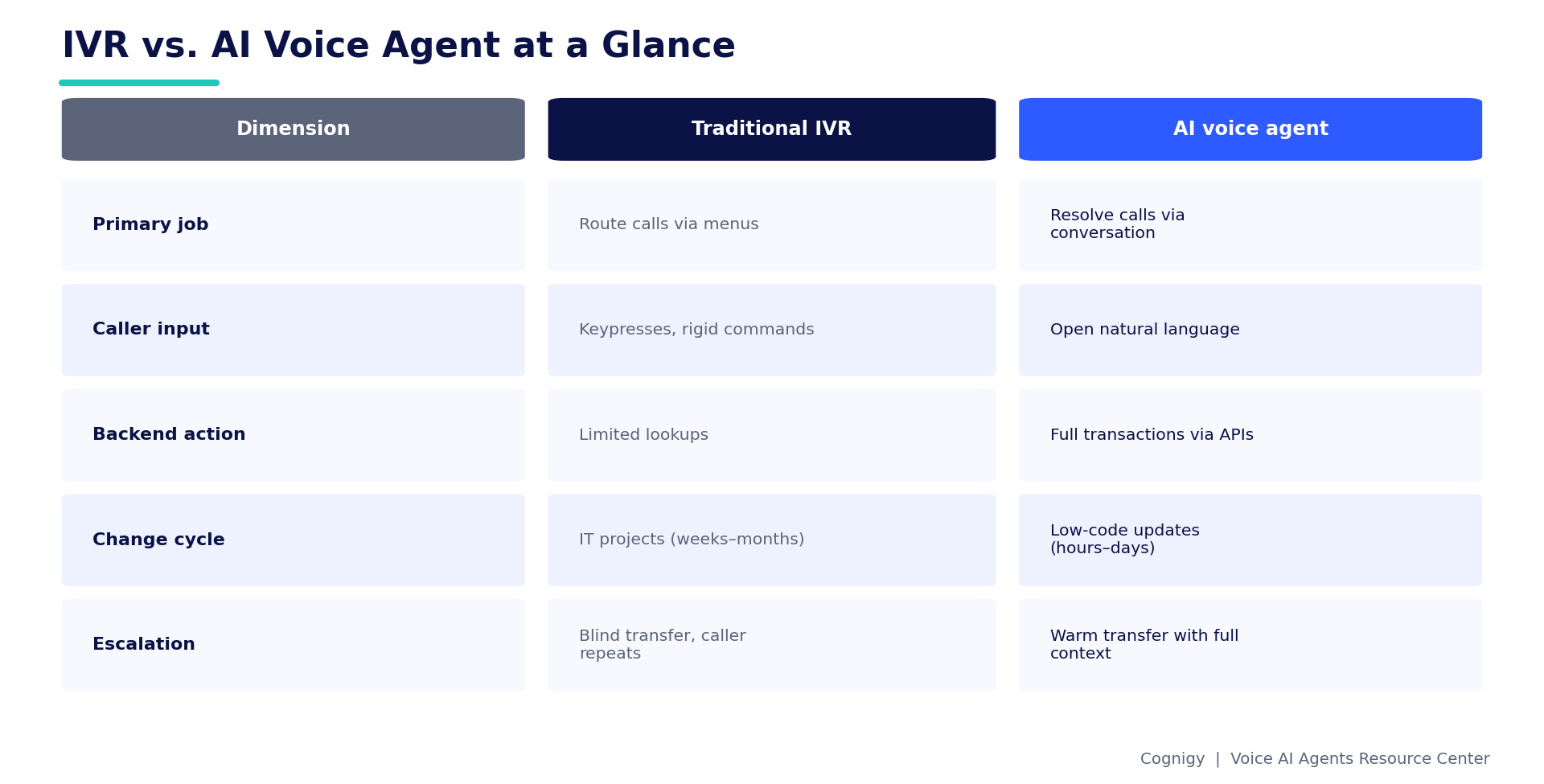
Comparison panel with five rows contrasting traditional IVR and AI voice agents across primary job, caller input, backend action, change cycle, and escalation.
IVR vs. AI voice agent at a glance. The two technologies differ in job, input, backend action, change cycle, and escalation quality.
Dimension Traditional IVR AI voice agent
Input DTMF keypresses, rigid speech grammar Open natural language, 100+ languages on leading platforms
Scope Route calls, simple lookups Resolve calls: authenticate, transact, update records
Caller experience Menu navigation, repetition State the need once, conversational turn-taking
Change cycle IT projects, weeks to months Low-code flow updates, hours to days
Escalation Blind transfer, caller repeats everything Context-rich handoff to a human agent

Two spokes examine this in detail: AI voice agents vs. IVR compares the technologies dimension by dimension, and call containment rate explains how to measure whether automation is genuinely resolving calls rather than deflecting them.

Where enterprises deploy AI voice agents

Adoption follows call volume and repeatability. The highest-value early use cases share three traits: high frequency, well-defined resolution paths, and dependence on data the agent can reach through APIs.

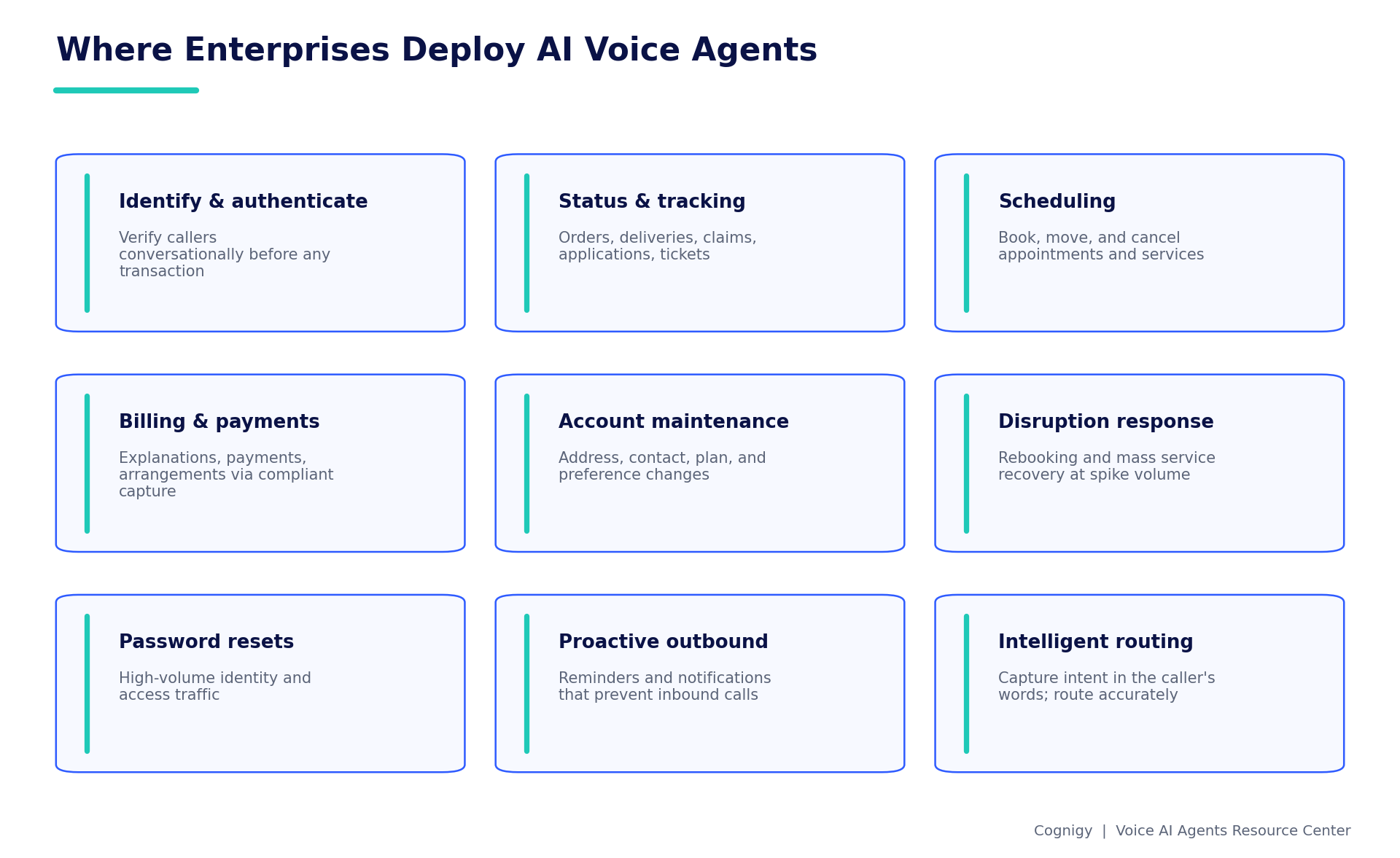
Grid of nine cards naming common AI voice agent deployments: authentication, status and tracking, scheduling, billing and payments, account maintenance, disruption response, password resets, proactive outbound, and intelligent routing.
Where enterprises deploy AI voice agents. Nine recurring deployment patterns across industries, from authentication to proactive outbound.

Common deployments include:

  • Customer identification and authentication before any transaction.
  • Order status, delivery tracking, and appointment scheduling.
  • Flight, hotel, and service rebooking during disruptions.
  • Billing explanations, payments, and payment arrangements.
  • First notice of loss and claims status in insurance.
  • Password resets and account unlocks.
  • Proactive outbound calls: reminders, notifications, and collections.

Real deployments illustrate the scale: Lufthansa Group used Cognigy.AI to absorb crisis-level call volume for rebookings and refunds (Lufthansa case study), and Cognigy's customer success stories document voice and chat automation across airlines, logistics, retail, and utilities (customer success stories). The spokes on voice AI agent use cases, voice AI agents for customer service, and AI voice agents for outbound calls map these patterns by industry and function.

Fitting voice AI into your existing contact center

A frequent misconception is that adopting voice AI requires replacing the contact center platform. In practice, enterprise voice AI platforms connect to existing CCaaS and telephony infrastructure — Amazon Connect, Genesys, NICE CXone, Avaya, and others — over standard SIP, so the AI agent answers in front of, or alongside, the existing routing layer. Cognigy documents this pattern in its Voice Gateway overview and platform-specific integration guides such as the Genesys Cloud CX voice integration guide.

The architectural questions that matter — SIP trunking versus native connectors, where speech services run, how context transfers on escalation, and how the AI layer stays portable across platforms — are covered in the spoke on voice AI agents for CCaaS platforms.

Measuring value: containment, handle time, and experience

Voice AI programs succeed when they are managed against explicit metrics from day one. The core measures are:

  • Call containment rate — the share of calls resolved without human escalation, measured honestly (a frustrated hang-up is not containment).
  • Resolution quality — task completion, transfer accuracy, and post-call verification.
  • Efficiency — average handle time on escalated calls, agent after-call work, cost per resolved contact.
  • Experience — CSAT on automated calls, repeat-call rate, and sentiment.

Because containment is both the most cited and most misused metric, it has its own spoke: call containment rate: how to measure it correctly. Benchmark claims vary widely by industry and use-case mix, so treat any single "average containment" figure with skepticism and baseline against your own call types.

Multilingual and global service

For global enterprises, language coverage is often the deciding factor between vendors. Modern platforms combine multilingual speech recognition, machine translation, and localized synthetic voices; Cognigy, for example, supports service in over 100 languages across voice and chat (Cognigy Voice AI Agents). Architecture choices — native language models per market versus real-time translation — carry cost, latency, and quality tradeoffs, examined in the spoke on multilingual voice AI agents.

Evaluating platforms and building the business case

Enterprise buyers typically shortlist platforms against six criteria groups: voice-specific capability (ASR/TTS quality, latency, barge-in), integration depth (CCaaS, CRM, backend APIs), orchestration and control (deterministic flows blended with LLM reasoning), security and compliance, operations tooling (analytics, testing, monitoring), and commercial model. The spoke on choosing the best AI voice agent for your contact center provides a full evaluation framework and scorecard, and AI phone agent explains deployment models for teams starting from telephony rather than from the contact center platform.

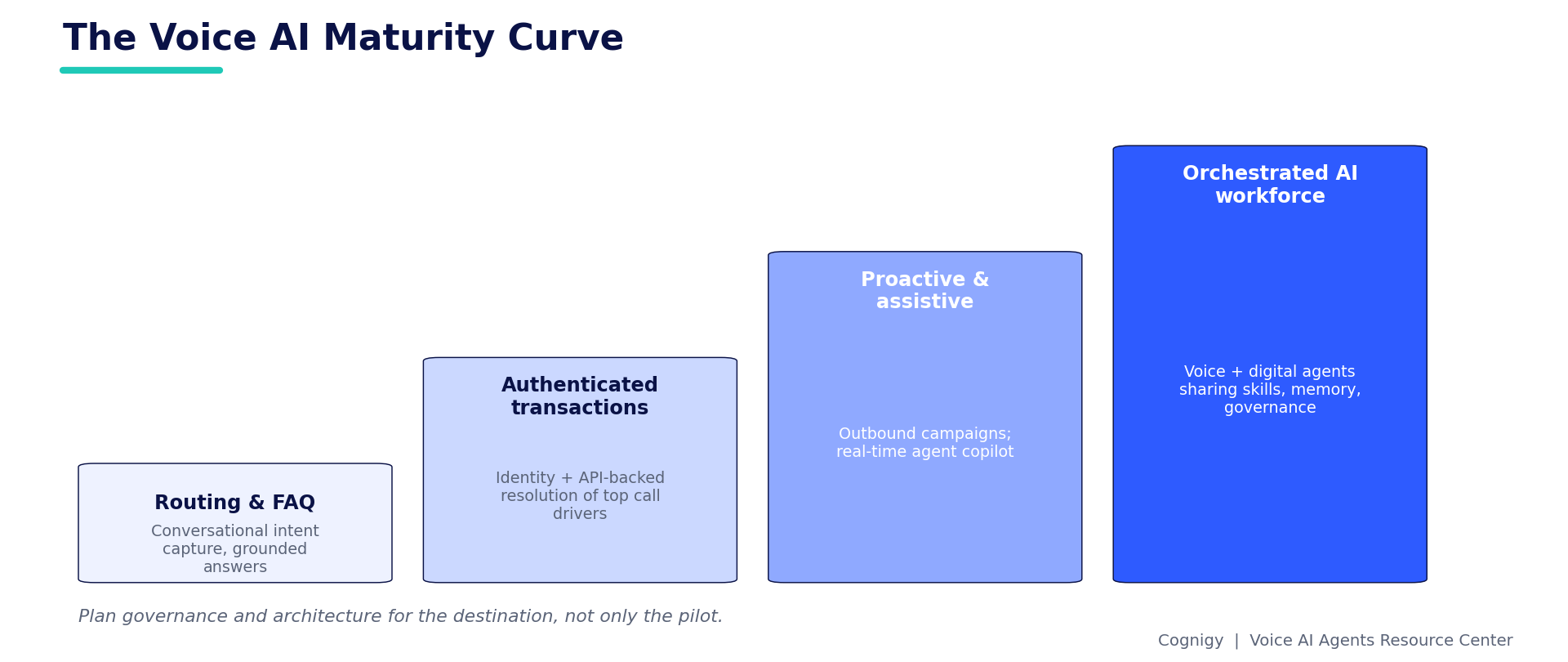
Ascending staircase diagram with four steps: routing and FAQ, authenticated transactions, proactive and assistive, orchestrated AI workforce.
The voice AI maturity curve. Programs typically progress from routing and FAQ automation to an orchestrated AI workforce across channels.

Most enterprises progress through a recognizable maturity curve: routing and FAQ automation first, then authenticated transactions, then proactive outbound and agent-assist, and finally an orchestrated AI workforce operating across voice and digital channels. Plan the roadmap — and the governance model — for the destination, not the pilot.

Risks, limitations, and governance

AI voice agents are production systems acting on customer accounts, so they require the same rigor as any other system of action:

  • Accuracy limits. ASR errors rise with noise, crosstalk, and heavy accents; design confirmation steps for high-risk actions.
  • Hallucination control. LLM-generated responses must be constrained by retrieval, guardrails, and deterministic flows for regulated content.
  • Escalation design. Every flow needs a clear, fast path to a human, with conversation context attached.
  • Privacy and compliance. Call recording consent, PCI-compliant payment capture, and regional data residency must be designed in, not bolted on.
  • Change management. Agents, supervisors, and QA teams need new skills: reviewing AI conversations, tuning flows, and monitoring drift.

These constraints are manageable — but only for organizations that treat voice AI as an operated product with owners, metrics, and a testing discipline, not a one-time IT project.

Building the business case

Voice AI business cases stand on four value lines, in descending order of measurability. First, automated resolution: eligible calls resolved without an agent, valued at the fully loaded agent-minute cost they no longer consume. Second, escalation efficiency: calls that still reach humans arrive authenticated and intent-classified, shortening handle time and after-call work. Third, coverage economics: 24/7 and multilingual service without marginal staffing, which converts overflow, after-hours abandonment, and language queues from service gaps into handled contacts. Fourth, prevention: proactive outbound and better first-contact resolution reduce repeat volume — real value that never shows up in containment.

Model conservatively: use quality-adjusted containment assumptions per intent (not a blended aspiration), include platform, usage, speech/LLM consumption, telephony, and integration costs, and stage benefits by the rollout phases you can actually deliver. Finance teams respect a business case that shows its denominator; they remember one that didn't.

A note on organizational readiness: the programs that compound are the ones that assign a product owner for the voice agent, put transcript review on a weekly calendar, give QA teams authority to file and prioritize flow defects, and budget for continuous tuning rather than treating go-live as the finish line. Technology selection matters; operating discipline decides.

Getting started: a pragmatic sequence

  1. Baseline your call drivers. Pull twelve months of intent-level volume, handle time, and transfer data; rank by automatability using the three gates in use cases.
  2. Fix the measurement contract. Agree the containment definition, guardrail metrics, and reporting cadence before any vendor demo shapes them.
  3. Prove the plumbing. Validate SIP or connector integration to your CCaaS, and the escalation payload, on a test line.
  4. Launch one journey end to end. One intent, fully integrated, instrumented, with a rollback switch.
  5. Review, tune, expand. Weekly transcript reviews for the first quarter; then add the next use case on the shared foundations.

Enterprises that follow roughly this order report a consistent pattern: the second use case ships in a fraction of the first one's time, because telephony, authentication, integration scaffolding, and measurement were built once and reused.

Frequently Asked Questions

What is an AI voice agent?

An AI voice agent is a software program that holds natural spoken phone conversations with customers and completes tasks for them. It combines speech recognition to transcribe the caller, language understanding and large language models to interpret intent and decide actions, backend integrations to execute transactions, and text-to-speech to respond in a natural voice — resolving many calls without a human agent.

How is an AI voice agent different from an IVR system?

An IVR routes calls through fixed menus that callers navigate with keypresses or limited voice commands. An AI voice agent understands free-form natural language, holds multi-turn conversations, and resolves requests end to end by executing transactions in backend systems. IVR automates routing; AI voice agents automate resolution, and they escalate to humans with full conversation context.

Do AI voice agents replace human contact center agents?

In most enterprise deployments, AI voice agents absorb high-volume, repetitive calls — order status, authentication, scheduling, routine account changes — while human agents handle complex, sensitive, or exception cases. The practical effect is reallocation rather than wholesale replacement: shorter queues, less after-call work, and human effort concentrated where judgment and empathy matter most.

What technology stack does an AI voice agent use?

A production AI voice agent stack includes telephony connectivity (SIP trunking or a voice gateway into the CCaaS platform), automatic speech recognition, natural language understanding combined with large language models, an orchestration layer for business logic and API tool calls, guardrails and monitoring, and text-to-speech synthesis. Enterprise platforms integrate these components and connect them to CRM and backend systems.

How long does it take an enterprise to deploy an AI voice agent?

Timelines depend on use-case complexity and integration scope. A focused first use case on an existing CCaaS platform — such as authentication plus order status — is commonly delivered in weeks, while multi-use-case programs with deep backend integration typically run several months. Low-code orchestration platforms shorten iteration cycles significantly compared with custom-built voice stacks.

Explore the Voice AI Agents Resource Center

Work through the spokes in this order — it follows the natural learning and buying journey from definitions to technology, use cases, evaluation, and operations.

Next step

→ Call a live AI voice agent demo

→ Explore Cognigy Voice AI Agents