


.png?width=60&height=60&name=AI%20Copilot%20logo%20(mega%20menu).png)


.png?width=29&height=29&name=twitter%20(1).png)
.png?width=1080&height=1080&name=2026.08_Agentic%20Building%20Webinar%20(6).png)
Introducing Agentic Building for CX AI, powered by the open-source NiCE Cognigy Agent Plugin. It brings coding assistants directly into the agent development lifecycle, so teams can create, test, improve, and deploy CX AI Agents from the agentic interface they already use.
AI assistants are becoming a new productivity layer for modern work. They help people move from intent to execution—researching, analyzing, creating, and increasingly taking action across the systems they use every day.
One category has already shown how far this shift can go: coding agents. They are no longer limited to suggesting the next line of code. They can plan, build, test, refactor, and deliver working outcomes across complex systems. What began with software developers is quickly expanding to solution consultants, technical architects, and other knowledge workers.
CX AI development is next.
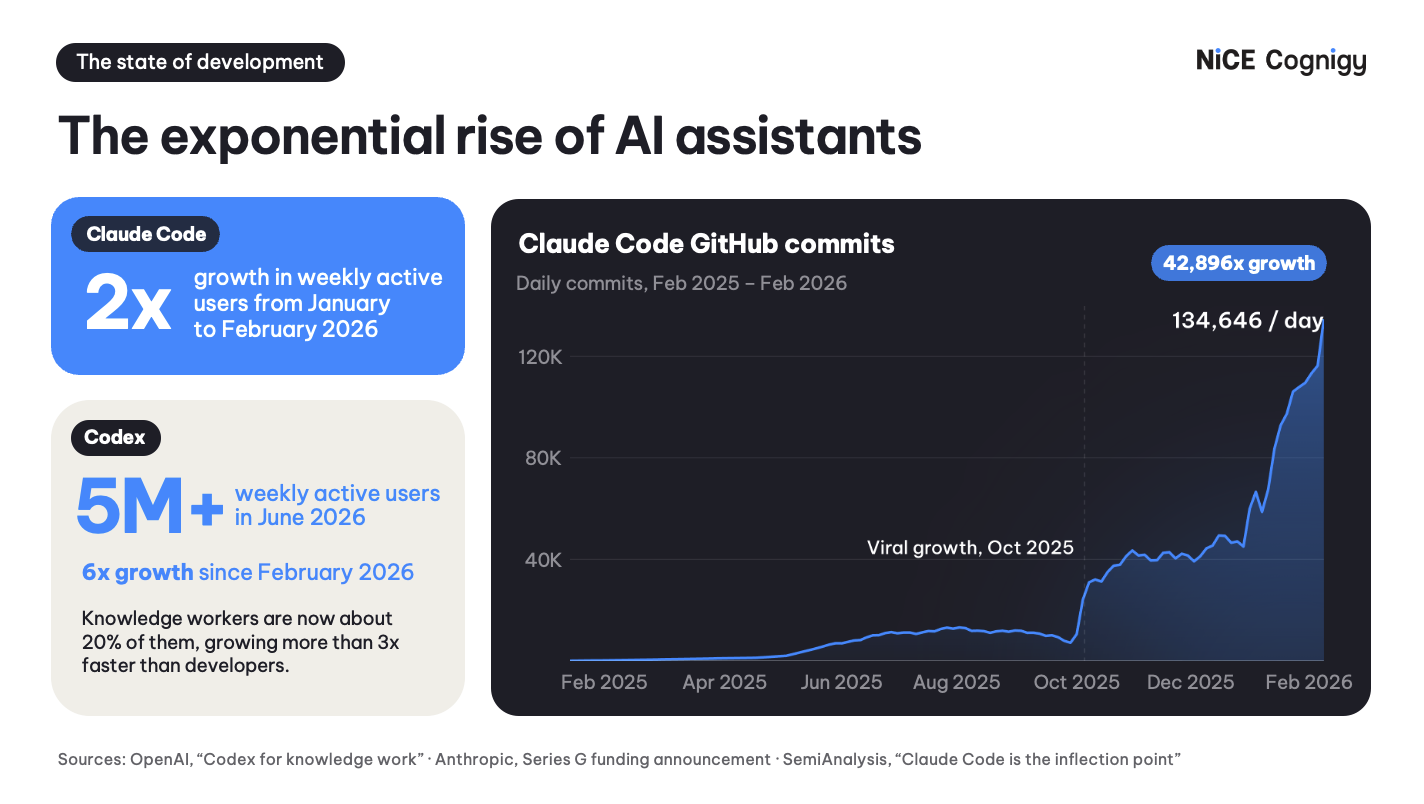
Today, we are introducing Agentic Building for CX AI, powered by the open-source NiCE Cognigy Agent Plugin. It brings coding assistants directly into the agent development lifecycle, so teams can create, test, improve, and deploy NiCE Cognigy AI Agents from the AI assistant, terminal, or IDE they already use.
Instead of starting each task from a blank canvas, builders can describe their desired outcome in natural language. The coding assistant translates that intent into a working CX AI Agent, while all resulting resources remain visible and manageable in the NiCE Cognigy platform.
A Third Persona Enters AI Agent Development
CX AI projects have traditionally brought two core personas together.
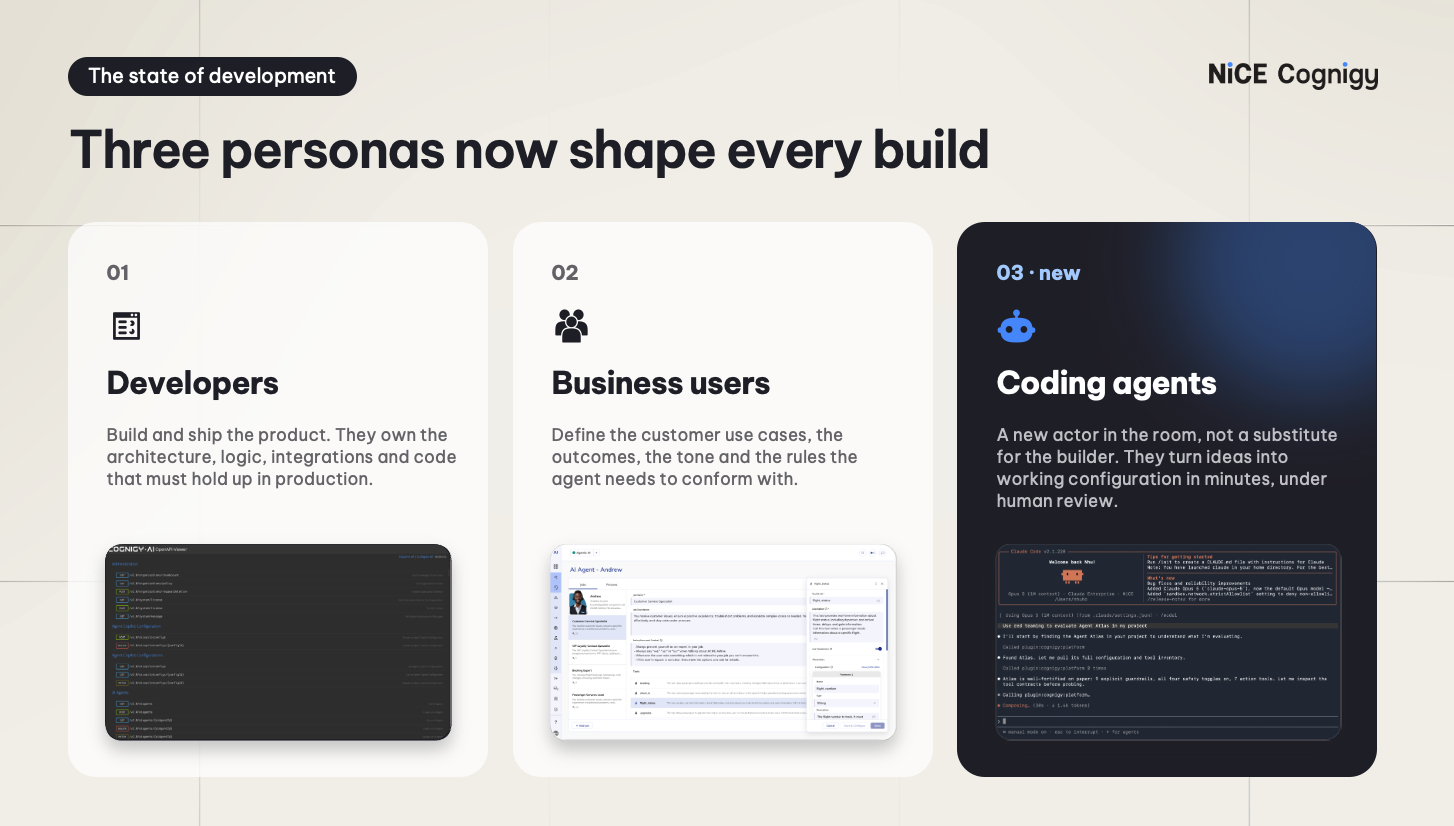
Developers own the architecture, integrations, logic, and code that must hold up in production. Business users define the customer use cases, desired outcomes, tone, and rules the AI Agent should follow.
Coding agents now add a third persona to the team. They are not a substitute for either developers or business users. They act as an implementation partner that can turn requirements into working configuration in minutes, automate repetitive changes, and help teams iterate at a speed that was previously difficult to achieve.
The developer and business user remain in control. The coding agent accelerates the work.
Meet the NiCE Cognigy Agent Plugin
At the center of Agentic Building is the NiCE Cognigy Agent Plugin, a headless developer tool that connects supported AI assistants to your existing Cognigy environment.
The Plugin is available now as an open-source project and works across a growing range of agentic development environments, including Claude Code, Claude Desktop, ChatGPT and Codex, Google Gemini CLI, Antigravity, and compatible hosts such as VS Code and Cursor.
Because it runs where builders already work, there is no additional authoring interface to learn. You can ask your coding agent to create or modify an AI Agent conversationally, then open the Cognigy UI to inspect the result, fine-tune the experience, and collaborate with the wider team.
From Create to Deploy, in One Loop
Agentic Building supports the full AI Agent lifecycle in a single working session.
- Create: Start with a prompt or source material already available to your assistant, such as a transcript, URL, brand reference, presentation, or statement of work. The coding agent can create AI Agents, Flows, AI Agent Job Nodes, Endpoints, Tools, Knowledge Stores, and multimodal xApps.
- Test: Talk to the AI Agent through its REST Endpoint, run realistic conversation simulations, probe it with adversarial prompts, and audit voice configurations before go-live.
- Improve: Feed test findings back into the build. Update the persona, guardrails, job description, tools, knowledge, or Flow logic, then compare the result.
- Test again: Repeat the loop until the AI Agent behaves as intended across the scenarios that matter.
- Deploy: Configure Webchat or Voice Gateway Endpoints, create browser-based WebRTC experiences, and publish the AI Agent to voice and chat channels.
This closes a common gap in AI Agent development. The work no longer has to stop when a demo succeeds. The same agentic session can continue through testing, optimization, and the last mile to a customer-facing experience.
More Than Just Connectivity: Built-in CX AI Expertise
Building effective CX AI Agents requires a deep understanding of conversational design, channels, voice, knowledge, integrations, and the platform patterns that turn an AI Agent into a production-ready customer experience.
The NiCE Cognigy Plugin brings this expertise into the agentic development workflow. It helps coding agents work with NiCE Cognigy in a structured, platform-aware way, using current documentation, established workflows, and specialized guidance for CX AI.
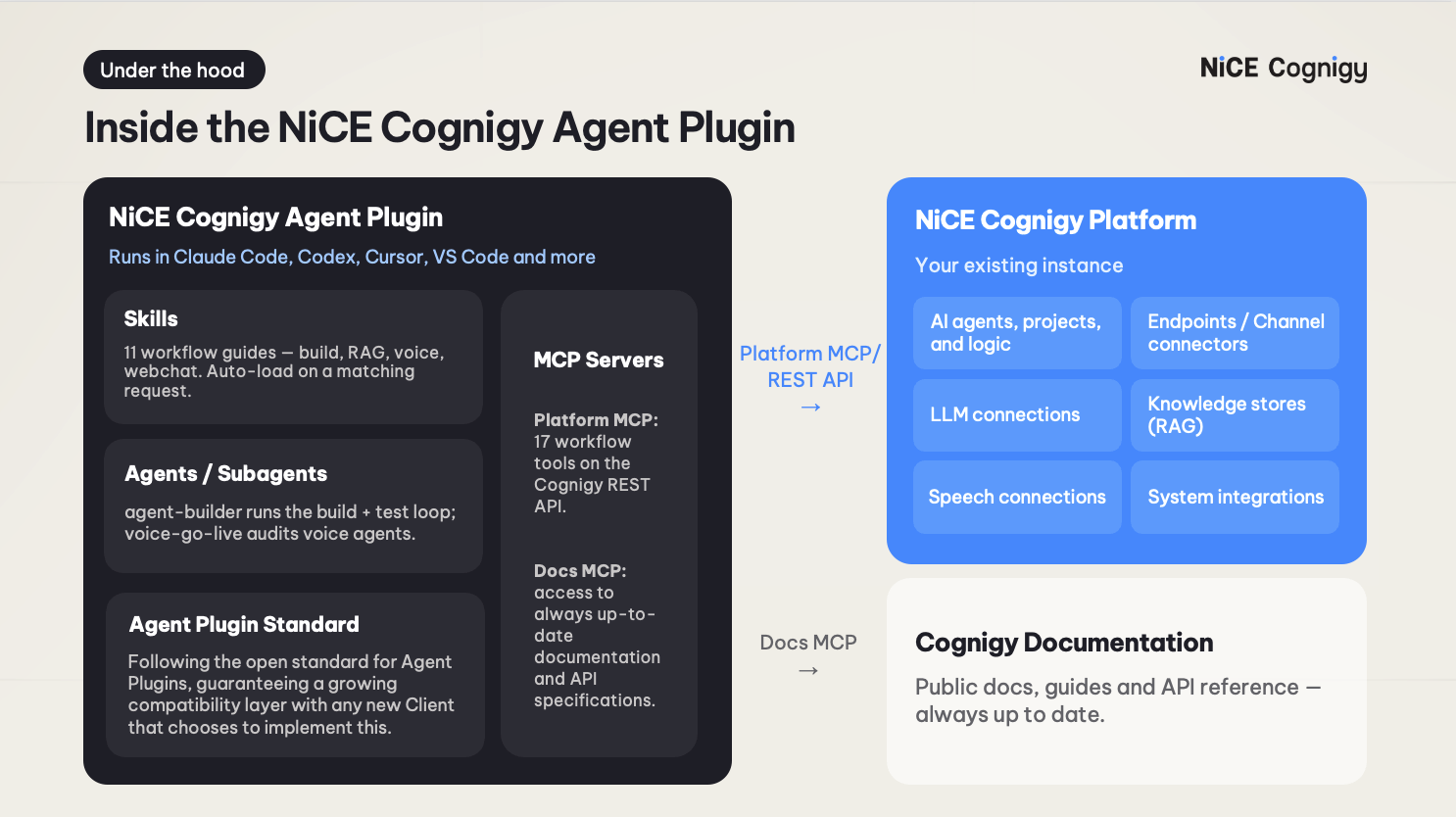
It brings several layers together in one developer experience:
- Platform access through MCP: A platform MCP server gives the coding agent standardized access to Cognigy capabilities for creating, updating, testing, deploying, packaging, and backing up AI Agent resources.
- Always-current documentation: A documentation MCP server gives the assistant access to Cognigy guides, public documentation, and API specifications, helping it work from up-to-date platform information.
- Cognigy-specific skills: Built-in workflow guidance teaches the assistant how to approach common tasks such as creating an AI Agent, configuring Knowledge AI, building Flows, setting up Webchat or WebRTC, and preparing a voice experience for go-live.
- Specialized agents: Where supported by the client, dedicated agents can orchestrate multi-step work. The Agent Builder runs the build-and-test loop, while the Voice Go-Live agent audits voice configurations and recommends or applies safe improvements.
- Open standard: Built on the new open Agent Plugin standard, the NiCE Cognigy Plugin provides a growing compatibility layer for any new client that implements the standard.
Together, these components give coding agents more than connectivity. They give them Cognigy-native context, implementation patterns, and orchestration.
Two Ways to Build, One Platform
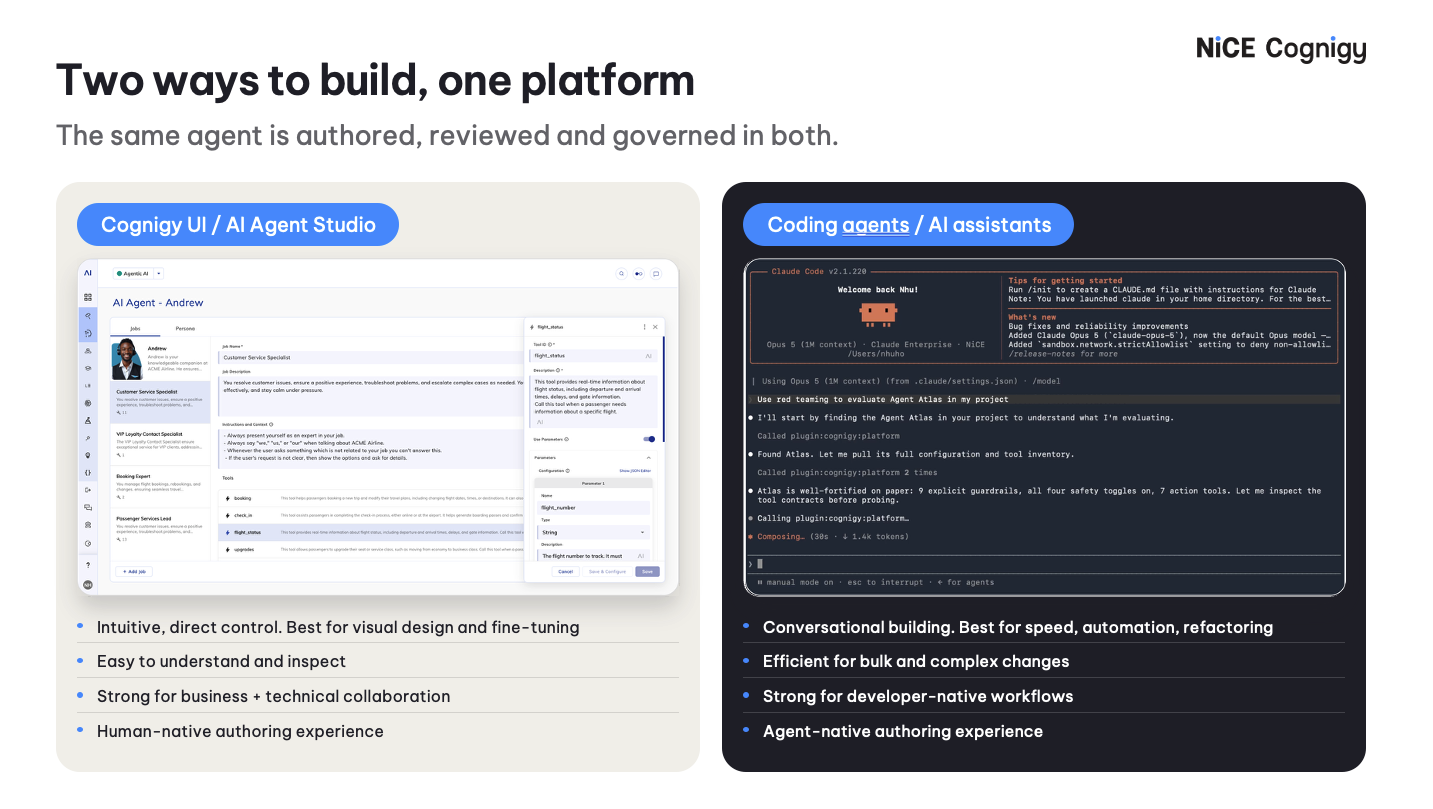
Agentic Building does not replace the Cognigy UI but complements it.
The visual authoring experience remains ideal for direct control, experience design, fine-tuning, inspection, and collaboration between business and technical teams. Coding agents are ideal for speed, automation, refactoring, bulk changes, and developer-native workflows.
Both approaches work with the same AI Agents and platform resources. A builder can delegate implementation to a coding agent, review the result in the Cognigy UI, make visual adjustments, and continue in either environment without creating a disconnected workflow.
The UI becomes the shared inspection surface. The coding agent becomes an additional way to build.
Make the Plugin Work the Way Your Organization Works
The NiCE Cognigy Plugin is open source, so it can be adapted to the standards and processes of each organization.
Teams can customize the included skills, instructions, and workflows to reflect internal terminology, architecture patterns, review requirements, and best practices. They can extend the Plugin with new tools and skills for their own use cases, or connect internal MCP servers to bring company APIs, systems, and data into the agentic development experience.
The Plugin provides the starting point. Your workflows make it yours.
Agentic Building Delegates Implementation, Not Accountability
Agentic Building is powerful, but the boundaries matter.
The Plugin is open-source software provided under its applicable license terms. It can perform resource-changing operations, including actions that overwrite or delete Cognigy resources. Teams should use backups, inspect high-impact changes, and validate results before deployment.
And, as with any AI-generated output, quality can vary by task and context. Human oversight remains critical—particularly for security, customer experience, compliance, and production readiness.
Agentic Building delegates implementation, not accountability.
Looking Ahead: A Hybrid Future for CX AI Development
The future of AI Agent development will not be purely visual or purely headless. It will combine human-native authoring with agent-native execution.
Business users will continue to shape customer outcomes. Developers will continue to own architecture and production quality. Coding agents will help both groups turn intent into working systems faster, run more complete test loops, and automate the work between an idea and a live experience.
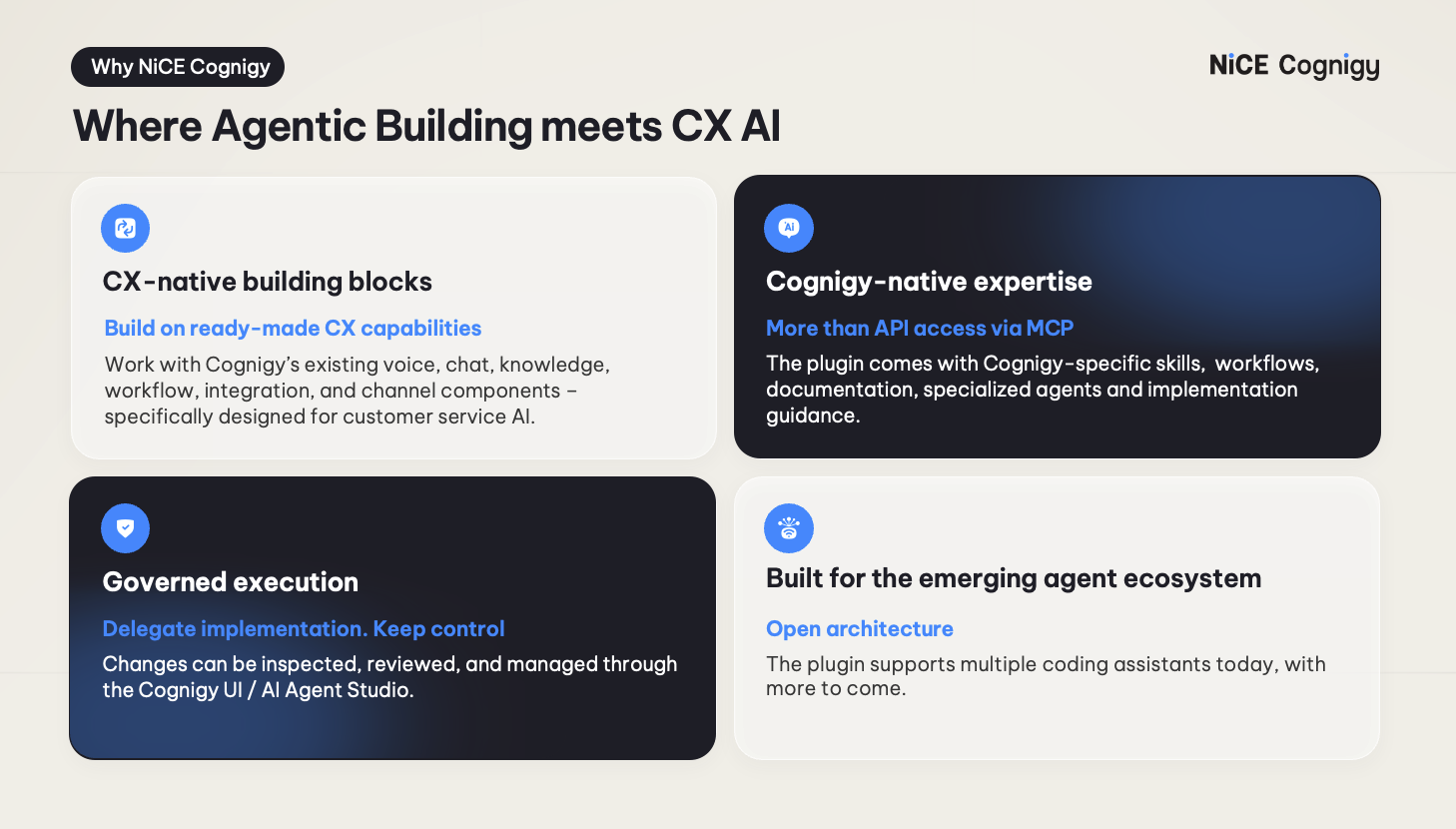
With Agentic Building, NiCE Cognigy brings these ways of working together on one platform—combining CX-native building blocks, Cognigy-specific expertise, governed execution, and an open architecture designed for the emerging agent ecosystem.
The NiCE Cognigy Plugin is available now on GitHub. Review the installation guide, explore the documentation, and take Agentic Building for a test drive.

.png?length=370&name=Knowledge%20Management_Featured%20Image%20(1).png)