Glossary

This glossary covers the complete vocabulary of modern contact center AI — from foundational concepts to the latest agentic architectures — aligned with NiCE Cognigy’s platform and the technology developments shaping customer experience in 2025 and beyond. Terms are sorted alphabetically.

  • Agent Copilot Real-time AI assistance solution embedded in the human agent's desktop that provides live support during customer interactions.
  • Agent Handover Transfer of a conversation from an AI Agent to a human agent when the interaction exceeds the AI's scope, the customer requests a human.
  • Agent Memory AI Agent's ability to retain and recall information across time — both within a conversation (short-term memory) and across multiple interactions over days, weeks, or months (long-term memory).
  • Agent Orchestration Management layer that coordinates the behaviour of one or more AI Agents — routing tasks to the appropriate agent, managing context transfer between agents, enforcing business rules, monitoring progress, and escalating to human agents when needed.
  • Agent-to-Agent (A2A) Protocol Open interoperability standard that defines how AI Agents from different vendors or platforms can discover each other's capabilities, delegate tasks, and exchange results.
  • Agentic AI AI systems that do not merely respond to a single prompt but autonomously plan, reason, and execute multi-step tasks toward a defined goal.
  • Agentic RAG Standard Retrieval-Augmented Generation by incorporating agentic behaviour into the retrieval process itself.
  • Agentic Workflow Sequence of automated steps executed by one or more AI Agents to achieve a business objective — where the path through those steps is determined dynamically at runtime based on context, data, and reasoning.
  • AI Agent Autonomous software system that perceives its environment through inputs such as text, voice, and data, reasons about what action to take using one or more AI models, executes that action via integrated tools or APIs.
  • AI Agent Evaluation Systematic process of assessing the performance, safety, accuracy, and business impact of AI Agents — both before deployment via simulation and testing, and in production via continuous monitoring of live interactions.
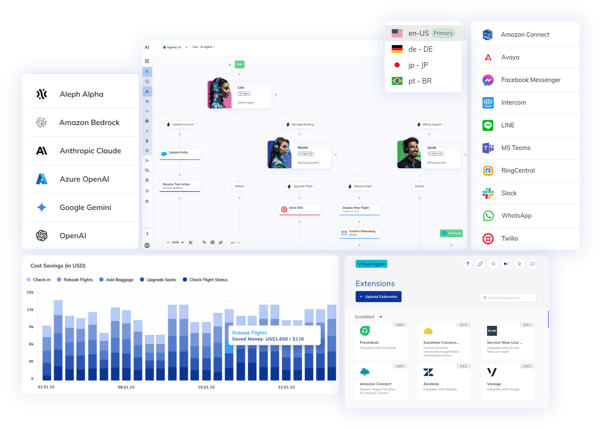
  • AI Agent Studio NiCE Cognigy's visual development environment for creating, configuring, and managing AI Agents.
  • AI Governance Policies, controls, monitoring mechanisms, and accountability structures that ensure AI systems behave safely, fairly, transparently, and in alignment with business objectives and regulatory requirements.
  • AI Guardrails Constraints applied to an AI Agent's inputs and outputs to prevent harmful, off-brand, non-compliant, or inaccurate responses.
  • AI Hallucination Phenomenon in which a generative AI model produces output that is fluent and confident-sounding but factually incorrect, fabricated, or unsupported by available evidence.
  • AI Observability Practice of monitoring the internal behaviour and real-world performance of AI Agents in production — going beyond surface metrics to understand why an agent responded as it did, how its reasoning evolved across a conversation.
  • AI Workforce Collective of AI Agents deployed within an organisation to handle customer and employee interactions at scale.
  • AI-First Contact Center One where AI Agents serve as the primary point of customer engagement — handling the majority of interactions autonomously across all channels, with human agents available for escalation, supervision, and the most complex or sensitive cases.
  • Auto Dialer Outbound communication system that automatically dials customer telephone numbers from a list and connects answered calls to a human agent, an AI Agent, or a pre-recorded message.
  • Automated Speech Recognition (ASR) AI technology that converts spoken audio into machine-readable text.
  • Automatic Call Distributor (ACD) Routing engine at the heart of a contact centre — the system that receives incoming calls and distributes them to the appropriate agent, queue, or automated system based on configured rules.
  • Automation Discovery AI-powered capability to analyse existing engagement data — conversation transcripts, voice recordings, routing signals, and performance metrics — to identify which customer interaction patterns are strong candidates for automation.
  • Average Handle Time (AHT) Mean total time a human agent spends on a customer interaction — including talk time, hold time, and after-call work such as logging notes and updating CRM records.
  • Barge-In Voice interaction feature that allows a caller to interrupt an AI Agent while it is speaking — and have the system immediately stop its current utterance, begin listening, and respond to the new input.
  • Blended Agent Contact centre employee trained and configured to handle both inbound and outbound interactions fluidly — switching between responding to incoming customer contacts and making proactive outbound calls or messages based on real-time workload.
  • CCaaS (Contact Center as a Service) Contact Center as a Service (CCaaS) is the cloud-delivered model for contact centre infrastructure — replacing on-premises hardware with a unified, subscription-based SaaS solution.
  • Chatbot AI-powered application that conducts text-based conversations with users in real time through interfaces such as websites, mobile apps, or messaging platforms.
  • Cloud-Native Architecture Design principles and technologies used to build applications specifically for cloud environments — leveraging microservices, containerisation via Kubernetes, declarative APIs, and continuous delivery pipelines.
  • Cognigy.AI Enterprise-grade agentic AI platform developed by NiCE Cognigy for customer service transformation.
  • Cognitive Computing AI systems designed to simulate aspects of human thought — including reasoning under uncertainty, contextual interpretation, learning from experience, and synthesising information from multiple sources to arrive at conclusions.
  • Composite AI Deliberate combination of multiple AI techniques — LLM-based reasoning, rule-based logic, deterministic workflows, knowledge retrieval, and predictive analytics — within a single system to achieve outcomes that no single method could deliver alone.
  • Contact Center A contact centre is the organisational hub through which a business receives and initiates customer communications across all channels — including voice, digital chat, email, SMS, social messaging, and video.
  • Contact Center Agent A contact centre agent is a member of staff responsible for handling inbound or outbound customer interactions on behalf of an organisation.
  • Contact Center AI (CCAI) Suite of artificial intelligence capabilities applied to automate, augment, and improve contact centre operations.
  • Containment Rate Percentage of customer interactions fully resolved by an AI Agent without requiring escalation to a human agent.
  • Context Window Maximum amount of text or tokens that a Large Language Model can process and hold in its working memory at any one time — the full scope of conversation history, retrieved knowledge, instructions.
  • Continuous ASR Speech recognition mode in which the AI listens and transcribes spoken input in real time as the customer speaks — without requiring explicit start or stop signals.
  • Conversation Analytics Process of systematically analysing the content, structure, and outcomes of customer interactions — at scale — to extract actionable business intelligence.
  • Conversational AI Technology stack that enables machines to understand, process, and respond to human language in real time — across text and voice channels.
  • Conversational IVR Evolution of traditional menu-based IVR — replacing touch-tone navigation with AI-powered spoken dialogue that understands natural language and responds intelligently.
  • Customer Effort Score (CES) Measures how much effort a customer had to exert to resolve their issue — typically captured via a post-interaction survey asking how easy the experience was, rated on a 7-point scale.
  • Deep Learning Subset of machine learning that uses multi-layered neural networks — inspired by the structure of the human brain — to learn hierarchical representations of data.
  • Digital Self-Service Capability for customers to resolve their own enquiries, complete transactions, and access information through digital channels without requiring human agent assistance.
  • Digital Wait Treatment Use of AI-powered engagement to interact with customers who are queued for a human agent — transforming passive hold time into productive, experience-enhancing interaction.
  • Enterprise-Grade AI AI systems that meet the reliability, security, scalability, governance, and compliance requirements of large organisations operating at scale.
  • First Contact Resolution (FCR) Proportion of customer interactions in which the issue is fully resolved in a single interaction — without a follow-up call, transfer, or repeat contact about the same issue.
  • GDPR The General Data Protection Regulation (GDPR) is the European Union's comprehensive legal framework governing the collection, processing, storage, and use of personal data belonging to EU residents.
  • Generative AI Models that can produce new content — text, speech, code, or images — by learning statistical patterns from large training datasets.
  • Hybrid Workforce Model Operational design in which AI Agents and human agents collaborate as complementary members of the same workforce.
  • Hyperautomation Strategic application of multiple automation technologies — AI, machine learning, NLP, RPA, and process mining — in combination to automate the broadest possible set of business processes end to end.
  • Intent-Based Routing Uses AI — specifically Natural Language Understanding — to identify what a customer wants before assigning the interaction to the appropriate queue, agent, or automated workflow.
  • Interactive Voice Response (IVR) Telephony system that interacts with callers through pre-recorded voice prompts and touch-tone keypad inputs — routing calls and providing automated self-service based on menu selections.
  • Job (in AI Agents) In the NiCE Cognigy platform, a Job is the role or mission assigned to an AI Agent — defining the specific business function it performs and the tools it is authorised to use.
  • Knowledge AI NiCE Cognigy's enterprise knowledge management and retrieval module — implementing Retrieval-Augmented Generation (RAG) to enable AI Agents to provide accurate, grounded answers from structured and unstructured enterprise knowledge sources.
  • Language Detection AI capability that enables a system to automatically identify the language a customer is using — either at the start of a conversation or dynamically as the conversation progresses — and adapt the interaction accordingly.
  • Large Language Model (LLM) Neural network trained on vast corpora of text that learns to predict, generate, and reason about language with human-like fluency.
  • LLM Orchestration Capability to manage, route, and govern multiple Large Language Models across an AI platform — selecting the appropriate model for each task based on cost, latency, capability, or compliance requirements.
  • Low-Code Platform Software development environment that minimises the need to write traditional code — replacing it with visual interfaces, drag-and-drop components, and pre-built templates.
  • Machine Learning (ML) Discipline within AI in which systems improve their performance on tasks by learning from data rather than following explicitly programmed rules.
  • Model Context Protocol (MCP) Open standard, introduced by Anthropic in 2024 and rapidly adopted across the industry, that defines a universal way for AI Agents to discover and connect to external tools, data sources, and services.
  • Multi-Agent System AI architecture in which multiple specialised agents collaborate to complete tasks that would exceed the capability, scope, or safety boundary of any single agent.
  • Multimodal CX Multimodal Customer Experience (Multimodal CX) is the delivery of customer interactions that combine multiple input and output modalities — text, voice, images, video, forms, maps, biometric prompts, and mobile device capabilities — within a single cohesive conversation.
  • Multivariate Testing (in AI) Multivariate testing in the context of AI Agents is the controlled, simultaneous evaluation of multiple agent configurations — different LLM prompts, guardrail settings, routing logic, knowledge bases.
  • Natural Language Generation (NLG) Process by which AI systems produce human-readable text or speech from structured data, logic, or retrieved knowledge.
  • Natural Language IVR Enhanced form of conversational IVR in which the AI understands open, free-form natural language — including multi-intent utterances, context-dependent meaning, and domain-specific vocabulary.
  • Natural Language Processing (NLP) Branch of AI that enables computers to read, parse, and derive meaning from human text and speech.
  • Natural Language Understanding (NLU) Sub-field of NLP focused specifically on comprehension — determining not just what words a customer used, but what they meant and what they want.
  • Net Promoter Score (NPS) Customer loyalty metric calculated from the question: 'How likely are you to recommend us to a friend or colleague?' Responses on a 0–10 scale categorise customers as Promoters (9–10), Passives (7–8), or Detractors (0–6).
  • Next Best Action AI-driven recommendation system that analyses the current context of a customer interaction — including customer history, real-time conversation signals, product data.
  • Nexus Engine (Cognigy) The Cognigy Nexus Engine is the multi-layered AI core embedded within Cognigy.AI — the orchestration and reasoning infrastructure that powers every AI Agent deployed on the platform.
  • Omnichannel Customer Experience Service model in which all customer-facing channels — voice, web chat, email, SMS, social messaging, mobile apps — are unified so that customer context, history, and intent are preserved and carried seamlessly across every interaction.
  • Outbound AI Agent AI-powered virtual agent that proactively initiates customer interactions — making outbound calls or sending messages — to deliver personalised, goal-driven communications at scale.
  • Predictive Routing Applies machine learning and historical interaction data to forecast, before a conversation begins, which agent or AI workflow will produce the best outcome for a specific customer.
  • Prompt Engineering Practice of crafting and optimising the instructions, context, and examples provided to a Large Language Model to elicit specific, high-quality, reliable outputs.
  • PSTN The Public Switched Telephone Network (PSTN) is the global infrastructure of interconnected telephone networks — operated by national and regional telecommunications carriers — that enables traditional telephone calls between any two phones on earth.
  • Retrieval-Augmented Generation (RAG) AI architecture that enhances a generative language model by grounding its responses in content retrieved from a curated, up-to-date knowledge base — rather than relying solely on what the model learned during training.
  • Robotic Process Automation (RPA) Technology that uses software robots to automate rule-based, repetitive digital tasks by mimicking the actions a human would take on a computer — clicking, filling in forms, copying data, and reading screen content.
  • Sentiment Analysis AI technique that identifies the emotional tone of customer communications — classifying text or speech as positive, negative, neutral, or more nuanced states such as frustrated, satisfied, confused, or urgent.
  • Session Border Controller (SBC) Network security and signalling management device that sits at the border between enterprise telephony networks and external VoIP or SIP-based networks — controlling, protecting, and routing real-time communication sessions.
  • SIP Protocol The Session Initiation Protocol (SIP) is the industry-standard signalling protocol used to initiate, modify, and terminate real-time communication sessions — including voice calls, video calls, and messaging.
  • SIP Trunk Virtual phone line that uses the SIP protocol over an IP network to connect an enterprise's phone system to the public telephone network or to other VoIP services.
  • Skill-Based Routing Directs incoming customer interactions to the agent — human or AI — most qualified to resolve that specific type of enquiry, rather than simply routing to whoever is available next.
  • Speaker Recognition AI technology that identifies or verifies a person's identity based on the unique acoustic characteristics of their voice — a form of biometric authentication.
  • Speech Synthesis (Text-to-Speech / TTS) Speech synthesis — commonly referred to as Text-to-Speech (TTS) — is the technology that converts written text into spoken audio output.
  • SSML Speech Synthesis Markup Language (SSML) is an XML-based standard that provides fine-grained control over how synthesised speech sounds.
  • Tool (in AI Agents) In the context of AI Agents, a tool is any capability, API, or integration that an agent can invoke to take action in the real world or retrieve information from an external system.
  • TTS Caching Performance optimisation technique in which commonly used synthesised speech audio clips — greetings, brand names, standard instructions, frequent confirmation messages — are pre-generated and stored for instant playback without requiring a real-time TTS API call.
  • Voice AI Application of artificial intelligence to voice-based communication — enabling machines to speak, listen, understand, and act in real-time phone and audio interactions.
  • Voice Automation Use of AI and telephony technology to handle inbound or outbound phone calls without human agent involvement — or with minimal human oversight.
  • Voice Bot AI system that can conduct spoken conversations with customers over telephony channels — understanding natural speech, processing intent, executing actions, and responding in synthesised voice.
  • Voice Concierge Highly personalised AI voice assistant that acts as a proactive, knowledgeable companion for customers — providing tailored recommendations, managing bookings, answering complex queries in spoken language, and creating a premium service experience over the phone.
  • Voice Gateway Infrastructure layer that connects cloud-based AI conversational systems to telephony networks — enabling voice bots and AI Agents to participate in real phone calls.
  • Voice Stream (RTP) The Real-time Transport Protocol (RTP) is the network protocol used to carry audio and video data over IP networks during a live communication session.
  • Webchat Text-based real-time messaging channel embedded within a website or web application, allowing visitors to interact with an AI Agent or live support team without leaving the page.
  • WebRTC Open protocol standard that enables real-time voice, video, and data communication directly within a web browser — without requiring additional plugins or software installation.
  • xApps NiCE Cognigy's proprietary multimodal micro-application framework — mobile-first, self-contained web applications that can be injected into any ongoing customer conversation across voice or digital channels to provide rich, interactive experiences.