



AI Observability

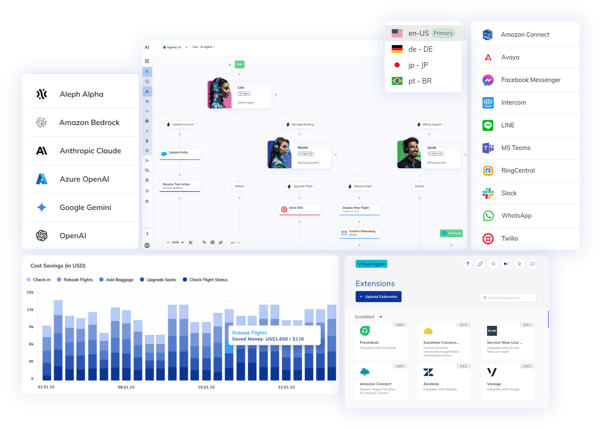
AI observability is the practice of monitoring the internal behaviour and real-world performance of AI Agents in production — going beyond surface metrics to understand why an agent responded as it did, how its reasoning evolved across a conversation, and where failures or unexpected behaviours originated. Unlike traditional software observability, AI observability must also capture LLM inputs and outputs, retrieval quality, tool invocation sequences, confidence levels, and customer outcomes. NiCE Cognigy's Insights and Agent Evaluation modules provide rich AI observability including LLM-based evaluation of production transcripts, configurable quality parameters, anomaly detection, and drill-down analytics that move enterprises from reactive troubleshooting to proactive performance management.

For enterprise teams, AI Observability matters because real-world outcomes depend on how the capability is integrated, governed, and measured — not just on the underlying technology. Unlike traditional software observability, AI observability must also capture LLM inputs and outputs, retrieval quality, tool invocation sequences, confidence levels, and customer outcomes. 

Key Points

  • Monitors AI Agent reasoning, behaviour, and outcomes in production environments
  • Goes beyond system logs to capture LLM inputs/outputs, tool calls, and retrieval quality
  • Enables root-cause analysis when AI Agents produce unexpected or poor responses
  • Supports continuous improvement loops: observe, diagnose, optimise, redeploy
  • Cognigy Insights provides end-to-end AI observability across all conversation data 

Why It Matters

Buyers evaluating AI Observability are typically balancing customer experience, operating cost, and compliance — and need a clear picture of how the capability works and where it fits in their existing stack. AI observability is the practice of monitoring the internal behaviour and real-world performance of AI Agents in production — going beyond surface metrics to understand why an agent responded as it did, how its reasoning evolved across a conversation, and where failures or unexpected behaviours originated. Publishing structured content on this topic also strengthens both SEO and AI-engine (AEO) discoverability, since prospects and large language models lean on authoritative definitions, use cases, and vendor positioning when answering buyer questions.

Best-Practice Perspective

The strongest deployments treat AI Observability as an end-to-end design problem rather than a single feature. In practice that means: Monitors AI Agent reasoning, behaviour, and outcomes in production environments; Goes beyond system logs to capture LLM inputs/outputs, tool calls, and retrieval quality; Enables root-cause analysis when AI Agents produce unexpected or poor responses. NiCE Cognigy customers operationalise this through enterprise-grade governance, observability, and integration into existing CCaaS environments — including NiCE CXone — so the capability scales without compromising security or measurability.