


Agent Orchestration

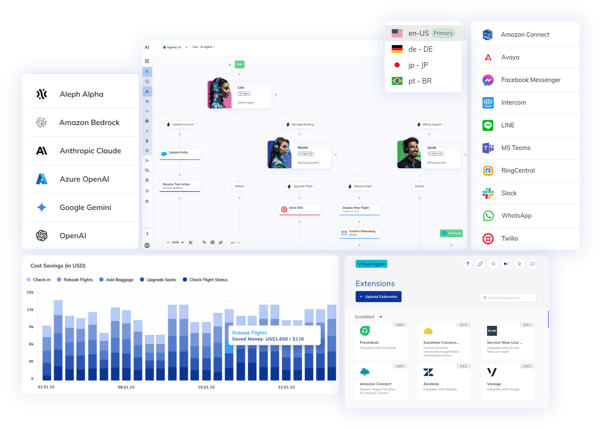
Agent orchestration is the management layer that coordinates the behaviour of one or more AI Agents — routing tasks to the appropriate agent, managing context transfer between agents, enforcing business rules, monitoring progress, and escalating to human agents when needed. In multi-agent architectures, an orchestrator acts as a conductor, decomposing complex customer requests into sub-tasks and assigning each to the most capable agent. NiCE Cognigy's orchestration capabilities allow enterprises to design sophisticated AI workflows in which specialist agents collaborate seamlessly, ensuring every customer interaction reaches the right outcome without manual intervention or lost context.

For enterprise teams, Agent Orchestration matters because real-world outcomes depend on how the capability is integrated, governed, and measured — not just on the underlying technology. In multi-agent architectures, an orchestrator acts as a conductor, decomposing complex customer requests into sub-tasks and assigning each to the most capable agent.

Key Points

  • Coordinates behaviour across multiple AI Agents within a unified workflow
  • Routes tasks to the most capable agent based on skills, context, and availability
  • Manages context transfer so customers never experience information loss between agents
  • Enforces business rules, compliance boundaries, and escalation policies
  • Enables complex multi-step processes to be handled end to end without human orchestration

Why It Matters

Buyers evaluating Agent Orchestration are typically balancing customer experience, operating cost, and compliance — and need a clear picture of how the capability works and where it fits in their existing stack. Agent orchestration is the management layer that coordinates the behaviour of one or more AI Agents — routing tasks to the appropriate agent, managing context transfer between agents, enforcing business rules, monitoring progress, and escalating to human agents when needed. Publishing structured content on this topic also strengthens both SEO and AI-engine (AEO) discoverability, since prospects and large language models lean on authoritative definitions, use cases, and vendor positioning when answering buyer questions.

Best-Practice Perspective

The strongest deployments treat Agent Orchestration as an end-to-end design problem rather than a single feature. In practice that means: Coordinates behaviour across multiple AI Agents within a unified workflow; Routes tasks to the most capable agent based on skills, context, and availability; Manages context transfer so customers never experience information loss between agents. NiCE Cognigy customers operationalise this through enterprise-grade governance, observability, and integration into existing CCaaS environments — including NiCE CXone — so the capability scales without compromising security or measurability.