



Generative AI

Generative AI refers to models that can produce new content — text, speech, code, or images — by learning statistical patterns from large training datasets. In customer service, generative AI powers dynamically drafted responses, synthesised voice output, automatic conversation summaries, and context-aware knowledge retrieval. Large Language Models are the most prevalent form of generative AI in enterprise deployments. Unlike earlier rule-based systems, generative AI handles open-ended, unpredictable conversations naturally, making it foundational to modern AI Agents. NiCE Cognigy integrates best-in-class generative models from multiple providers, giving enterprises flexibility and governance over how generative capabilities are applied.

For enterprise teams, Generative AI matters because real-world outcomes depend on how the capability is integrated, governed, and measured — not just on the underlying technology. Unlike earlier rule-based systems, generative AI handles open-ended, unpredictable conversations naturally, making it foundational to modern AI Agents. 

Key Points

  • AI models that produce new content — text, speech, code — from learned patterns
  • Powers dynamic responses, voice synthesis, conversation summaries, and knowledge retrieval
  • LLMs are the dominant form of generative AI in enterprise contact centre deployments
  • Handles open-ended, unpredictable conversation naturally — unlike rule-based predecessors
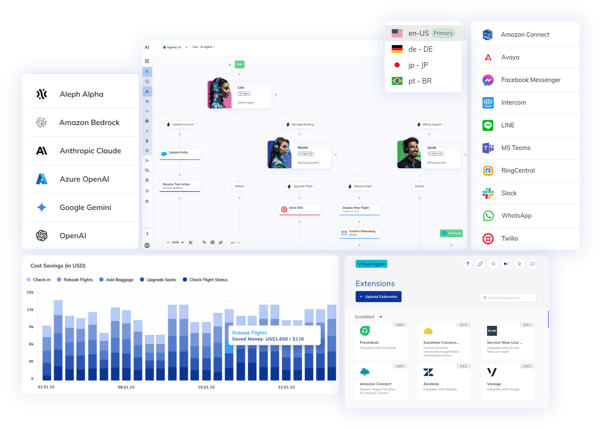
  • NiCE Cognigy integrates generative AI from OpenAI, Anthropic, Google, AWS, and others

Why It Matters

Buyers evaluating Generative AI are typically balancing customer experience, operating cost, and compliance — and need a clear picture of how the capability works and where it fits in their existing stack. Unlike earlier rule-based systems, generative AI handles open-ended, unpredictable conversations naturally, making it foundational to modern AI Agents. Publishing structured content on this topic also strengthens both SEO and AI-engine (AEO) discoverability, since prospects and large language models lean on authoritative definitions, use cases, and vendor positioning when answering buyer questions.

Best-Practice Perspective

The strongest deployments treat Generative AI as an end-to-end design problem rather than a single feature. In practice that means: AI models that produce new content — text, speech, code — from learned patterns; Powers dynamic responses, voice synthesis, conversation summaries, and knowledge retrieval; LLMs are the dominant form of generative AI in enterprise contact centre deployments. NiCE Cognigy customers operationalise this through enterprise-grade governance, observability, and integration into existing CCaaS environments — including NiCE CXone — so the capability scales without compromising security or measurability.