

AI Agent Evaluation: Building the Quality Program Around Your Agents

Alexander Christodoulou
Authors name: Alexander Christodoulou
Table of Content :
  • Intro

  • Key Takeaways

  • Why AI agents need a different quality discipline

  • The quality lifecycle

  • The quality stack

  • The operating model: quality as a standing function

  • Where to start, honestly

  • Frequently Asked Questions

  • Explore the AI Agent Quality Resource Center

Book a Demo
Get a demo of Cognigy.AI and discover the power of AI Agents for customer service

Intro

Every enterprise deploying AI agents eventually asks the same question, usually after the first surprising transcript: how do we know this thing is behaving? The answer is a quality program — the testing, guardrail, observability, and governance disciplines that surround production AI agents — and it is the least glamorous, highest-leverage investment in the entire automation stack. This hub maps the full lifecycle, with twelve deeper guides covering everything from test design to regulatory preparation. (One standing note: pages touching regulation describe practical preparation patterns, not legal requirements — your legal and compliance teams own the rules.)
Key Takeaways

  • AI agent evaluation is a lifecycle, not a launch gate: test before release with golden sets and regression suites, constrain during conversations with guardrails and grounding, observe after with monitoring and tracing, and govern always with clear ownership and human oversight.
  • Probabilistic systems demand this discipline — an AI agent is never "done" like deterministic software — and programs that run the full loop keep their automation trustworthy at scale.

Why AI agents need a different quality discipline

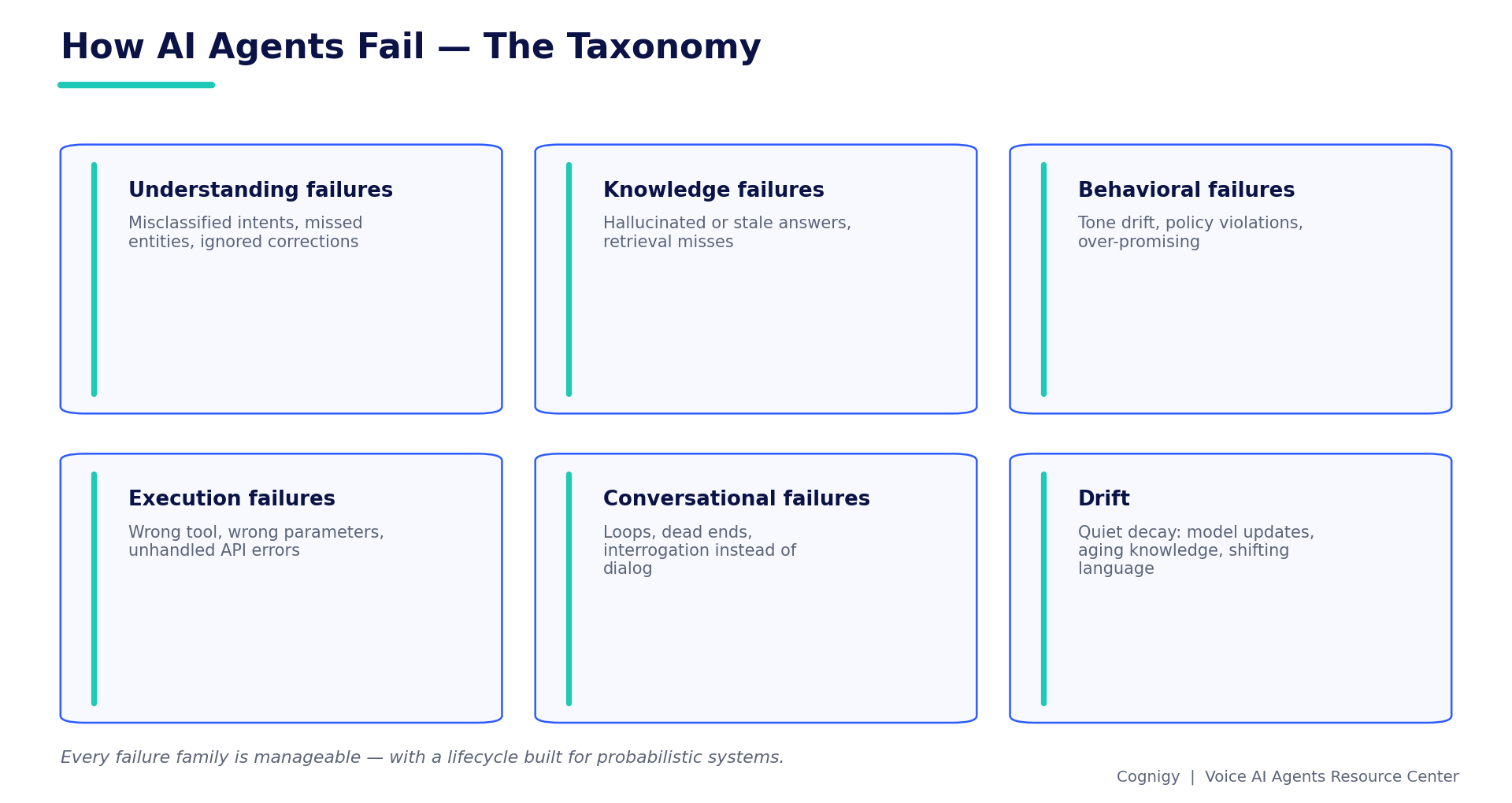
Six cards naming the AI agent failure taxonomy.
How AI agents fail. Six failure families — understanding, knowledge, behavioral, execution, conversational, and drift — each manageable with the right lifecycle.

Deterministic software fails reproducibly: the same input produces the same bug, a fix stays fixed. AI agents are probabilistic systems whose behavior emerges from models, prompts, retrieved knowledge, and integrations — which changes the failure landscape. The recurring failure families: understanding failures (misclassified intents, missed entities), knowledge failures (hallucinated or stale answers), behavioral failures (tone drift, policy violations, over-promising), execution failures (wrong tool, wrong parameters, unhandled API errors), conversational failures (loops, dead ends, ignored corrections), and drift — the quiet degradation when models update, knowledge ages, or customer language shifts. None of these is exotic; all of them are manageable — with a lifecycle built for probabilistic systems rather than a test plan borrowed from deterministic ones.

The quality lifecycle

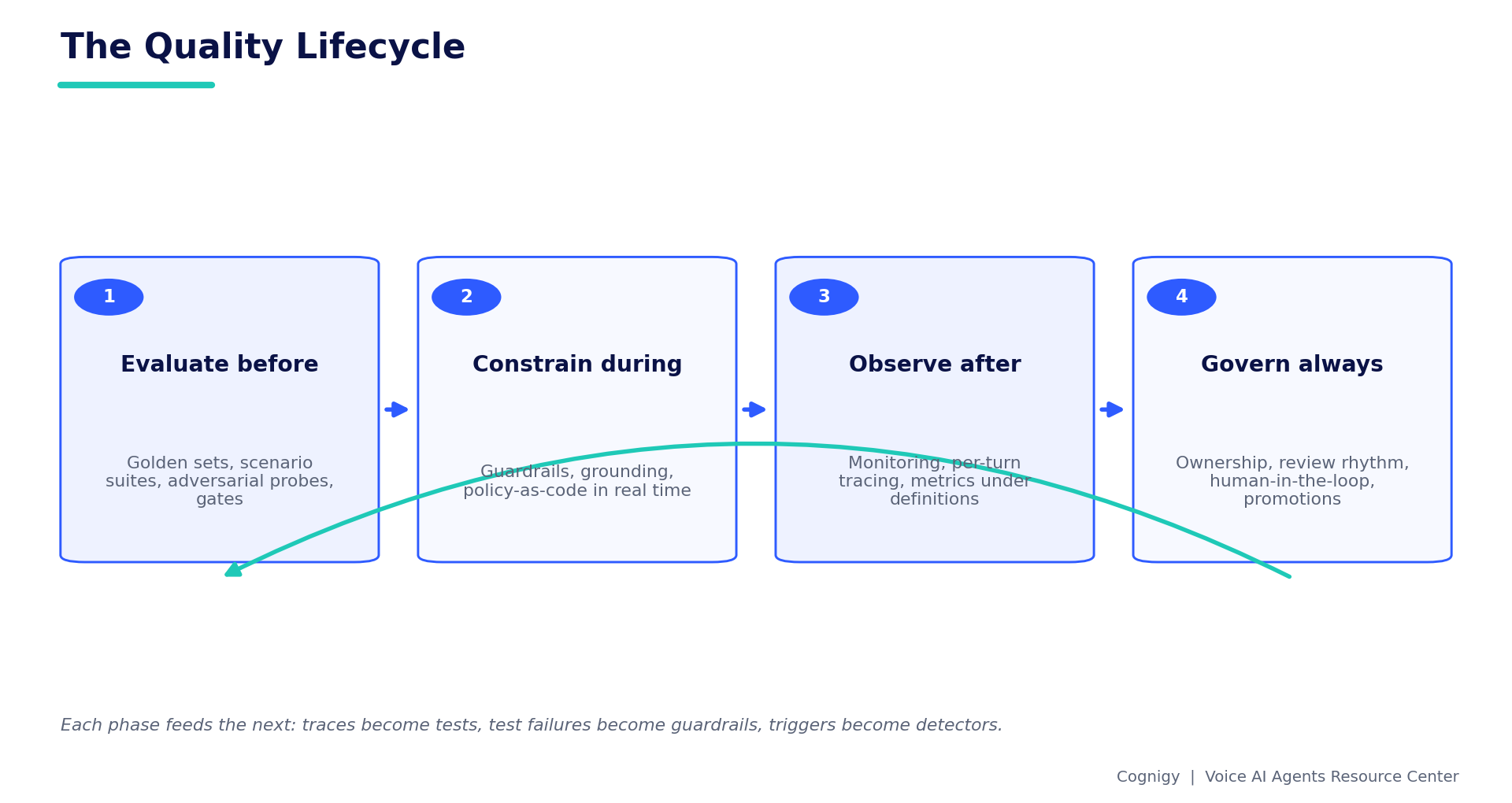
Circular four-phase flow of the AI quality lifecycle.
The quality lifecycle. Evaluate before, constrain during, observe after, govern always — with each phase feeding the next.

Four phases, running continuously. Evaluate before: golden test sets, scenario suites, and adversarial probes run pre-release — the disciplines of AI agent testing, conversational AI testing, and regression testing, with LLM evaluation supplying the scoring methods. Constrain during: guardrails enforcing input, policy, output, and action boundaries in real time, with hallucination prevention keeping answers grounded. Observe after: monitoring watching the operational signals, observability making every conversation turn traceable, and performance metrics anchoring it all in written definitions. Govern always: AI governance assigning ownership and rhythm, human-in-the-loop design placing people where judgment lives, and EU AI Act preparation as the regulatory horizon. Each phase feeds the next: production traces become test cases, test failures become guardrails, guardrail triggers become monitoring signals.

The quality stack

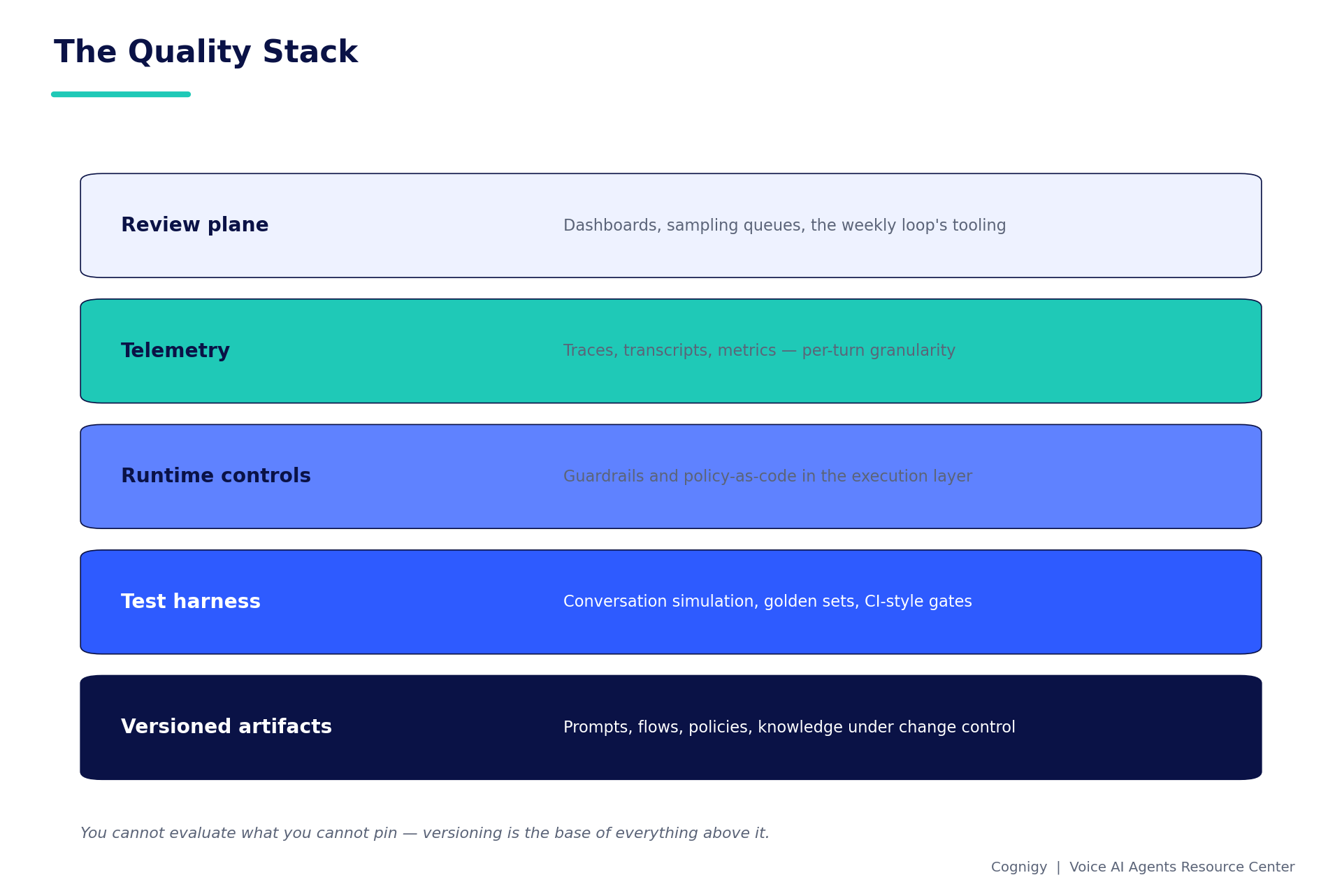
Stacked layer diagram of the AI quality stack.
The quality stack. Versioned artifacts, a test harness, runtime controls, telemetry, and the review plane — the platform substrate of the program.

Under the lifecycle sits a stack worth naming, because platform choice determines how much of it you get versus build. At the base, versioned artifacts: prompts, flows, policies, and knowledge under change control — you cannot evaluate what you cannot pin. Above it, the test harness: automated conversation simulation, golden sets, and CI-style gates. Then runtime controls: guardrails and policy-as-code in the execution layer, where the model cannot override them (the architecture from Pillar 3's AI agent security). Then telemetry: traces, transcripts, and metrics with per-turn granularity. On top, the review plane: dashboards, sampling queues, and the weekly loop's tooling. When evaluating platforms, this stack belongs in the scorecard — Pillar 4's evaluation criteria weight operations tooling for exactly this reason.

The operating model: quality as a standing function

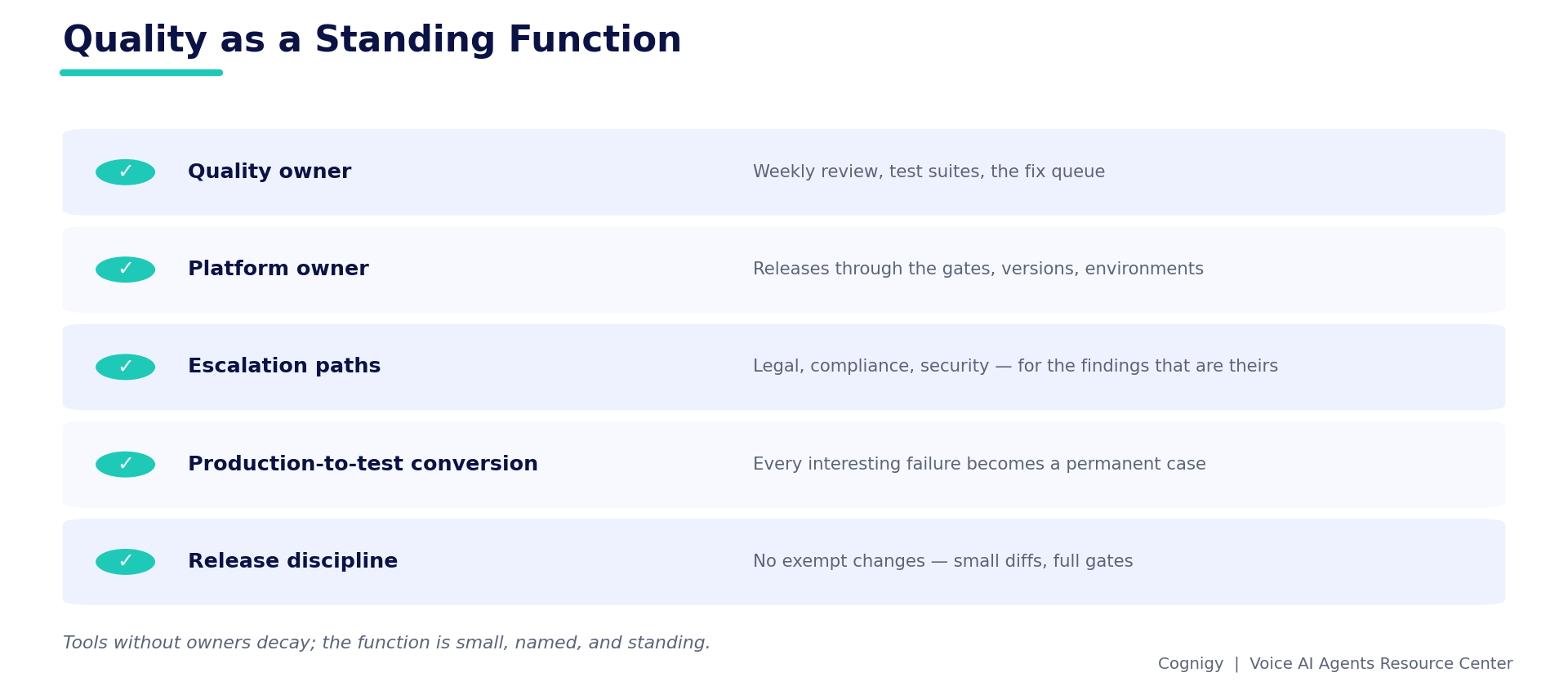
Checklist graphic of the quality operating model.
Quality as a standing function. A quality owner, a platform owner, escalation paths, and the two defining habits: production-to-test conversion and release discipline.

Tools without owners decay. The working pattern is small and standing: a quality owner (often from QA or CX operations) who runs the weekly review — sampled transcripts, guardrail triggers, metric movements — and maintains the test suites; a platform owner who manages releases through the gates; and escalation paths to legal, compliance, and security for the findings that belong to them. Two habits separate mature programs: production-to-test conversion (every interesting failure becomes a permanent regression case — the suite grows from reality, not imagination) and release discipline (no prompt, flow, policy, or model change ships without passing the gates — including the "small" changes, which cause most incidents precisely because they skipped review).

Where to start, honestly

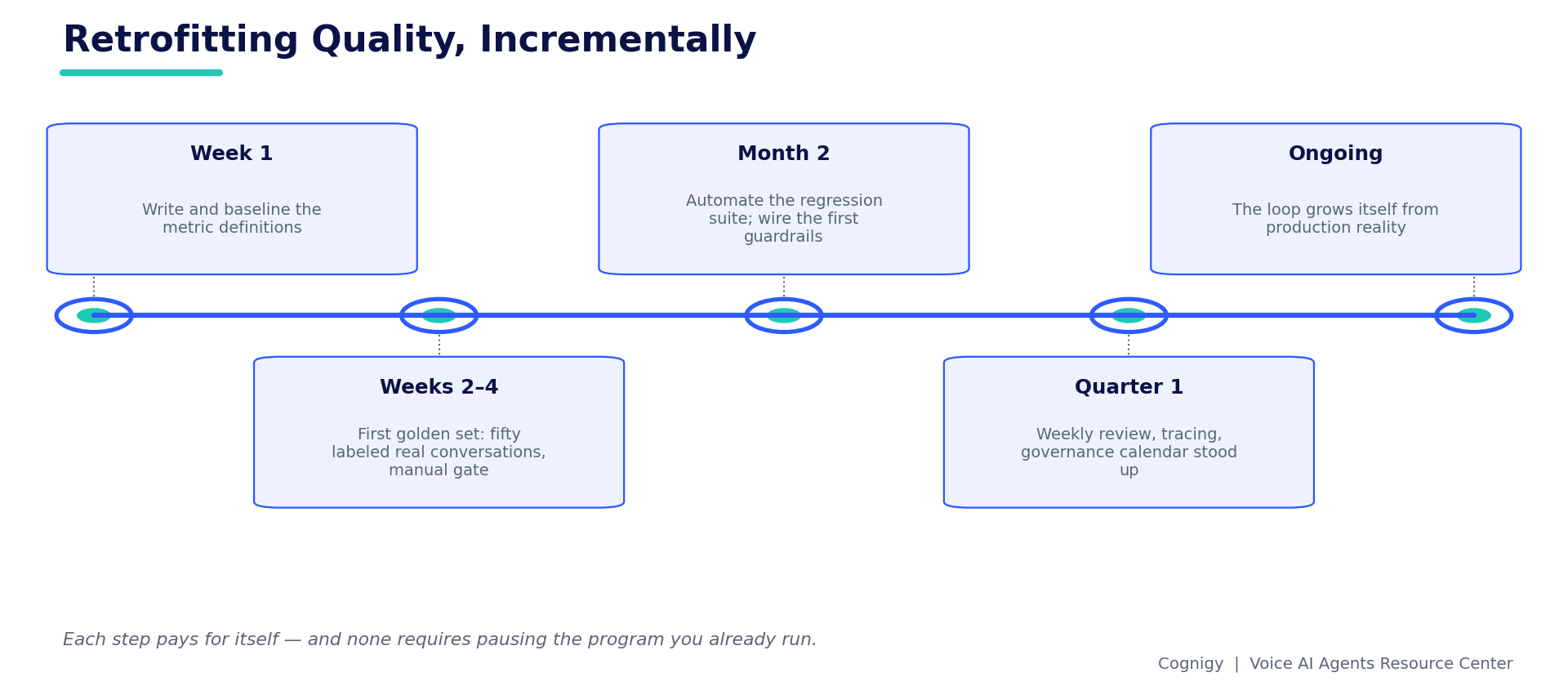
Horizontal timeline of the quality program entry sequence.
Retrofitting quality incrementally. Definitions and baselines first, a golden set next, then automated gates, then the full weekly rhythm — without pausing the program.

Most teams arrive here with agents already in production and no formal program — which is fine, because the entry sequence is incremental. Week one: write the metric definitions and baseline them (performance metrics has the discipline). Weeks two to four: build the first golden set from your own transcripts — fifty real conversations, labeled — and run it as a manual gate. Month two: automate the regression suite and wire the first guardrails where transcripts showed risk. Quarter one: stand up the weekly review, tracing, and the governance calendar. Each step pays for itself immediately, and none requires pausing the program you already run — quality is retrofitted the same way it is maintained: one loop at a time.

Frequently Asked Questions

What is AI agent evaluation?

The quality lifecycle around production AI agents: pre-release testing with golden sets and regression suites, runtime constraints through guardrails and grounding, post-release monitoring and per-turn observability, and standing governance with human oversight. Because AI agents are probabilistic systems, evaluation is continuous — an agent is never "done" the way deterministic software is.

How do AI agents fail in production?

In recurring families: understanding failures (misclassified intents, missed entities), knowledge failures (hallucinated or stale answers), behavioral failures (tone drift, policy violations), execution failures (wrong tools or parameters, unhandled API errors), conversational failures (loops, dead ends), and drift — quiet degradation as models update, knowledge ages, and customer language shifts.

What does a complete AI quality program include?

Four continuous phases: evaluate before release (golden sets, scenario suites, adversarial probes, regression gates), constrain during conversations (guardrails, grounding, policy-as-code), observe after (monitoring, tracing, metrics under written definitions), and govern always (ownership, review rhythm, human-in-the-loop design, and regulatory preparation).

Who should own AI agent quality in an organization?

A small standing function: a quality owner running the weekly review and maintaining test suites, a platform owner managing gated releases, and escalation paths to legal, compliance, and security. The two defining habits are converting every production failure into a permanent regression case and gating every change — including small ones, which cause most incidents.

How do you start an AI quality program for agents already in production?

Incrementally: write and baseline metric definitions first, build a golden set of fifty labeled real conversations and run it as a manual release gate, then automate the regression suite and add guardrails where transcripts showed risk, then stand up the weekly review, tracing, and governance calendar. Each step pays for itself without pausing the program.

Explore the AI Agent Quality Resource Center

All pages in this pillar — start at the hub for the lifecycle view, then go deeper by discipline.

Next step

→ See Cognigy in action

→ Explore Cognigy.AI