
The Best Conversational AI Platforms: An Evaluation Guide That Respects Your Estate

Alexander Teusz
Authors name: Alexander Teusz
Table of Content :
  • Intro

  • Key Takeaways

  • What "best" actually means

  • The categories in the market

  • The six criteria families that separate platforms

  • The process: longlist to decision

  • Using analyst research without outsourcing the decision

  • Where Cognigy sits in this, stated plainly

  • The pitfalls that produce mismatches

  • Frequently Asked Questions

  • Explore the Platform Evaluation Resource Center

Book a Demo
Get a demo of Cognigy.AI and discover the power of AI Agents for customer service

Intro

Every "best conversational AI platforms" listicle shares a secret: it was written without knowing your contact volumes, your CRM, your compliance regime, or your team. This hub takes the opposite approach. Instead of ranking vendors for a reader it has never met, it equips the buying committee to run an evaluation that produces the right answer for a specific estate — criteria, process, templates, and the honest economics. Twelve deeper guides hang off it, from the RFP template to build vs. buy and how to use analyst research without outsourcing the decision to it.
Key Takeaways

  • "Best conversational AI platform" is a property of fit, not a universal ranking: the right platform depends on your channels, integration estate, governance requirements, languages, and team.
  • This guide replaces the listicle with an evaluation method — the six criteria families that genuinely separate platforms, a staged process from longlist to proof of concept, and the pitfalls that produce expensive mismatches.

What "best" actually means

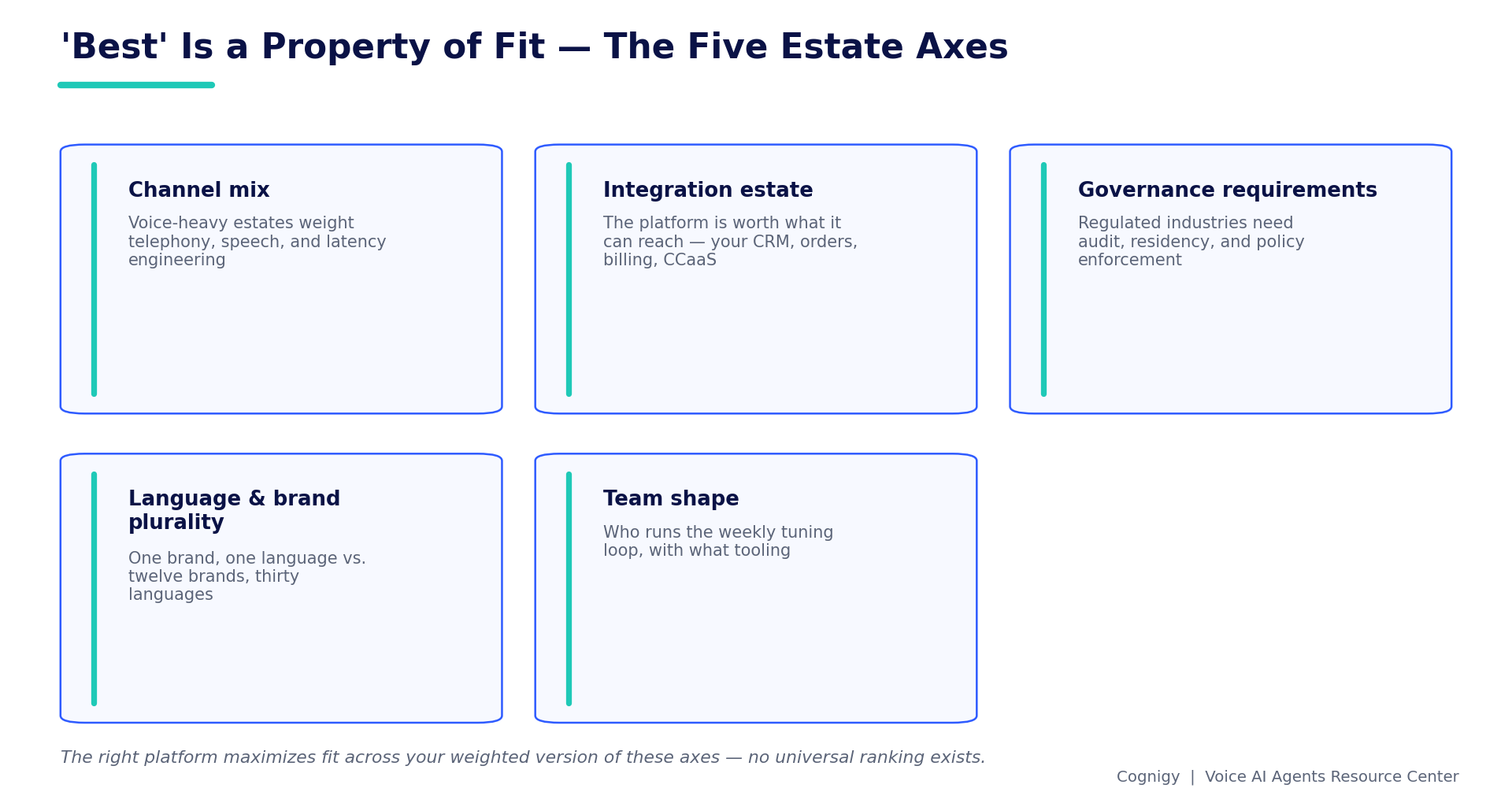
Five cards naming the estate axes that determine which platform is best for a given organization.
'Best' is a property of fit. The five estate axes that determine platform fit: channel mix, integration estate, governance requirements, plurality, and team shape.

Platforms don't rank on one axis; estates differ on at least five. Channel mix: a voice-heavy contact center weighs telephony, speech, and latency engineering that a chat-only estate never touches (the voice stack is Pillar 1's AI voice agents territory). Integration estate: the platform is worth what it can reach — your CRM, order management, billing, and contact center infrastructure. Governance requirements: regulated industries need audit, residency, and policy enforcement that others can defer. Language and brand plurality: one brand in one language and twelve brands in thirty languages are different problems. Team shape: who will run the weekly tuning loop, and what tooling do they need? "Best" is the platform that maximizes fit across your weighted version of these axes — which is why this pillar's core artifact is a scored evaluation method, not a league table.

The categories in the market

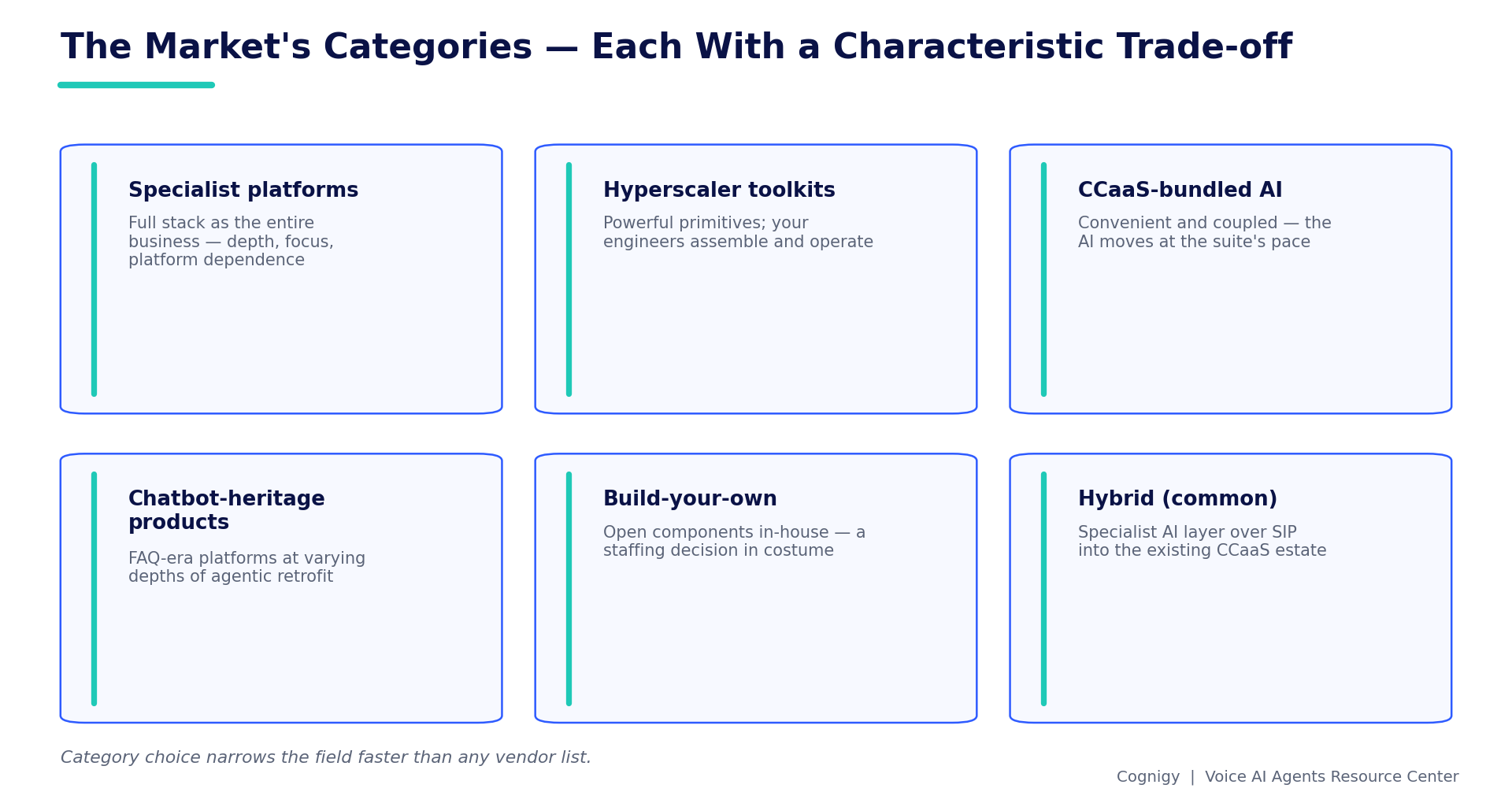
Six cards describing the conversational AI market categories and their trade-offs.
The market's categories. Specialist platforms, hyperscaler toolkits, CCaaS-bundled AI, chatbot-heritage products, build-your-own, and the common hybrid — each with a characteristic trade-off.

The landscape sorts into recognizable categories, each with a characteristic trade-off. Specialist conversational/agentic AI platforms build the full stack — understanding, orchestration, tools, governance — as their entire business. Hyperscaler AI toolkits offer powerful primitives that your engineers assemble and maintain. CCaaS-bundled AI ships inside contact center suites, convenient and coupled. Chatbot-heritage platforms grew up from FAQ automation and vary widely in execution depth — the category history in enterprise chatbot platforms. And build-your-own assembles open components in-house — a real option with real costs, weighed in build vs. buy. Category choice narrows the field faster than any vendor list; the landscape tour is conversational AI vendors and the platform anatomy underneath it is AI agent platforms.

The six criteria families that separate platforms

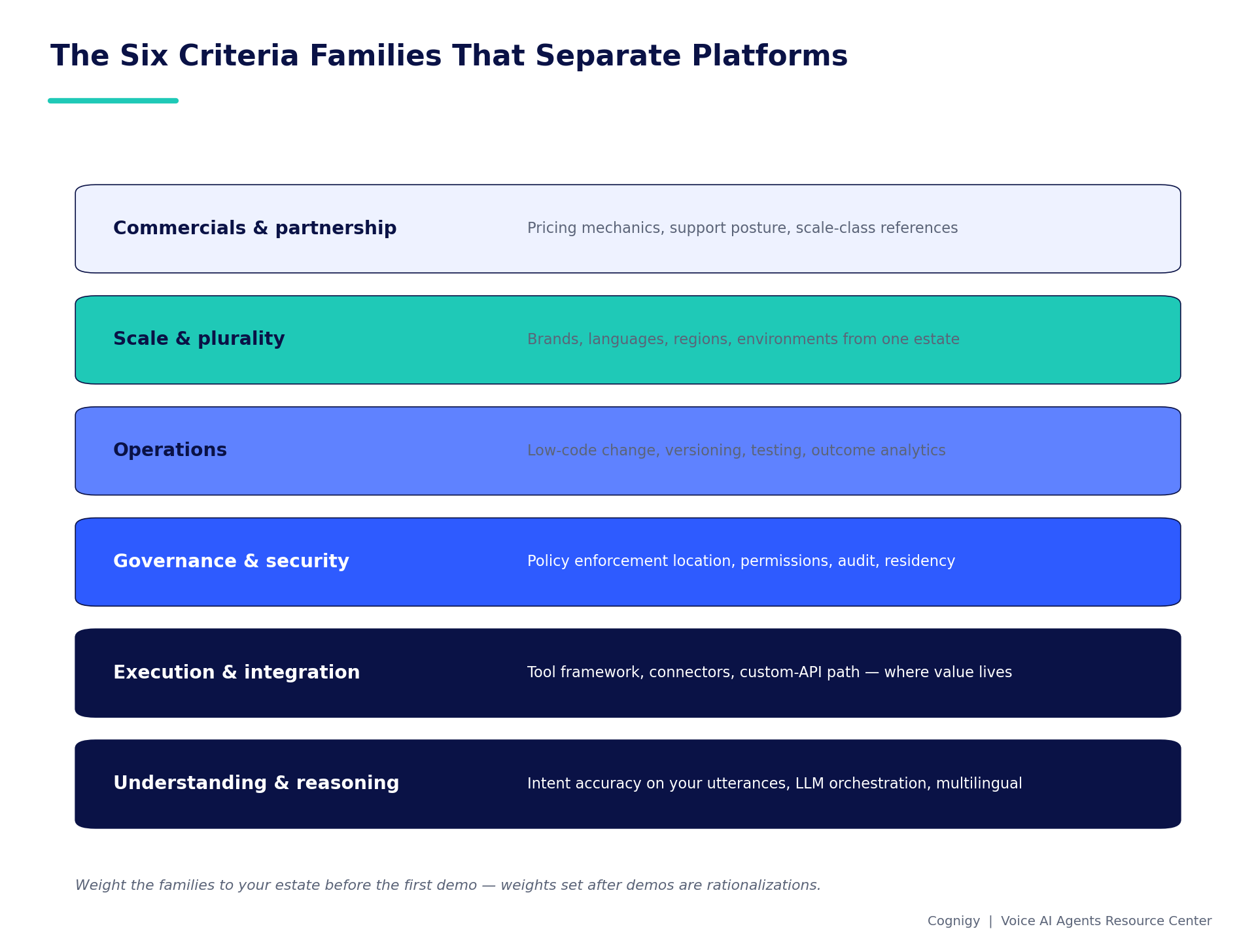
Stacked layer diagram of the six criteria families that separate conversational AI platforms.
The six criteria families. Understanding, execution and integration, governance, operations, scale, and commercials — weighted to your estate before the first demo.

Across hundreds of enterprise evaluations, six families do the separating. Understanding & reasoning: intent accuracy on your utterances, LLM orchestration, multilingual depth. Execution & integration: the tool framework, connector breadth, custom API paths — where agentic value lives, per this program's requirements framework in enterprise AI agents. Governance & security: policy enforcement location, permissions, audit, residency. Operations: low-code change, versioning, testing, analytics — the tuning loop's tooling. Scale & plurality: brands, languages, regions, environments from one estate. Commercials & partnership: pricing mechanics you can model (conversational AI pricing), support posture, references in your scale class. The comparison guide turns these families into a scorable matrix.

The process: longlist to decision

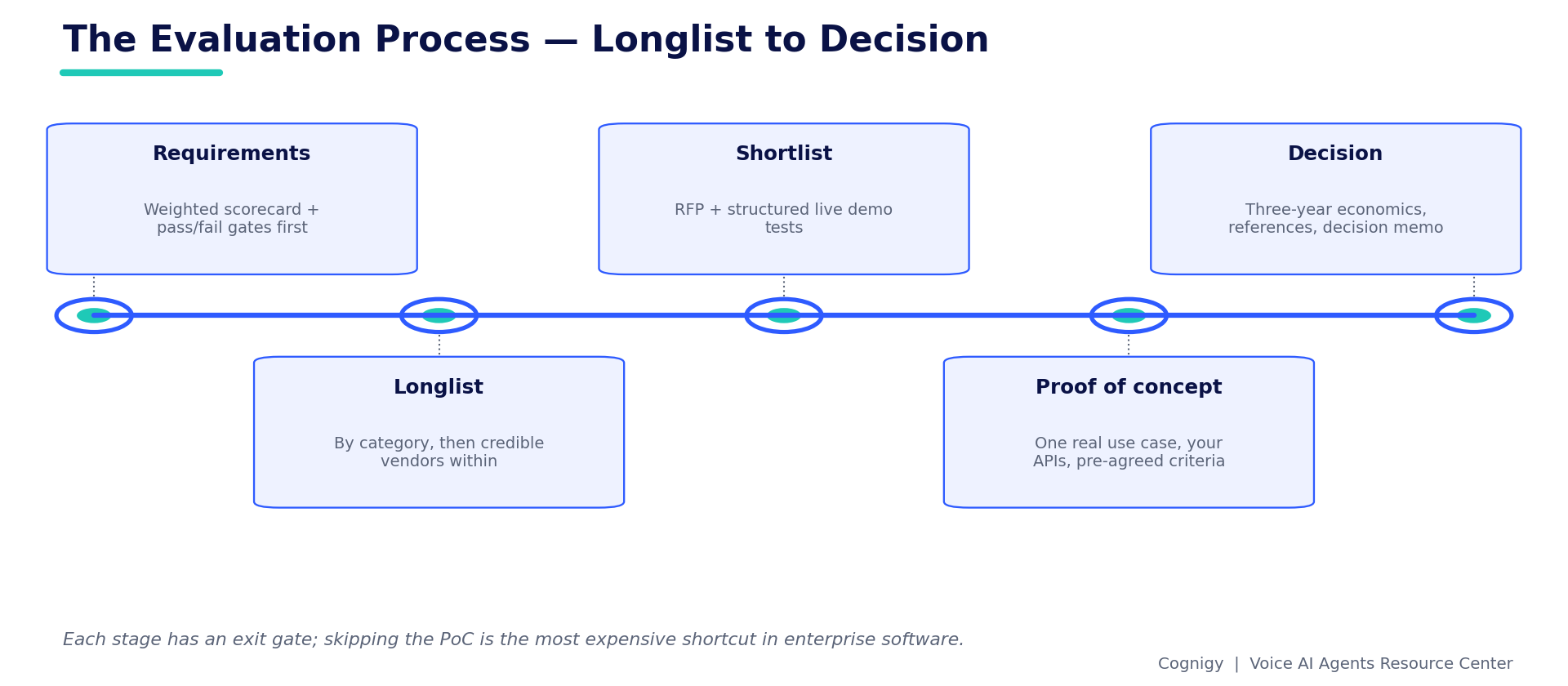
Horizontal timeline with five evaluation milestones from requirements to decision.
The evaluation process. Requirements, longlist, shortlist, proof of concept, decision — each stage with an exit gate.

Good evaluations run in stages with exit criteria. Requirements first: write the weighted scorecard before any demo shapes it. Longlist by category: pick the categories that fit, then the credible vendors within them. Structured shortlist: RFP against the scorecard (template here), live demo tests instead of slideware. Proof of concept: one real use case, your APIs, your data, measured against pre-agreed criteria. Decision & negotiation: scored results, references checked, pricing modeled over three years. The staged method — including how long each stage should take and what kills evaluations — is how to evaluate conversational AI platforms.

Using analyst research without outsourcing the decision

Analyst evaluations — Gartner's Magic Quadrant and Forrester's Wave among them — are genuinely useful inputs: market education, vendor discovery, diligence signals. They are not substitutes for your scorecard, because they weight criteria for a generalized enterprise, not your estate. The reading and usage guides — what the methodologies measure, what they cannot see, and how to fold them into your process — are Gartner Magic Quadrant and Forrester Wave. (This guide reproduces no licensed analyst content and claims no placements; obtain current reports from the firms or licensed reprints.)

Where Cognigy sits in this, stated plainly

This guide is published by Cognigy, and the honest way to handle that is disclosure plus method: everything above is written to be run against any vendor, including us. For readers evaluating Cognigy specifically, Cognigy alternatives maps the categories a shortlist should include, and the Cognigy vs. series explains the fair-comparison method behind head-to-head pages (named-competitor editions pending internal sign-off). Judge us with the same scorecard — the demo tests in this pillar were designed to be passable only by platforms we'd want to compete against.

The pitfalls that produce mismatches

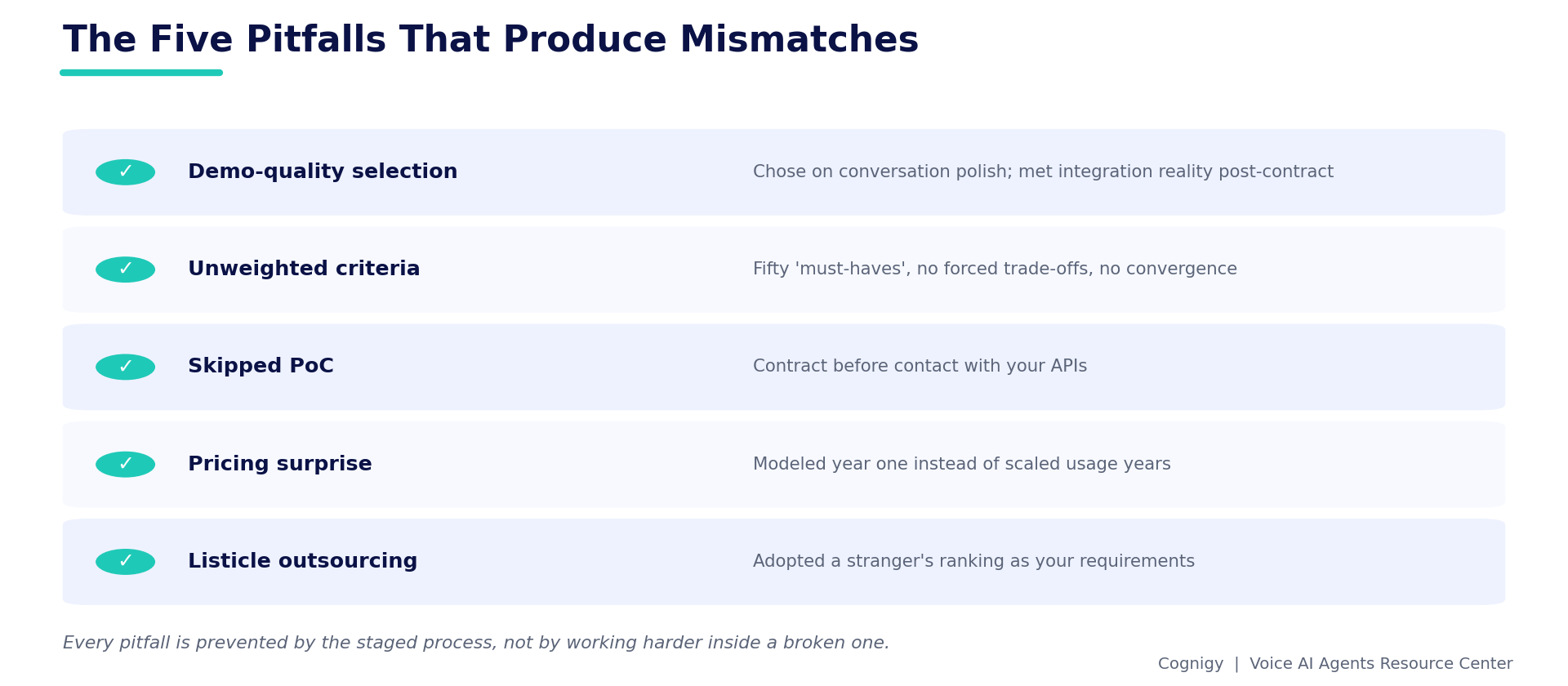
Checklist graphic of the five evaluation pitfalls that produce platform mismatches.
The five pitfalls. Demo-quality selection, unweighted criteria, skipped PoC, pricing surprise, and listicle outsourcing — all prevented by the staged process.

Five recur. Demo-quality selection: choosing on conversation polish, discovering integration reality later. Unweighted criteria: fifty requirements, all "must-have," no forced trade-offs. Skipped PoC: contract before contact with your APIs. Pricing surprise: modeling year one instead of scaled usage years. And listicle outsourcing: adopting someone else's ranking as your requirements. Every one is prevented by the process above — which is the entire argument of this pillar: the best conversational AI platform is the one your evaluation earns, not the one a stranger's list promised.

Frequently Asked Questions

What is the best conversational AI platform?

The one that fits your estate — there is no universal ranking. Fit is determined by your channel mix (voice changes everything), integration estate, governance and compliance requirements, language and brand plurality, and the team that will operate it. A weighted scorecard across those axes, tested through demos and a proof of concept on your own use case, produces the answer a listicle cannot.

Which criteria separate conversational AI platforms in practice?

Across six criteria families: understanding and reasoning (tested on your utterances), execution and integration (the tool framework and connector reach), governance and security (where policy enforcement lives, audit depth), operations (low-code change, testing, analytics), scale and plurality (brands, languages, regions), and commercials (pricing mechanics, support, references). Score them weighted by your priorities, live rather than from datasheets.

Are 'best platform' rankings and listicles reliable?

Treat them as discovery tools, not decisions. Rankings are written without knowledge of your volumes, systems, compliance regime, or team — the factors that actually determine fit. Analyst evaluations are more rigorous but still weight criteria for a generalized enterprise. Use both to build a longlist, then let your own weighted evaluation and proof of concept decide.

What categories of conversational AI platforms exist?

Five recur: specialist conversational/agentic AI platforms building the full stack; hyperscaler toolkits offering primitives your engineers assemble; CCaaS-bundled AI shipping inside contact center suites; chatbot-heritage platforms of varying execution depth; and build-your-own from open components. Choosing categories that fit your estate narrows the field faster than comparing individual vendors.

How long should a conversational AI platform evaluation take?

Weeks to a small number of months, run in stages: requirements and weighted scorecard first, category-based longlist, structured shortlist with live demo tests, then a proof of concept on one real use case with your APIs against pre-agreed criteria. Evaluations that skip the PoC trade weeks now for quarters of rework later; evaluations without weighted criteria never converge at all.

Explore the Platform Evaluation Resource Center

All pages in this pillar — start at the hub for the method, then go deeper by stage.

Next step

→ See Cognigy in action

→ Explore Cognigy.AI