

AI in Banking Customer Service: Building the Program Compliance-First

Alexander Christodoulou
Authors name: Alexander Christodoulou
Table of Content :
  • Intro

  • Key Takeaways

  • Why financial services traffic suits AI — and why it's demanding

  • The capability map, financial services edition

  • The banking side

  • The insurance side

  • The sensitive surfaces, handled like adults

  • The rollout order that survives review

  • Frequently Asked Questions

  • Explore the Financial Services AI Resource Center

Book a Demo
Get a demo of Cognigy.AI and discover the power of AI Agents for customer service

Intro

Banks and insurers run some of the world's largest contact operations, under some of its heaviest regulatory obligations — which makes financial services simultaneously the best and the most demanding home for customer service AI. The best, because the traffic is high-volume, bounded, and API-reachable; the most demanding, because every automated action touches money, identity, and regulated communication. This hub is the program guide for that combination: the capability map, the compliance-first architecture, the use-case economics, and the rollout order — with twelve deeper guides, banking and insurance both. (A standing note for this entire pillar: it describes technology and operating patterns, not legal requirements — regulatory obligations vary by jurisdiction and product, and your compliance and legal teams own the rules.)
Key Takeaways

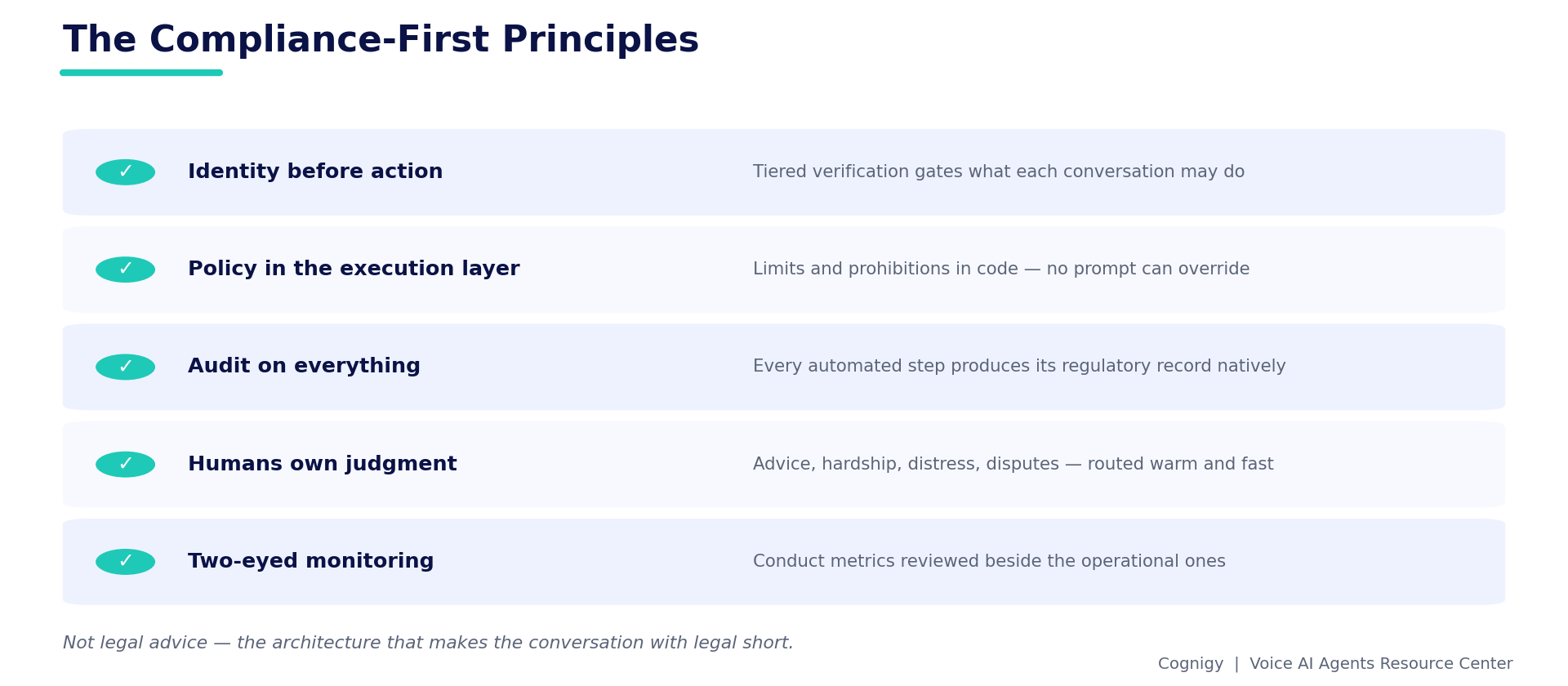
  • AI in banking and insurance customer service succeeds when it is built compliance-first: verified identity before any account action, policy enforced in the execution layer rather than the prompt, complete audit on every automated step, and humans owning judgment calls.
  • Within those guardrails, the use cases are unusually strong — balances and cards, payments and arrangements, claims intake, policy servicing — because financial service traffic is high-volume, bounded, and API-reachable.

Why financial services traffic suits AI — and why it's demanding

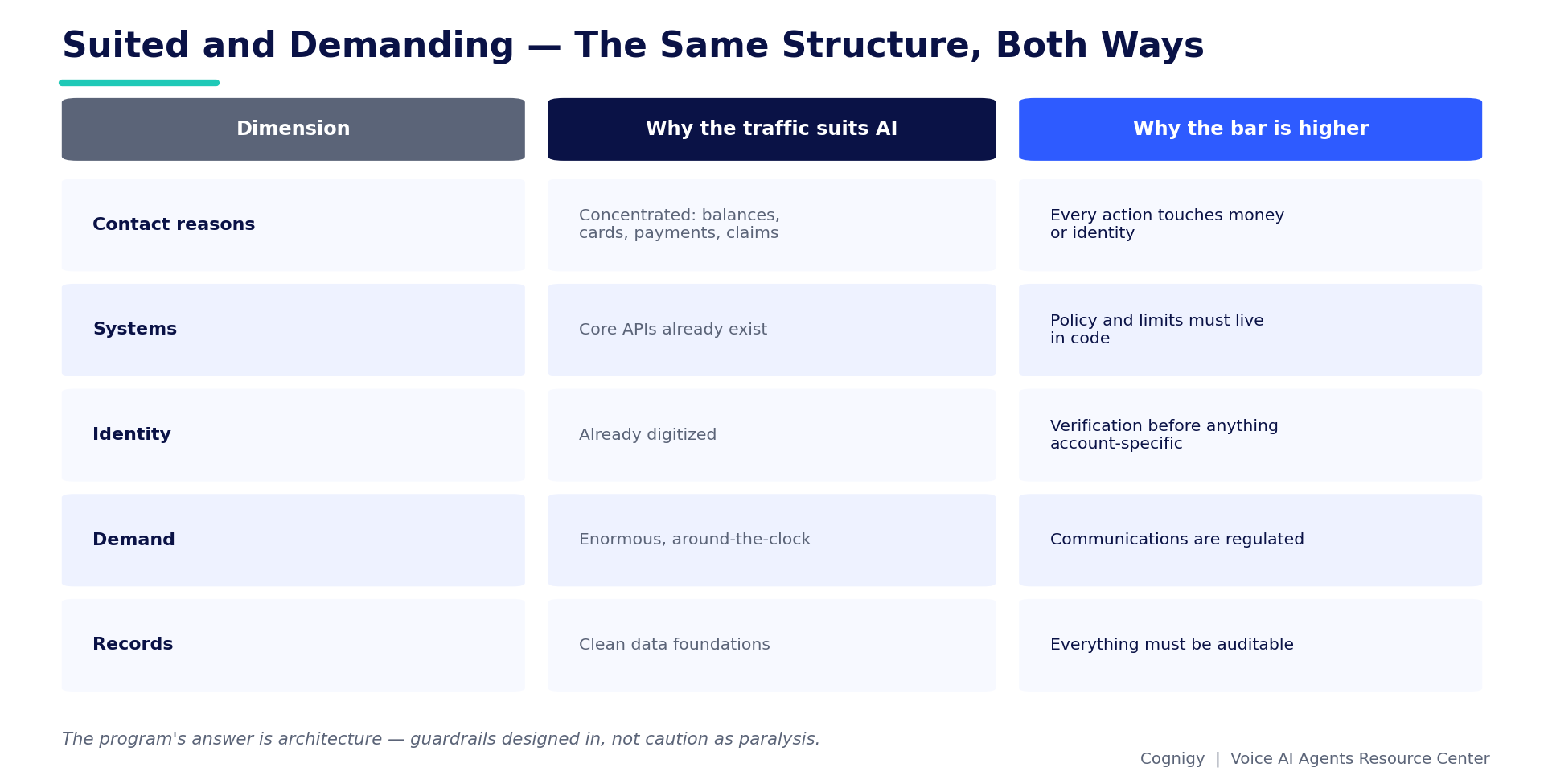
Comparison table showing why banking traffic suits AI and why the requirements are higher.
Suited and demanding. The same structural facts that make financial services traffic automatable — concentration, APIs, digitized identity — also raise the compliance bar.

The suitability is structural. Contact reasons concentrate heavily: balances and transactions, card controls, payments and transfers, disputes, claims status, policy changes — recurring, well-defined, and executable against core systems that already expose APIs. Volumes are enormous and around-the-clock; identity is already digitized; and the cost of queues lands on customers in moments that matter (a frozen card abroad, a claim after a crash). The demands are equally structural: identity must be verified before anything account-specific; communications are regulated (disclosures, consent, fair treatment); records must be auditable; and errors touch money. The program's answer is not caution-as-paralysis — it is architecture: guardrails designed in, per compliance in financial services AI.

The capability map, financial services edition

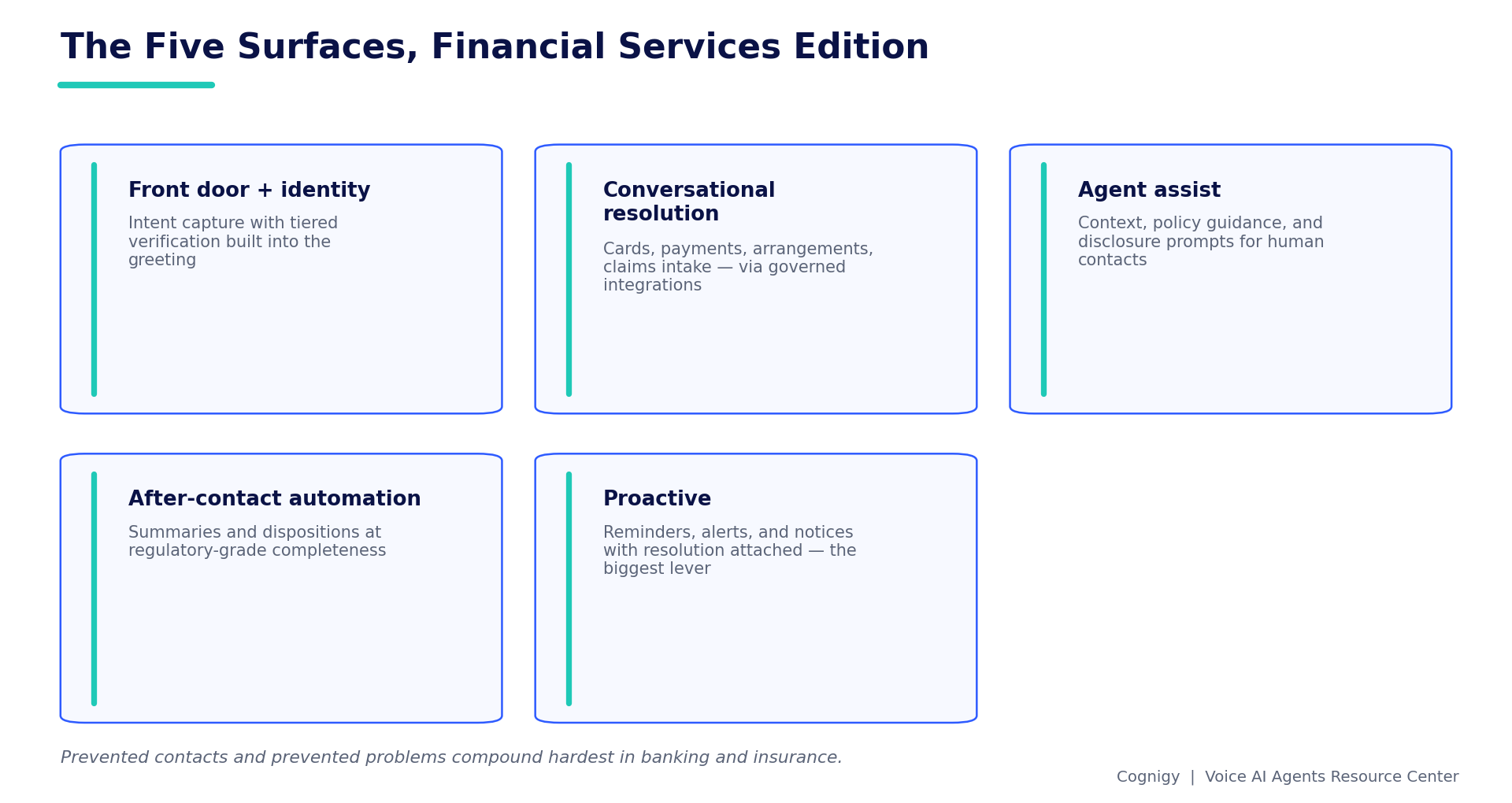
Five cards naming the automation surfaces with banking accents.
The five surfaces, financial services edition. Front door with identity, conversational resolution, agent assist, after-contact automation, and proactive outreach.

The five automation surfaces from this content program's contact center automation guide translate directly, with industry accents. Front door: intent captured in natural language plus conversational identity verification — the banking version carries step-up authentication tiers. Conversational resolution: AI agents completing tasks — card freezes, payment arrangements, address changes, claims intake — through core-banking and policy-admin integrations, the agentic architecture from Pillar 3's AI agents for customer service. Agent assist: context, policy guidance, and disclosure prompts for the contacts that stay human. After-contact automation: summaries and dispositions with the audit depth regulators expect. Proactive: payment reminders, renewal notices, fraud alerts with resolution attached — the highest-leverage surface in banking, because prevented contacts and prevented delinquency compound.

The banking side

Three guides cover the banking core. Conversational AI in banking is the foundation piece — channels, integration estate, and trust design. AI chatbot for banking takes the term most searchers use and upgrades it honestly: what a banking chatbot can complete now versus answer about. Voice AI in banking covers the channel where banking's stakes are highest — phone-first customers, voice identity, and the engineering that real-time speech demands. The generative layer — where LLMs genuinely help in a regulated estate, and the grounding and controls that make them deployable — is generative AI in banking customer service, and the full automation program view is banking customer service automation with the concrete catalog in banking use cases.

The insurance side

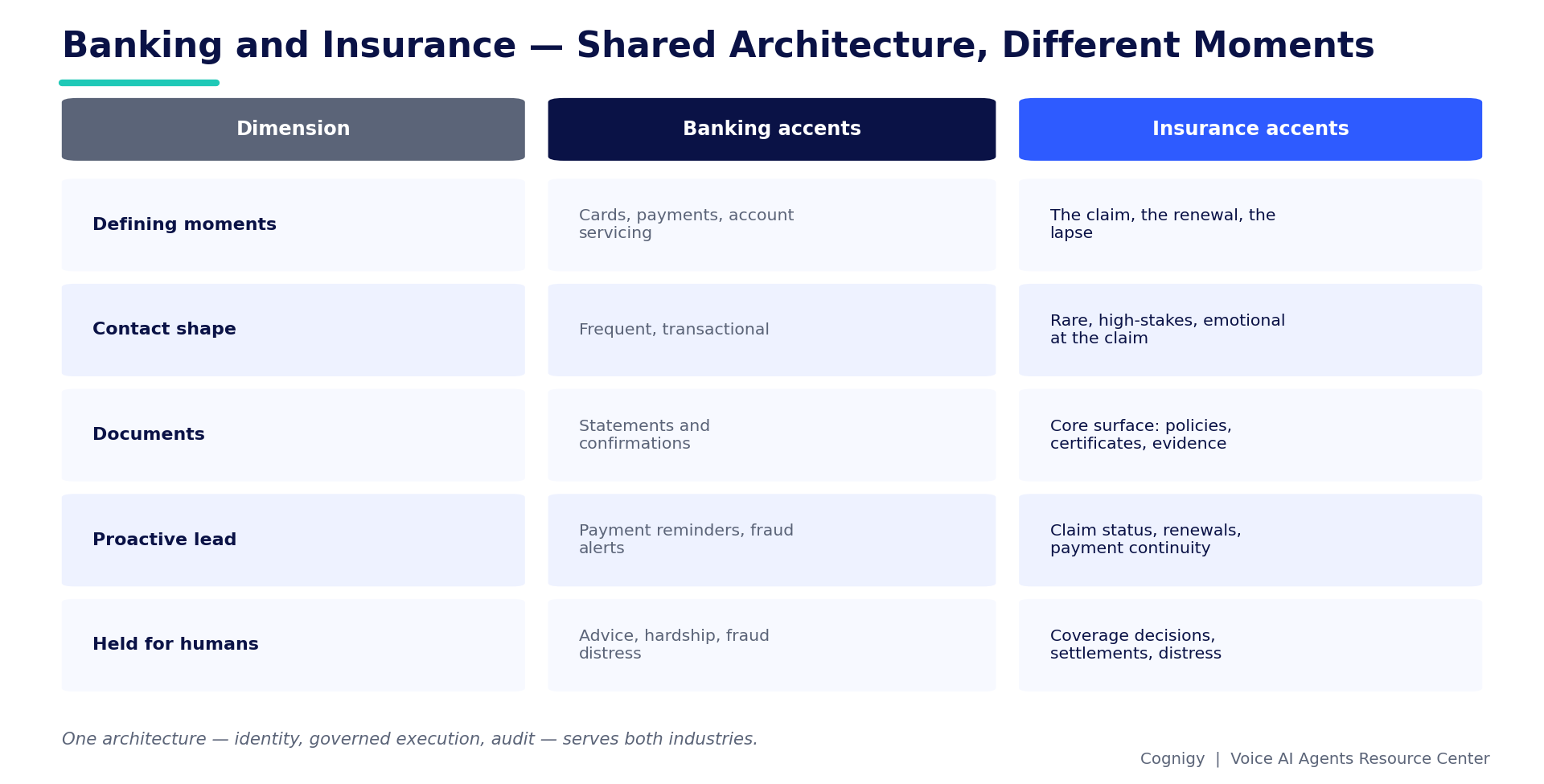
Comparison table of banking versus insurance service accents.
Banking and insurance accents. One architecture — identity, governed execution, audit — with different defining moments per industry.

Insurance shares the architecture and changes the moments. AI in insurance customer service maps the service lines — claims, policy servicing, distribution support. Insurance chatbot does for insurers what the banking-chatbot page does for banks. Two moments get dedicated guides because they carry the economics: FNOL and claims automation — first notice of loss is insurance's most emotionally loaded, most automatable intake — and policy servicing and renewals, the retention surface where proactive automation quietly earns its keep.

The sensitive surfaces, handled like adults

Checklist graphic of five compliance-first principles.
The compliance-first principles. Identity before action, policy in the execution layer, audit on everything, humans owning judgment, and two-eyed monitoring.

Two topics in this pillar demand extra care and get it. Collections and payment reminders is written dignity-first: automation as the channel that lets customers resolve arrears privately and early, under consent, frequency, and conduct rules your compliance team owns. And compliance is the architecture page: identity tiers, policy-as-code in the execution layer, audit completeness, data handling, and the human-oversight model — the controls that make everything else in this pillar deployable. Neither page dispenses legal advice; both are designed to make the conversation with your legal team shorter and better.

The rollout order that survives review

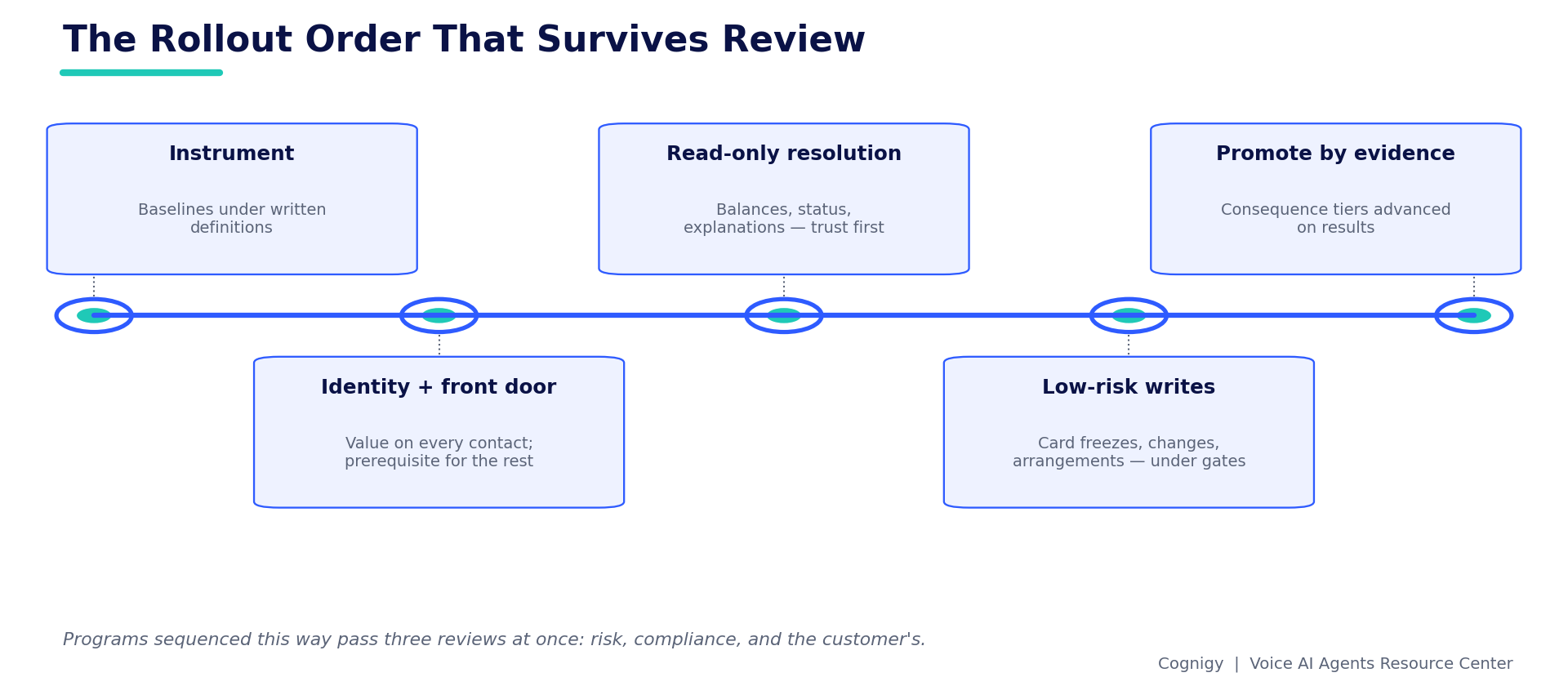
Horizontal timeline of the five-stage financial services rollout.
The rollout order that survives review. Instrument, identity plus front door, read-only resolution, gated writes, and evidence-based tier promotion.

Financial services programs succeed in a characteristic order. Instrument and baseline under written definitions (the measurement discipline). Front door plus identity: intent capture with tiered verification — value on every contact, and the prerequisite for everything transactional. Read-only resolution first: balances, status, explanations — automation earns trust before it touches money. Low-risk writes under confirmation gates: card controls, address changes, payment arrangements within policy. Then expansion by consequence tier, each promotion earned with evidence, per the autonomy model in Pillar 3's autonomous AI agents. Programs sequenced this way pass three reviews at once — risk, compliance, and the customer's.

Frequently Asked Questions

How is AI used in banking customer service?

Across five surfaces: intent capture with conversational identity verification at the front door, AI agents completing tasks through core-banking integrations (card controls, payments, arrangements, account changes), agent assist with policy and disclosure guidance, after-contact documentation with audit depth, and proactive outreach — payment reminders, renewal notices, fraud alerts with resolution attached.

Is AI safe to use in a regulated bank or insurer?

With the right architecture, yes: identity verified before any account action, policy enforced in the execution layer rather than the prompt, per-task autonomy levels with confirmation gates on consequential actions, complete audit trails, and humans owning judgment calls. The controls are designed in, then reviewed by your risk, compliance, and legal functions — who own the rules.

What should banks automate first in customer service?

The trust-building order: front door plus tiered identity verification (value on every contact), read-only resolution (balances, status, explanations), then low-risk writes under confirmation gates (card freezes, address changes, arrangements within policy), expanding by consequence tier as evidence accumulates. Money-moving and judgment-heavy contacts stay gated longest.

Do the same AI approaches work for banking and insurance?

The architecture is shared — identity, governed execution, audit, human oversight — while the moments differ: banking leads with cards, payments, and account servicing; insurance leads with claims intake (FNOL), policy servicing, and renewals. Both benefit most from proactive patterns, because prevented contacts and prevented delinquency or lapse compound.

Why is financial services customer service well suited to AI?

Traffic concentrates in high-volume, well-defined, API-reachable intents — balances, cards, payments, claims status, policy changes — with digitized identity and around-the-clock demand. The same structure that makes the traffic automatable makes the obligations heavy, which is why successful programs are built compliance-first rather than retrofitted.

Explore the Financial Services AI Resource Center

All pages in this pillar — start at the hub for the program view, then go deeper by line.

Next step

→ See Cognigy in action

→ Explore Cognigy.AI