"AI IVR" is what most buyers type when the real question is: can our phone system stop making callers navigate menus? The answer is yes, and this page explains exactly what the AI version of an IVR is, which components make it work, what it can and cannot do, and how it typically lands inside an existing contact center rather than replacing it. It is the definitional core of this pillar's broader guide to conversational IVR.
Key Takeaways
An AI IVR is an interactive voice response system powered by speech recognition, natural language understanding, and increasingly LLM reasoning, so callers speak naturally instead of pressing keys.
Unlike legacy IVR, it can identify callers conversationally, complete transactions through backend APIs, and escalate with context.
Most enterprises deploy it as an AI layer connected to their existing telephony estate rather than as a platform replacement.
Definition
An AI IVR is an interactive voice response system whose front end is artificial intelligence rather than a menu tree: automatic speech recognition (ASR) transcribes the caller, natural language understanding — increasingly combined with large language model reasoning — determines intent and extracts details, and the system responds in synthesized speech. Where a legacy IVR asks callers to translate their problem into its menu, an AI IVR does the translating itself.
The scope of the term has widened as the technology has. Early "AI IVR" meant intent classification bolted onto a menu — understand the request, then route it. Current systems are closer to AI voice agents: they hold multi-turn conversations, call APIs to complete tasks end to end, and hand off to humans with transcript and context attached. Where a given product sits between those two points is the single most useful question to ask in any evaluation.
Architecture: what's inside
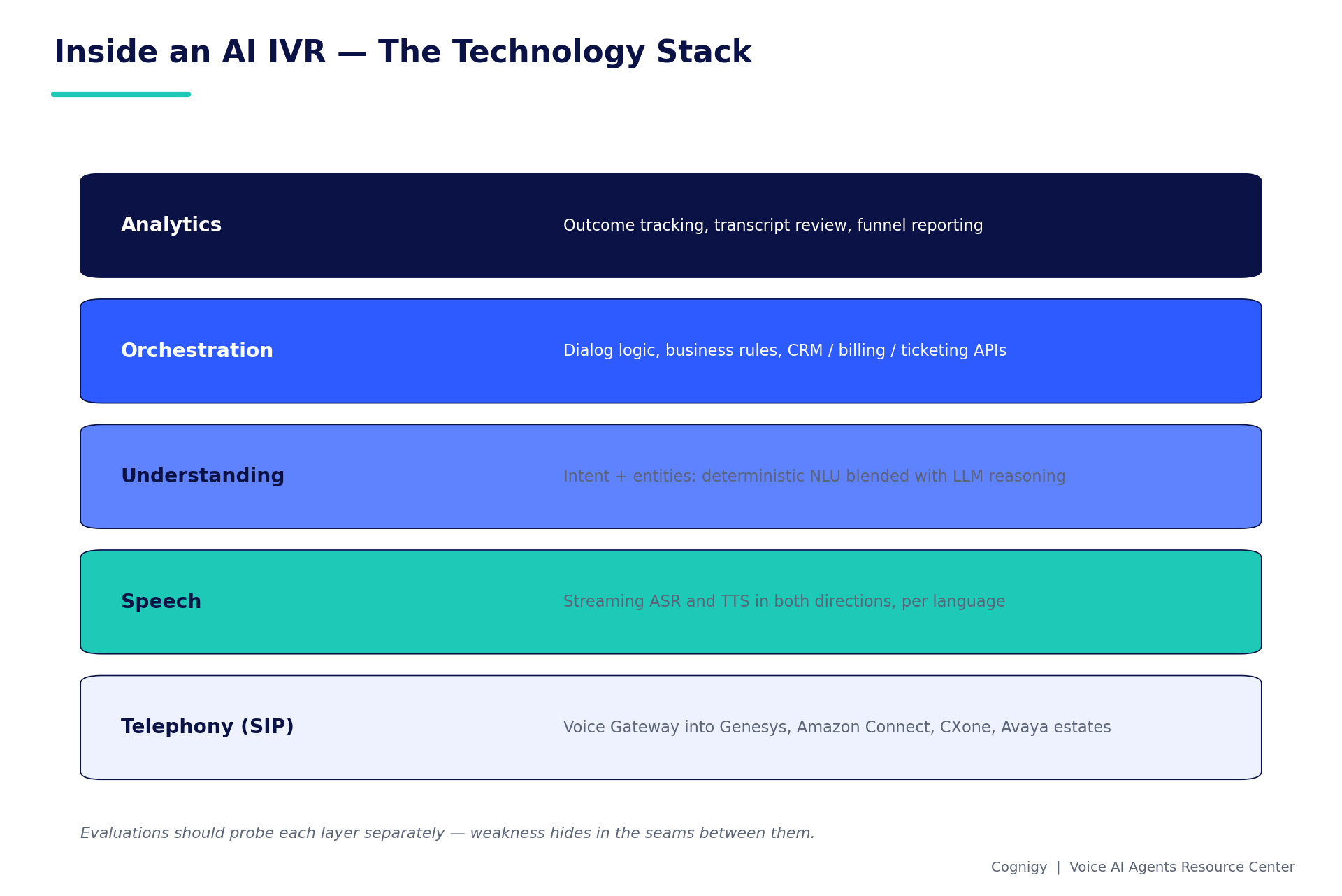
Inside an AI IVR. The AI IVR technology stack: SIP telephony, streaming speech, blended understanding, API orchestration, and analytics.
Five layers turn a phone call into a resolved request. At the bottom, telephony: the call arrives over SIP from carriers or the CCaaS platform — in Cognigy's architecture this is Voice Gateway, which connects to estates like Genesys, Amazon Connect, NICE CXone, and Avaya. Above it, the speech layer streams ASR and text-to-speech per language. The understanding layer classifies intent and extracts entities such as order numbers and dates. The orchestration layer runs dialog logic, business rules, and API calls into CRM, billing, and ticketing systems under guardrails. The analytics layer records transcripts, outcomes, and the funnel data that drives weekly tuning. A deeper engineering treatment of the same pipeline — latency budgets, barge-in, streaming — lives in how voice AI agents work.
A call, end to end
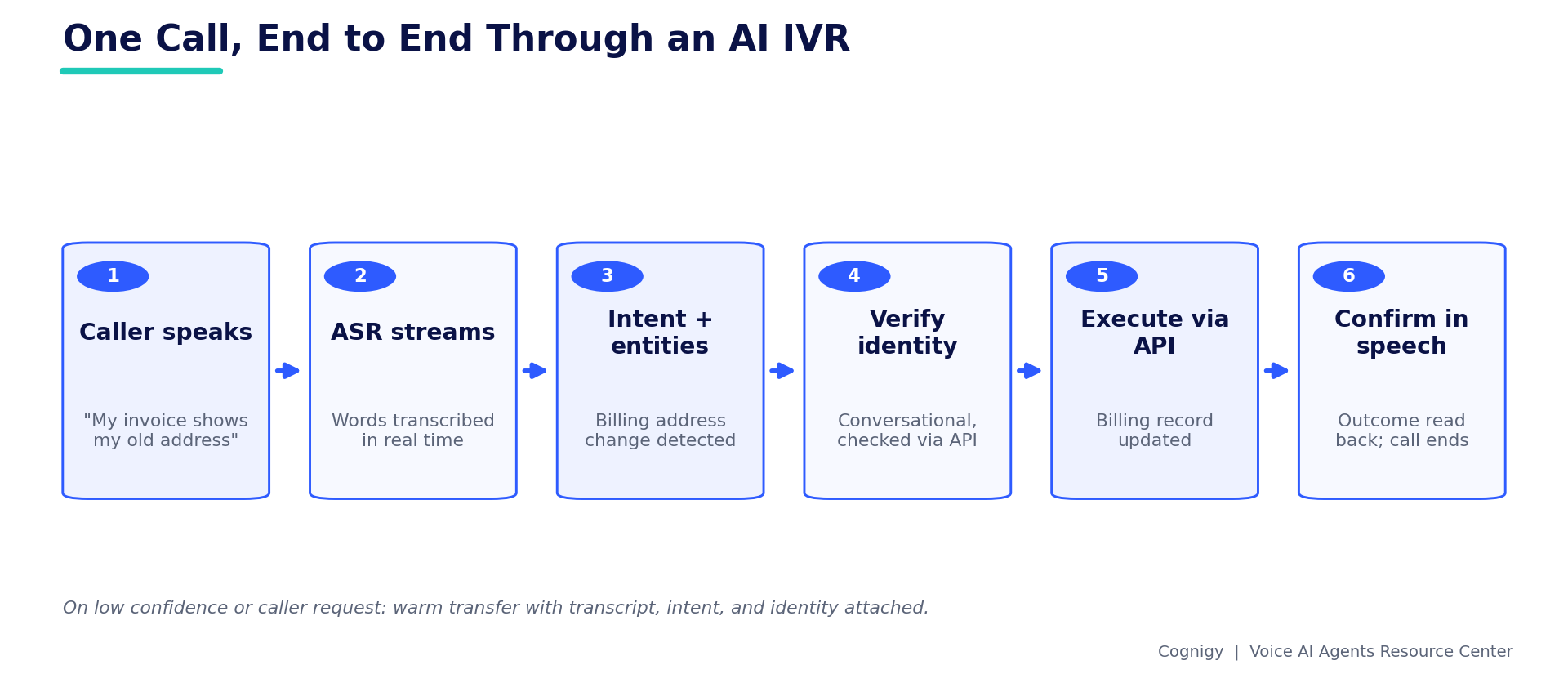
One call through an AI IVR. An address-change call end to end: spoken request, streaming recognition, intent and entity extraction, conversational verification, API execution, spoken confirmation.
A concrete flow makes the difference tangible. The caller dials; the AI IVR answers immediately: "Thanks for calling — how can I help?" The caller says, "I moved last month and my invoice still shows the old address." ASR streams the words; understanding resolves the intent (billing address change) and the entity (address); orchestration verifies the caller conversationally against account data, then updates the record through the billing API and confirms it back in natural speech. Total time: under two minutes, no menu, no queue. If at any point confidence drops or the caller asks for a person, the system transfers warm — the human agent receives the transcript, the verified identity, and the point of failure, so the caller never starts over.
AI IVR vs. legacy IVR
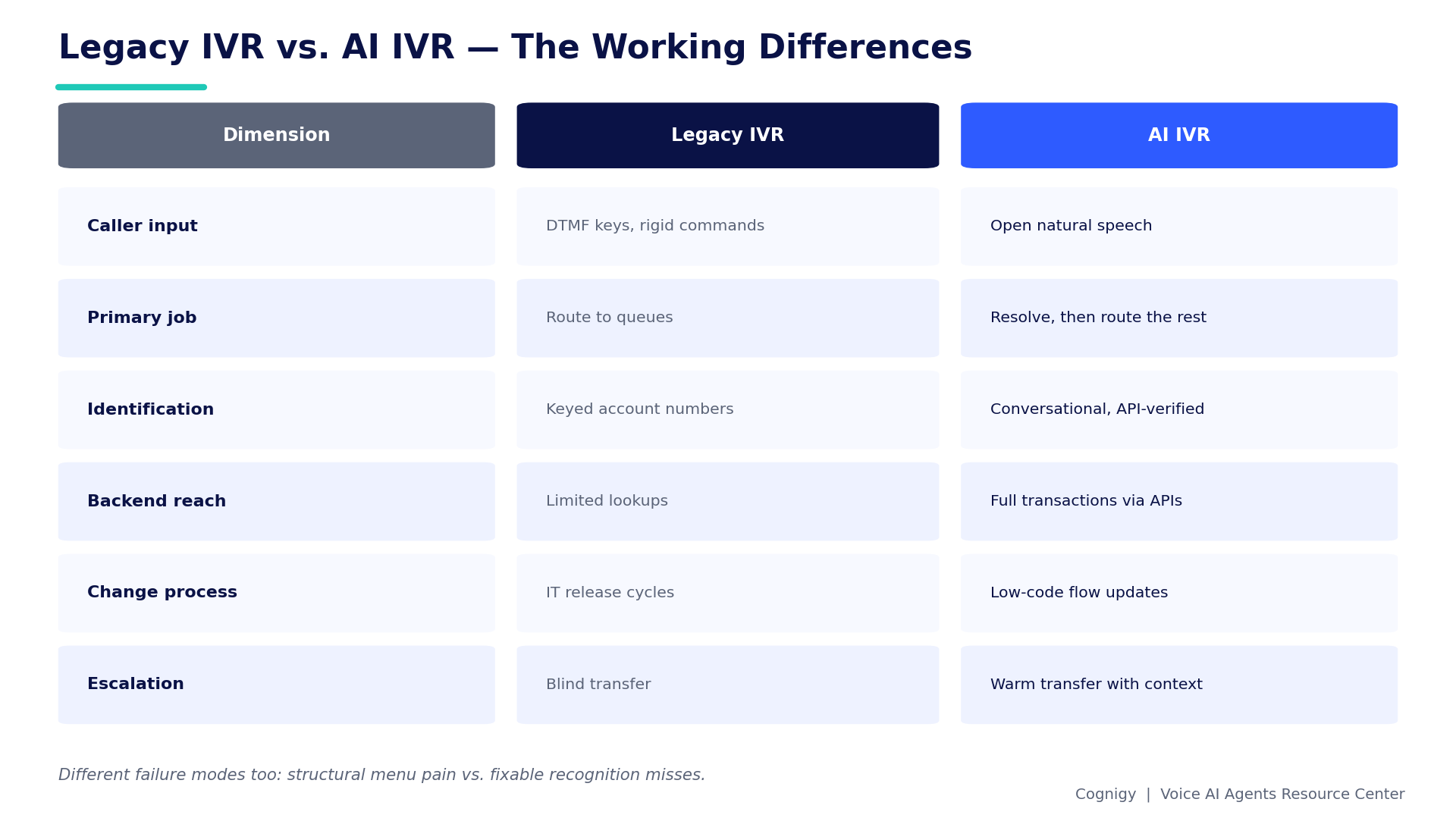
Legacy IVR vs. AI IVR. Six working differences between legacy and AI IVR, from caller input and identification to change process and escalation quality.
Dimension
Legacy IVR
AI IVR
Caller input
DTMF keys, rigid commands
Open natural speech
Primary job
Route to queues
Resolve, then route what remains
Identification
Keyed account numbers
Conversational, API-verified
Backend reach
Limited lookups
Full transactions via APIs
Change process
IT release cycles
Low-code flow updates
Escalation
Blind transfer
Warm transfer with context
Failure mode
Menu maze, zero-out storms
Misrecognition, over-scoped automation
The last row is deliberate. AI IVRs are not failure-free; they fail differently — a misheard alphanumeric, an over-ambitious use case. The difference is that their failures are measurable in transcripts and fixable in configuration, while a menu's failures are structural. The full paradigm comparison, including economics, is in IVR vs. conversational AI.
What an AI IVR can complete, not just classify
Classification was the previous generation's ceiling; completion is the current one's job. Production AI IVRs routinely handle identification and authentication, order and claim status, appointment booking and changes, address and plan updates, payment arrangements, password resets, and proactive disruption response. The boundary is API reachability and risk: a task the backend exposes and policy allows is automatable; judgment-heavy, emotionally loaded, or legally sensitive calls should route to humans by design. Which of your call drivers fall on each side of that line is exactly the assessment described in IVR modernization strategy.
Deployment: layer, not rip-and-replace
The most common enterprise pattern deploys the AI IVR as a layer in front of the existing estate. The carrier or CCaaS platform forwards calls over SIP to the AI layer; the AI resolves what it can; escalations flow back into the existing routing and queueing fabric, which continues to deliver calls to agents exactly as before. This is why AI IVR projects can start in weeks: nothing about agent desktops, workforce management, or carrier contracts changes on day one. The sequencing of moving traffic onto the layer — and eventually retiring menus behind it — is covered step by step in replace IVR with AI and the migration checklist.
Build responsibilities after go-live
An AI IVR is not set-and-forget, and vendors who imply otherwise are selling the previous generation's operating model. High-performing teams run a weekly loop: review transcripts of failed or escalated calls, fix the top leaks (misrecognized entities, dead-end intents, API timeouts), and expand scope one integration at a time. Because modern platforms expose flows as low-code configuration, this loop belongs to the CX operations team rather than an IT backlog — a shift in ownership that is as important to outcomes as the technology itself.
Buying signals and red flags
Three questions separate genuine AI IVRs from re-labeled menu systems. First: "Show me a caller changing an address end to end, with the API call" — completion, not classification. Second: "Who changes a prompt on a Tuesday afternoon, and how long does it take?" — low-code reality versus professional-services dependency. Third: "What does your escalation payload contain?" — transcript, intent, and identity, or just a transfer. Programs that also fix their measurement definitions before the demo — see IVR containment rate — walk into vendor conversations with the leverage of knowing their own numbers.
Frequently Asked Questions
What is an AI IVR?
An AI IVR is an interactive voice response system that uses speech recognition, natural language understanding, and increasingly LLM reasoning so callers can speak naturally instead of pressing keys. It interprets the caller's own words, completes tasks through backend integrations where possible, and escalates to humans with transcript and context when needed.
How is an AI IVR different from a normal IVR?
A normal IVR routes calls through fixed menus navigated by keypad tones; an AI IVR understands open speech and can resolve requests end to end — verifying identity conversationally, executing transactions through APIs, and warm-transferring what it cannot finish. The change is from routing calls to resolving them, with low-code updates replacing IT release cycles.
Does an AI IVR require replacing our phone system or contact center platform?
Typically no. AI IVRs deploy as a layer connected over SIP to the existing carrier or CCaaS estate — Genesys, Amazon Connect, NICE CXone, Avaya, and similar platforms — so agent routing, desktops, and telephony contracts stay in place. Traffic moves to the AI layer progressively, and platform decisions can be revisited later with data.
What tasks can an AI IVR actually complete on its own?
Anything the backend exposes through an API and policy allows: caller identification, order and claim status, appointment booking and rescheduling, address and account updates, payment arrangements, password resets, and proactive notifications. Judgment-heavy or emotionally sensitive calls should be designed to reach humans quickly, with the AI contributing identification and context rather than attempting resolution.
Is an AI IVR the same thing as an AI voice agent?
The terms increasingly overlap. "AI IVR" frames the technology as an upgrade to the IVR role — answering and handling inbound calls — while "AI voice agent" describes the full agentic system capable of multi-turn dialog, backend transactions, and contextual escalation. Modern AI IVRs are built on voice agent technology; the label mostly reflects where the buyer is starting from.
Explore the Conversational IVR Resource Center
All pages in this pillar — start at the hub for the full picture, then go deeper by topic.