
Conversational IVR: The Complete Guide to Modernizing Your IVR

Alexander Teusz
Authors name: Alexander Teusz
Table of Content :
  • Intro

  • What is conversational IVR?

  • From touch-tone to conversation: four generations

  • Anatomy of a conversational IVR

  • The caller journey, before and after

  • Renovate, replace, or wrap: the strategic choice

  • What changes operationally

  • Measuring the modernization

  • The migration itself

  • Why enterprises are moving now

Book a Demo
Get a demo of Cognigy.AI and discover the power of AI Agents for customer service

Intro

Every enterprise phone number still leads somewhere, and for most of them that somewhere is an IVR built years ago: a menu tree, a queue, and a growing share of callers pressing zero. Conversational IVR is the industry's answer — keep the always-on, instant-answer economics of IVR, but replace menu navigation with natural language understanding so callers state their need once and the system takes it from there. This hub explains the technology, the modernization paths, and the metrics, and connects to twelve deeper guides on each decision you will face along the way.
What is conversational IVR?

Conversational IVR is an interactive voice response system that understands open, natural speech instead of requiring keypad presses or rigid voice commands. Rather than "press 1 for billing," a conversational IVR opens with a question — "How can I help you today?" — interprets the caller's own words, and either resolves the request through automation or routes it, with the caller's intent and identity attached.

The term covers a spectrum. At the modest end, an existing IVR gains a natural-language front door that classifies intent and drops the caller into the same routing fabric. At the ambitious end, the "IVR" is effectively retired as a caller-facing layer and an AI voice agent handles the whole conversation — understanding, backend transactions, and contextual escalation — with the legacy platform reduced to telephony plumbing. Most enterprise programs live between these poles and move along the spectrum over time, which is why this pillar treats modernization as a strategy question, not a product swap. The definitional groundwork — what separates an AI IVR from a natural language IVR and both from legacy menus — is covered in dedicated spokes.

From touch-tone to conversation: four generations

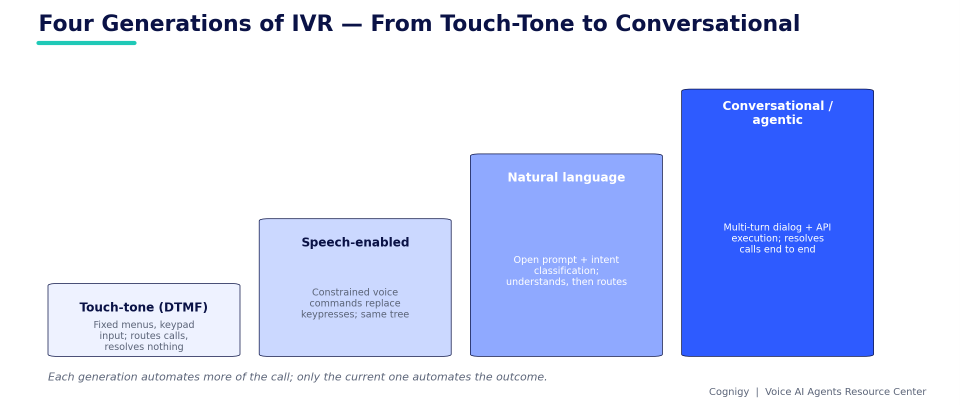
Ascending staircase diagram with four steps labeled touch-tone DTMF, speech-enabled, natural language, and conversational agentic, each with a one-line description of its capability.

Figure: Four generations of IVR. IVR's four generations, from touch-tone menus to conversational, agentic systems that resolve calls rather than route them.


IVR has modernized before. Touch-tone (DTMF) menus arrived first: reliable, cheap, and universally disliked at depth. Speech-enabled IVR added constrained voice commands ("say billing or payments"), trading keypresses for grammar lists without changing the tree. Natural language IVR introduced statistical intent classification behind an open greeting — a genuine leap, but typically still a router: it understood the request, then sent the caller to a queue. The current generation is conversational and agentic: large-language-model reasoning, multi-turn dialog, and API execution let the system complete the task rather than merely file it. Understanding where your estate sits on this line — and which generation each vendor pitch actually describes — is half the vocabulary battle; IVR vs. conversational AI draws the category lines precisely.

Anatomy of a conversational IVR


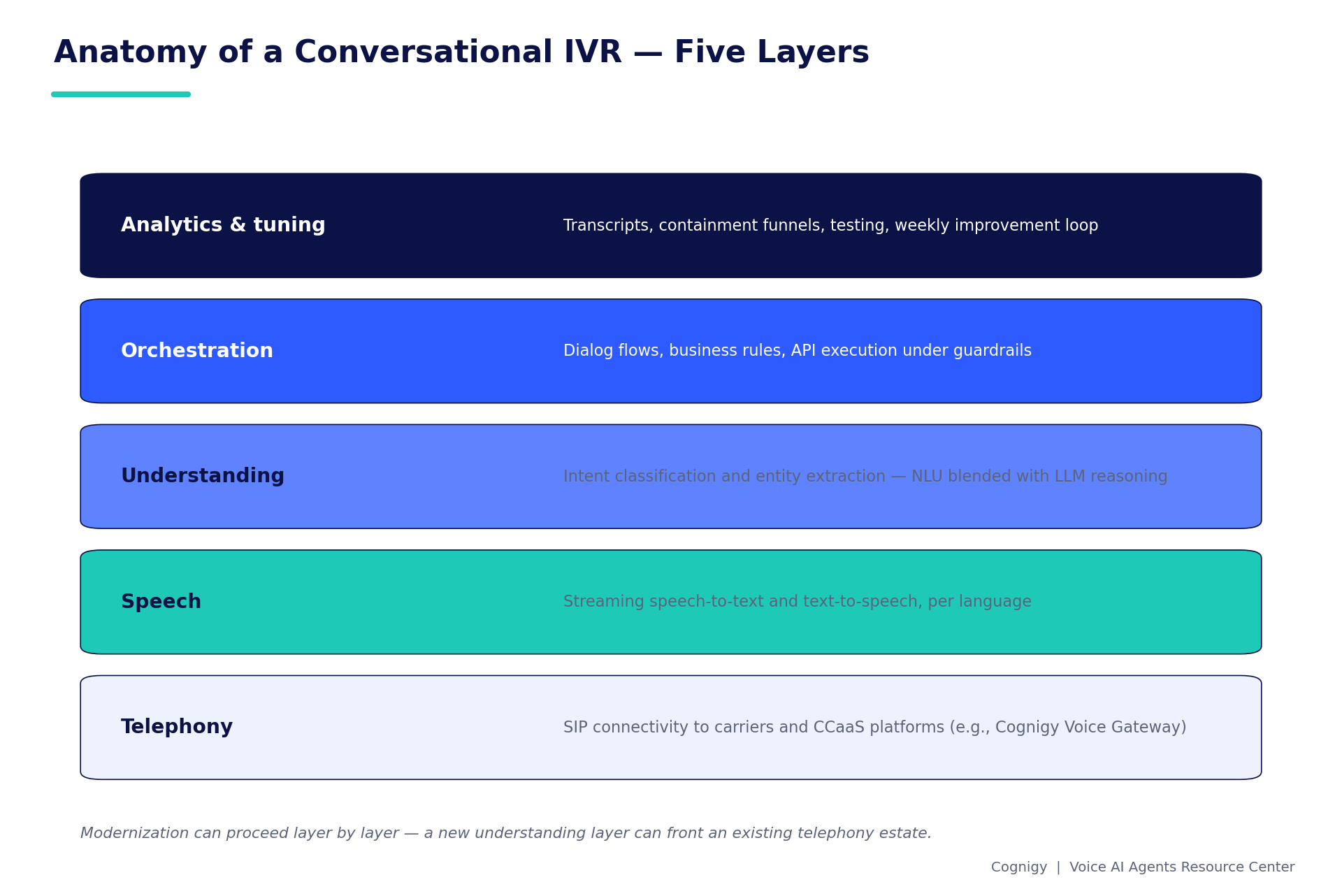
Stacked layer diagram of a conversational IVR showing five layers: analytics and tuning, orchestration, understanding, speech, and telephony with SIP connectivity.

 Figure: Anatomy of a conversational IVR. The five layers of a conversational IVR: telephony, speech, understanding, orchestration, and analytics — modernization can proceed layer by layer. 


Five layers make natural language on the phone work. Telephony carries the call in over SIP from carriers or the contact center platform — Cognigy's Voice Gateway is this layer in the Cognigy stack. Speech converts audio to text and back, streaming in both directions per language. Understanding classifies intent and extracts entities, today typically blending deterministic NLU with LLM reasoning. Orchestration executes: dialog flows, business rules, API calls into CRM, billing, and order systems, all under guardrails. Analytics closes the loop with transcripts, containment funnels, and testing. The layers matter to buyers because modernization can proceed layer by layer — a new understanding layer can front an old telephony estate — and because platform evaluations should probe each layer separately, a discipline detailed in the technical spoke on how voice AI agents work.

The caller journey, before and after

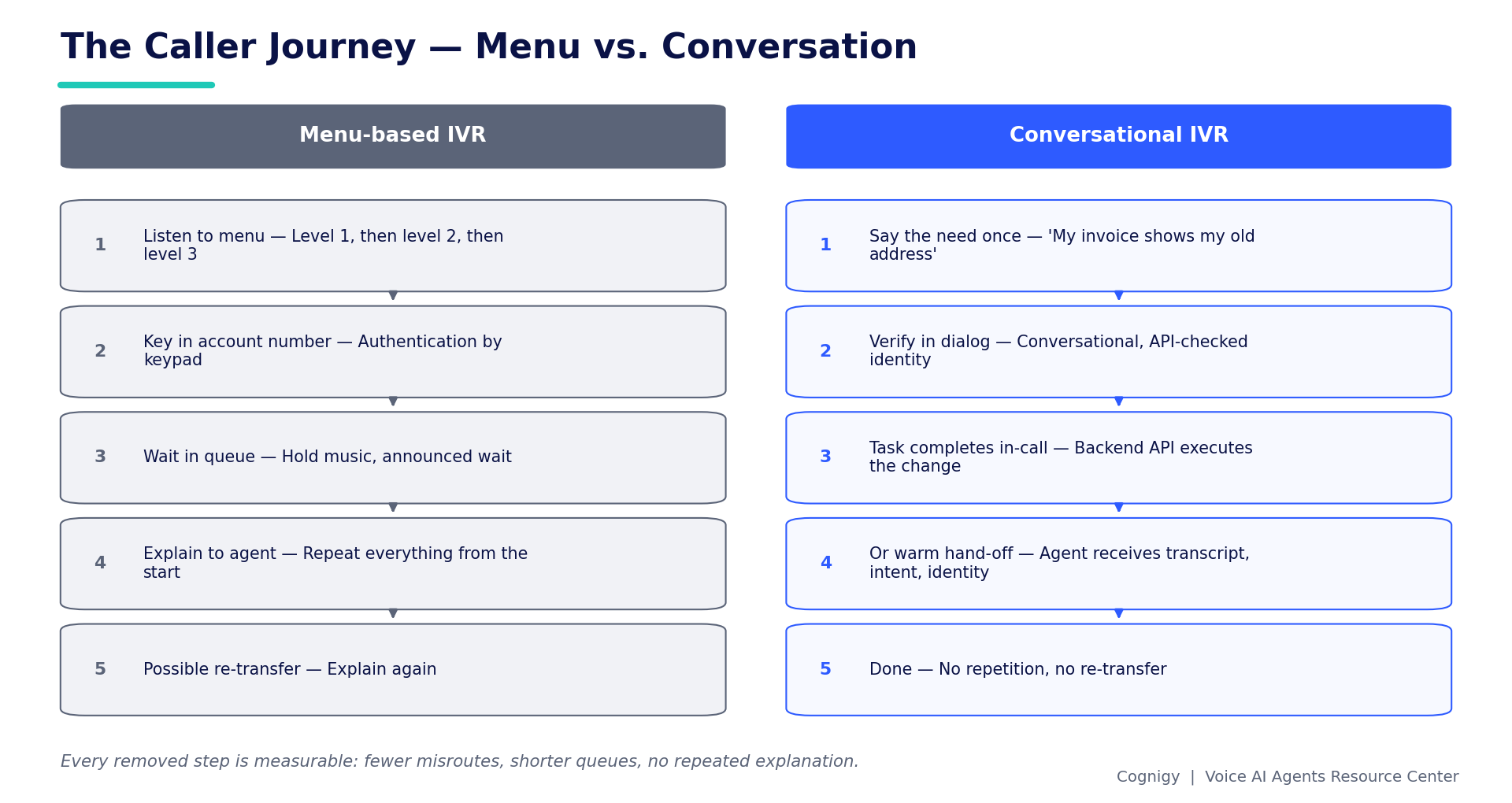
Two parallel lanes comparing the menu-based IVR journey — listen, key in account, wait, explain, re-explain — with the conversational journey — say the need once, verify in dialog, task completes or warm hand-off.

Figure: The caller journey, menu vs. conversation. Side-by-side caller journeys: five effortful steps through a menu-based IVR versus a single stated need resolved or warm-transferred by a conversational IVR.

The business case for conversational IVR is easiest to see from the caller's chair. The menu journey: listen to options, choose, choose again, key in an account number, wait, then explain everything to an agent. The conversational journey: say the need once, confirm identity in dialog, and either finish in automation or reach a human who already has the transcript, the intent, and the account on screen. Every removed step is measurable — fewer misroutes, shorter queues, less repeated explanation — and every one shows up in the two numbers legacy IVRs are judged by: containment and abandonment.

Renovate, replace, or wrap: the strategic choice

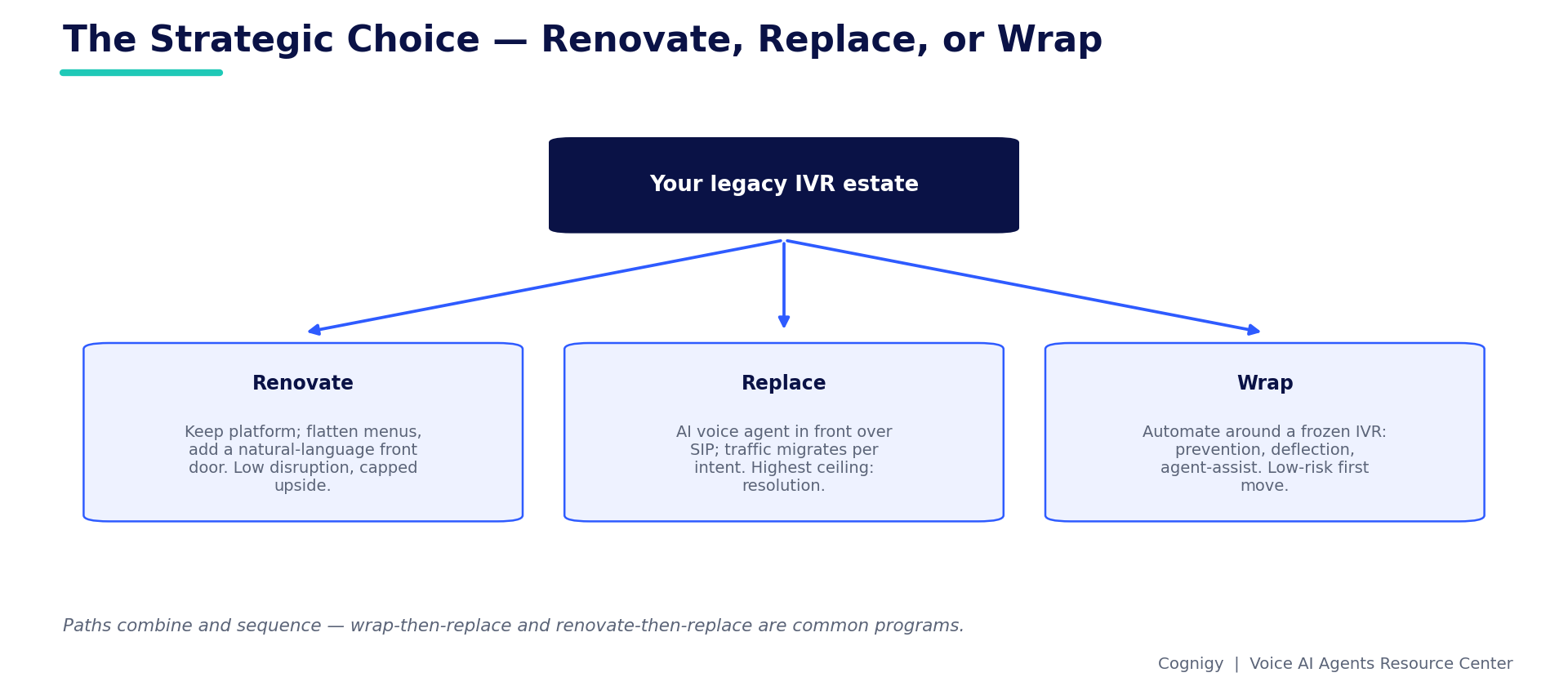
Decision tree from a root labeled your legacy IVR estate branching to three options: renovate, replace, and wrap, each with a short description of when it fits.

Figure: Renovate, replace, or wrap. The three strategic modernization paths for a legacy IVR estate — renovate the menus, replace them with an AI layer, or wrap the estate with automation around it.


Three modernization paths dominate real programs, and choosing among them is the central strategic decision this pillar supports:

  • Renovate: keep the IVR platform, flatten menus, add a natural-language front door. Lowest disruption, capped upside — the tree still limits what callers can do. Where renovation makes sense and where it stalls is covered in IVR modernization strategy.
  • Replace: put an AI voice agent in front of (and eventually instead of) the IVR, moving traffic use case by use case. Highest upside — resolution instead of routing — and the pattern most enterprise programs converge on, detailed in replace IVR with AI.
  • Wrap: keep the IVR for routing while automating around it — proactive outbound that prevents calls, agent-assist that shortens them, and digital deflection. Often the right first move when the IVR estate is contractually or technically frozen; the option set is mapped in IVR alternatives.

The honest version of this choice includes the option to defer: an IVR handling purely navigational traffic at low volume may not be the best next dollar of automation spend. The strategy spoke includes the assessment that tells you which case you are in.

What changes operationally

Conversational systems change who can modify the phone experience and how fast. Legacy IVR changes are IT projects on release cycles; modern platforms expose flows as low-code configuration that trained CX teams adjust in hours — a difference that compounds during product launches, policy changes, and disruptions. Scope also widens: beyond call handling, IVR automation now covers the tasks around the call — identification before it, wrap-up after it, notifications instead of it. And the operating model shifts from set-and-forget to weekly tuning against transcripts, the cadence every high-performing program shares.

Measuring the modernization

Three metric families anchor an IVR modernization program. Containment — the share of calls completed without a human — must be measured honestly on the legacy estate first, or the "before" baseline will flatter the past; the measurement discipline is in IVR containment rate. Abandonment — callers hanging up inside menus or queues — is the clearest caller-pain signal a legacy IVR emits, unpacked in IVR call abandonment rate. And the business case ties both to money: cost per resolved contact, agent-minute savings, and the investment lines they must clear, modeled without invented benchmarks in ROI of IVR replacement.

The migration itself

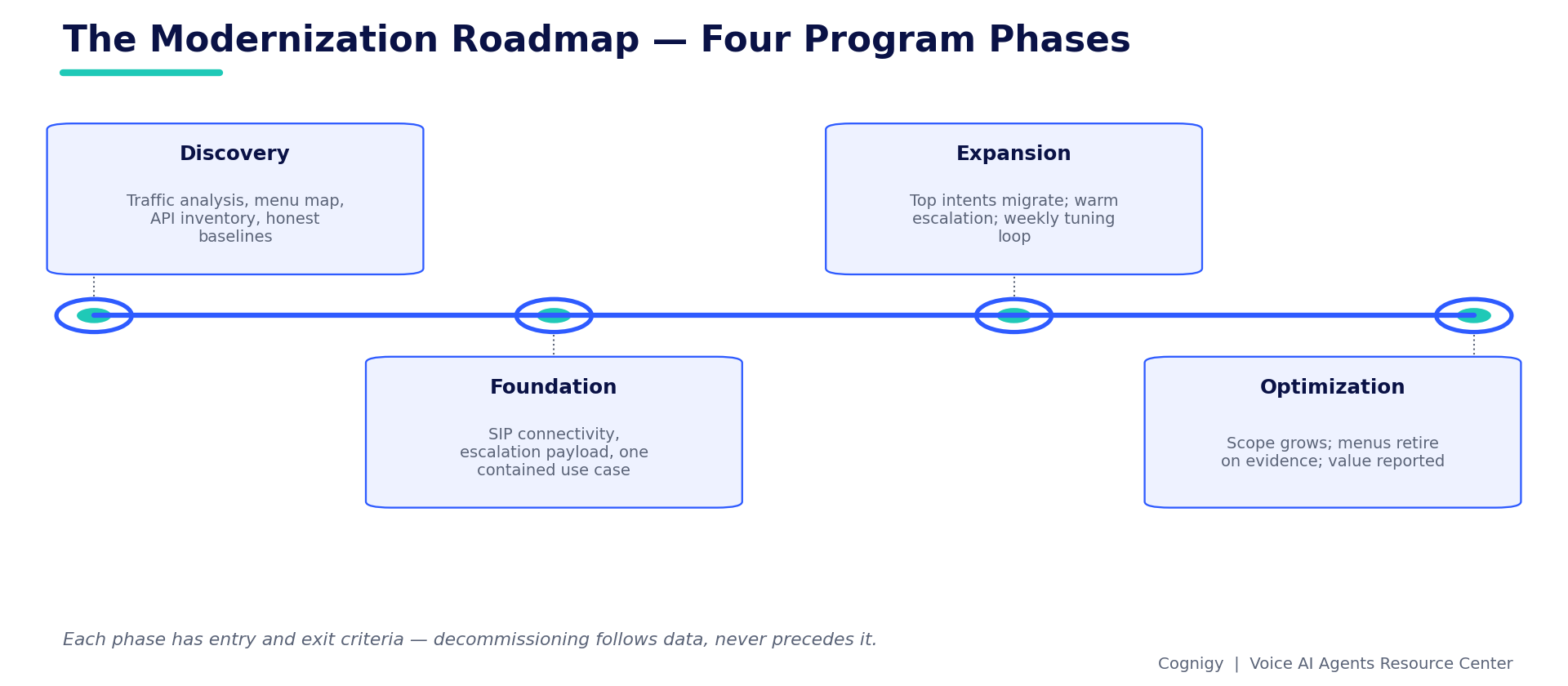
Horizontal timeline with four milestones labeled discovery, foundation, expansion, and optimization, each with a brief description of the phase's work.

Figure: The modernization roadmap. Four program phases from discovery to optimization, each with entry and exit criteria; decommissioning follows evidence.


Programs that succeed run migration in phases: discovery (traffic analysis, intent inventory, integration audit), foundation (telephony connectivity, one contained use case), expansion (top intents move to AI, warm escalation wired), and optimization (weekly tuning, decommissioning menus as their traffic disappears). Each phase has entry and exit criteria, owners, and rollback plans — the full sequence, with the items teams most often miss, is the IVR-to-AI migration checklist. Cognigy's deployment pattern — SIP connection into existing Genesys, Amazon Connect, NICE CXone, or Avaya estates via Voice Gateway (integration guide) — exists precisely so migration never requires ripping out the platform first.

Why enterprises are moving now

Three forces converge. Caller tolerance for menus has collapsed as consumers experience conversational AI elsewhere. The technology crossed the resolution threshold — modern systems complete transactions, not just classify intents, as production deployments like Lufthansa Group's crisis-rebooking voice agents demonstrate at scale. And the economics moved: language coverage, change speed, and automation scope that once required per-language, per-menu engineering now ship as platform capability (Cognigy.AI). The window where a touch-tone menu reads as "normal" to customers is closing; the guides below are the map for what to do about it.