


.png?width=60&height=60&name=AI%20Copilot%20logo%20(mega%20menu).png)



.png?width=29&height=29&name=twitter%20(1).png)
With NiCE Knowledge Management, enterprises can turn existing content into a consistent, contextual, and scalable foundation for AI-driven customer experience. That foundation helps AI Agents, human teams, self-service, and connected workflows act from the same trusted knowledge.
When AI moves from answering to resolving, trusted knowledge becomes part of the operating model.
How AI-ready knowledge gives enterprise AI Agents the context, authority, and feedback loops to resolve with confidence
A customer asks what should be a straightforward question.
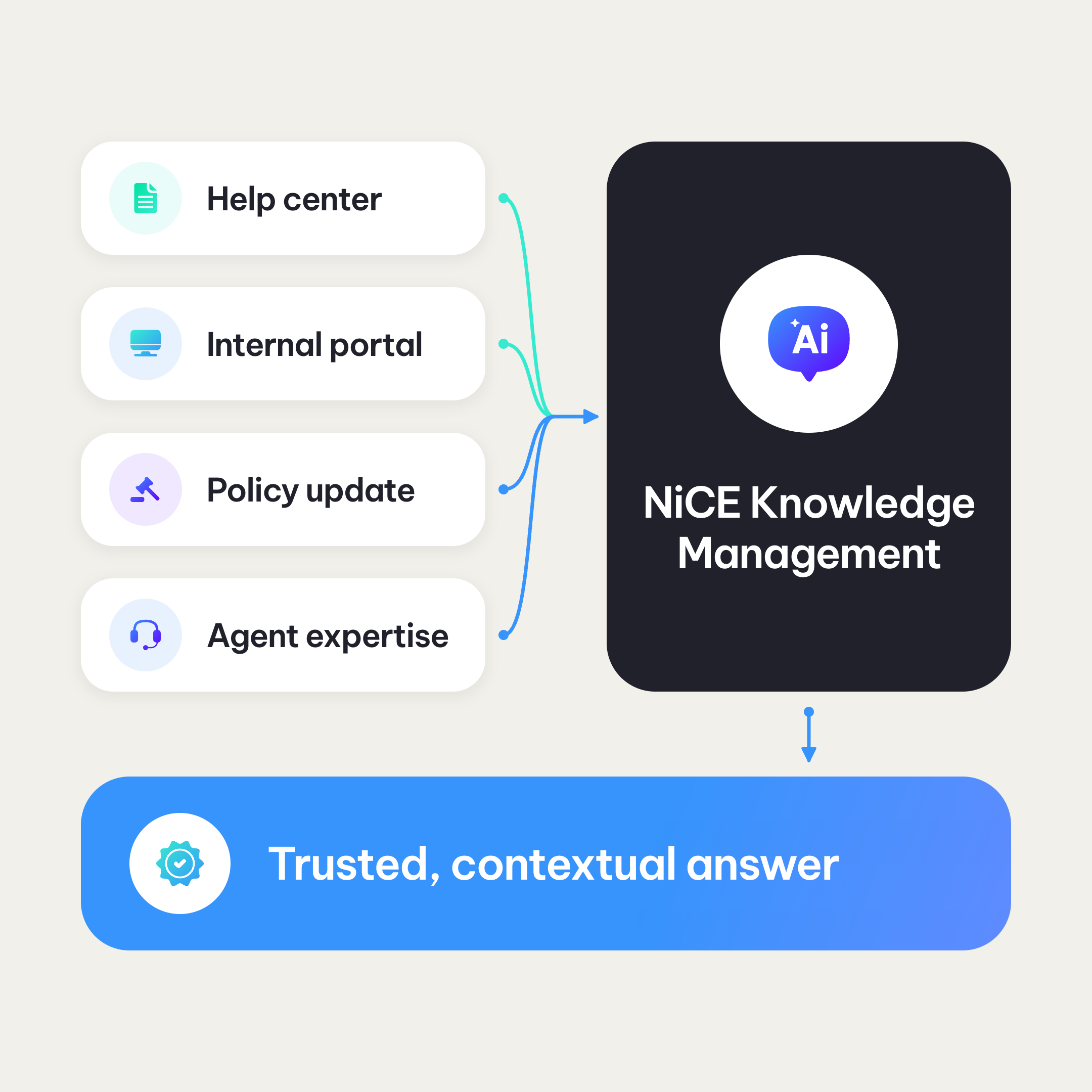
The public help center gives one answer. An internal portal adds a qualification. A recently updated legal document says something different. An experienced support agent has developed a workaround.
Which answer should an AI Agent trust?
That question becomes more consequential as AI Agents move beyond summarizing information and begin resolving customer needs. When an AI Agent changes a booking, troubleshoots a product, processes a request, or guides a customer through a regulated interaction, the wrong answer can introduce customer, operational, compliance, and brand risk.
Gartner predicts that by 2029, agentic AI will autonomously resolve 80% of common customer service issues without human intervention, contributing to a 30% reduction in operational costs. A separate 2026 Gartner survey found that 58% of service leaders aim to upskill agents into knowledge management specialists as organizations expand AI and self-service. (Gartner, 2025; Gartner, 2026)
As AI takes on more responsibility, knowledge becomes part of the customer service operating model rather than a static content library.
The hidden constraint on AI performance
Models are improving at working across larger bodies of information, selecting relevant context, comparing sources, and completing multi-step tasks. That progress expands what enterprises can automate. Reliable deployment still depends on the organization defining which sources are authoritative, who can access them, when they apply, and what happens when they conflict. (OpenAI; Anthropic)
Most enterprises already have abundant content.
They have product documentation, support articles, policy updates, training materials, community posts, PDFs, case histories, and knowledge held by experienced employees. The challenge is determining which source is authoritative and under what circumstances.
When knowledge is duplicated, outdated, disconnected, or missing context, an AI system can produce a fluent answer that is still wrong.
AI-ready knowledge must answer three questions:
- What is safe to say? The content must be current, approved, source-backed, and owned.
- To whom does it apply? The answer may depend on the customer, product, role, region, entitlement, version, or permission level.
- How should it improve? Search behavior, unsuccessful queries, feedback, escalations, and content gaps must feed a continuous improvement cycle.
The executive question is whether the business can trust the answer, understand why it was selected, and control how it is used.
What AI-ready knowledge looks like
AI-ready knowledge is connected, contextual, governed, and continuously improving.
NiCE Knowledge Management brings scattered enterprise content into a shared knowledge foundation for customers, human agents, AI Agents, copilots, and self-service. It combines content authoring, AI search, permissions, governance, analytics, and omnichannel delivery so each experience can work from the same trusted body of knowledge. (NiCE)
Cognigy Knowledge AI, part of NiCE’s broader knowledge portfolio alongside NiCE Knowledge Management, helps AI Agents deliver relevant answers grounded in your business content.
ExpertAI, also called GenSearch, uses retrieval-augmented generation to find relevant information in an organization’s approved knowledge base and form a natural-language answer. Source pages remain available, while permissions, filters, personas, and relevance settings help determine which information can be retrieved and how the response should be formed. (NiCE Knowledge Success Center)
In practical terms, the knowledge layer provides four things that model capability alone cannot reliably supply:
- What AI can use: Structured, approved content and the source hierarchy, metadata, permissions, and ownership associated with it.
- Why an answer applies: The customer’s question, identity, product, role, location, entitlement, and access level narrow retrieval before the model generates a response.
- How people retain control: Content owners, review cycles, approval workflows, audit trails, and escalation paths define where human judgment remains part of the process.
- How the knowledge improves: Search behavior, feedback, unsuccessful queries, and content gaps show knowledge teams what needs to be created, corrected, or improved.
Retrieval, context, governance, and feedback turn a large body of content into a dependable customer experience. Model N provides a clear example. Its Helpcenter already contained extensive and valuable information. The next challenge was making the right knowledge immediately relevant to each customer.
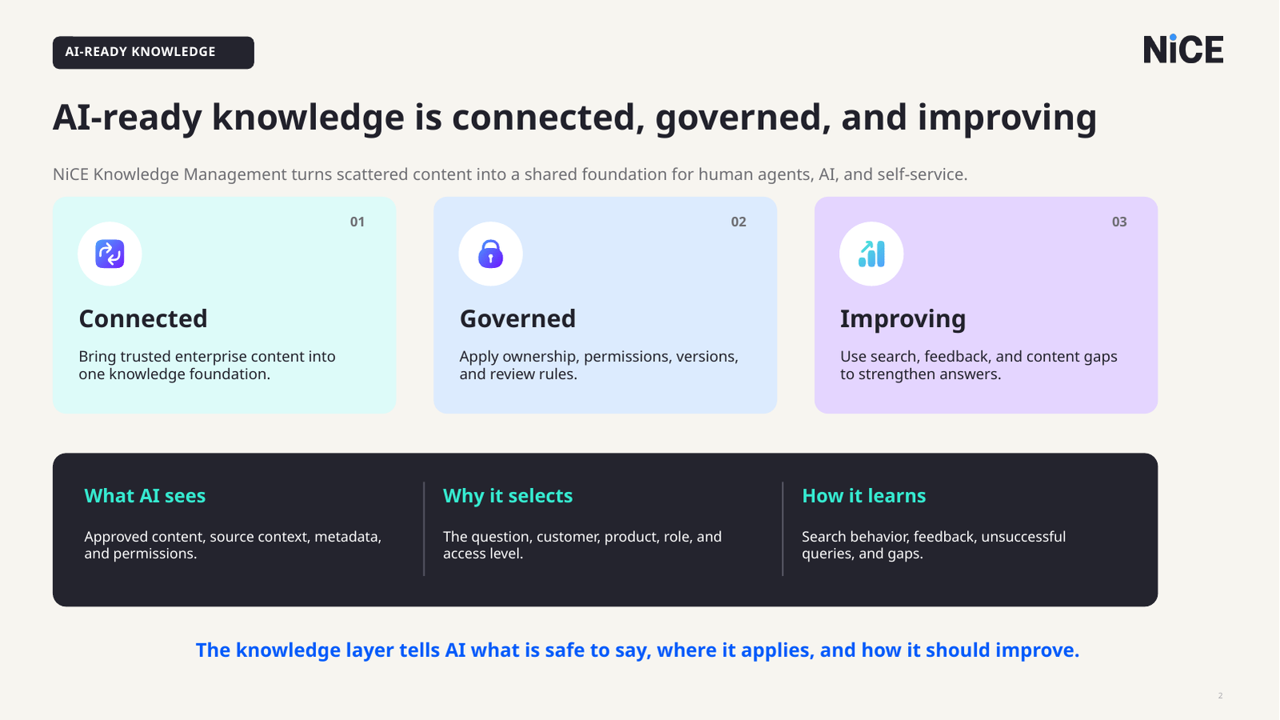
Connected, governed, and continuously improving knowledge gives AI the context and controls required for dependable answers.
Model N: Making every answer relevant to the customer
Model N’s Helpcenter had grown into a rich customer knowledge environment. It included more than 20,000 product documents, 730 release articles, 700 support articles, 250 how-to articles, more than 100 videos, and customer-specific material. (CXone Expert Awards)
The content was valuable, but finding the right answer could still require too many clicks.
The correct answer also varied by user. It depended on the customer’s product, account, support access, role, and permissions.
Model N addressed this by organizing access around 10 product groups, more than 200 customer groups, and a dedicated support group. That structure helped generative search reduce irrelevant information and return answers appropriate to the person asking.
For Model N, correctness became contextual. The information had to match the customer, product, permission level, and moment.
Model N treated AI search as an experience change rather than a feature activation. The rollout included four months of sandbox testing and persona configuration, feedback from internal users and the support organization, and a pilot with 15 early-adopter customers.
The company launched its AI Helpcenter in July 2025 and supported the rollout with customer education, search guidance, and ongoing feedback. It also expanded Helpcenter as a single source of truth so customers could find product, support, learning, and customer-specific content in one experience. At its March 2026 customer conference, Model N held two hands-on AI Helpcenter sessions with more than 30 customers, helping users understand the experience while gathering direct input about what they needed next. (CXone Expert Awards)
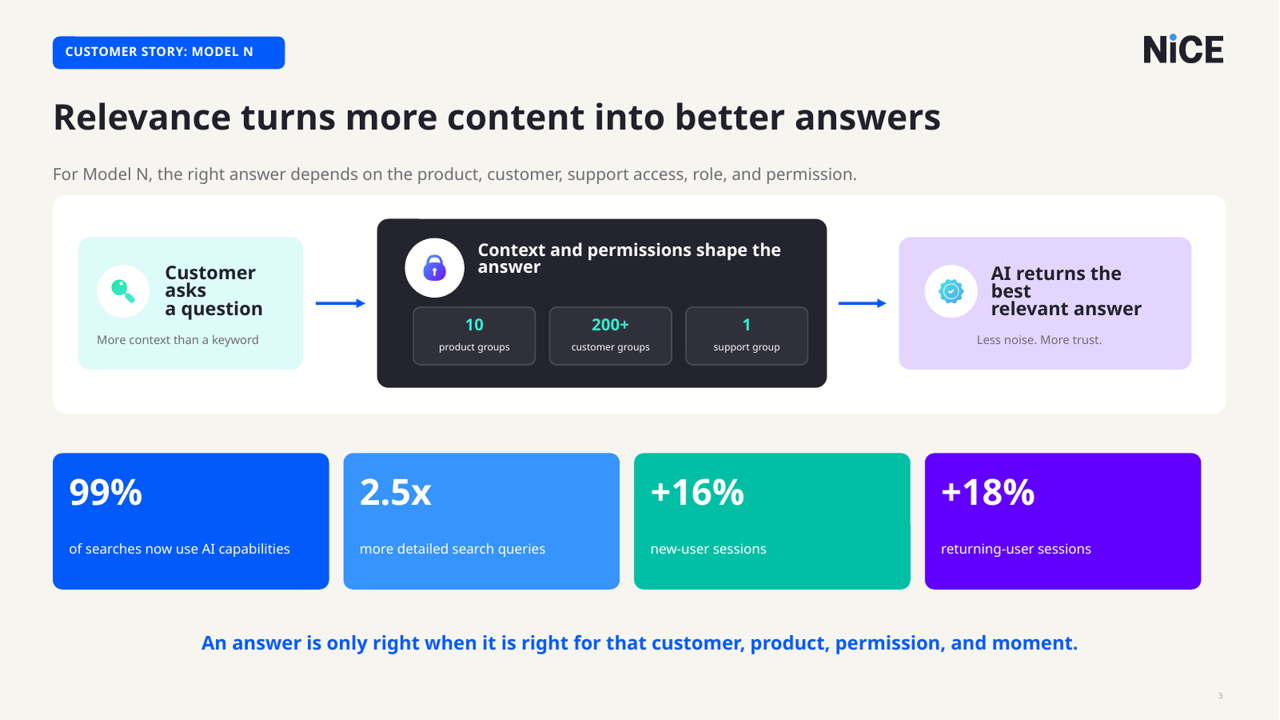
Model N combines richer customer questions with product, customer, and support permissions to return more relevant answers.
As people became familiar with the experience, their behavior changed. Instead of entering isolated keywords, they began asking more detailed questions that gave the AI more context.
The results reflected that shift:
- 99% of searches now use AI capabilities.
- Search queries became 2.5 times more detailed.
- New-user sessions increased 16%.
- Returning-user sessions increased 18%.
Model N shows how relevance builds trust at the point of search. NetApp faced a related enterprise challenge: preserving trust and consistency as knowledge expanded across more teams, contributors, content, and customer demand.
NetApp: Scaling knowledge without losing consistency
As NetApp’s Customer Success organization grew, Customer Support, Professional Services, Renewals, and Cloud Support developed their own repositories, access rules, and publishing processes.
Those systems gave individual teams control over their content, but they also created silos. Information that could help another employee or customer became difficult to find, reuse, and maintain consistently.
NetApp needed a knowledge operating model that could scale as content volume, contributor participation, and customer demand increased while keeping quality standards consistent across teams.
NetApp combined NiCE Knowledge Management with tools built by its own knowledge management team. Together, they connect content creation, publishing, quality checks, case reviews, search, feedback, and administration within one improvement cycle. AI-assisted authoring helps contributors create and refine content. Quality reviews and case audits help teams apply consistent knowledge-centered service standards. Search and feedback signals show where content needs to be updated or expanded. (NiCE Cognigy)
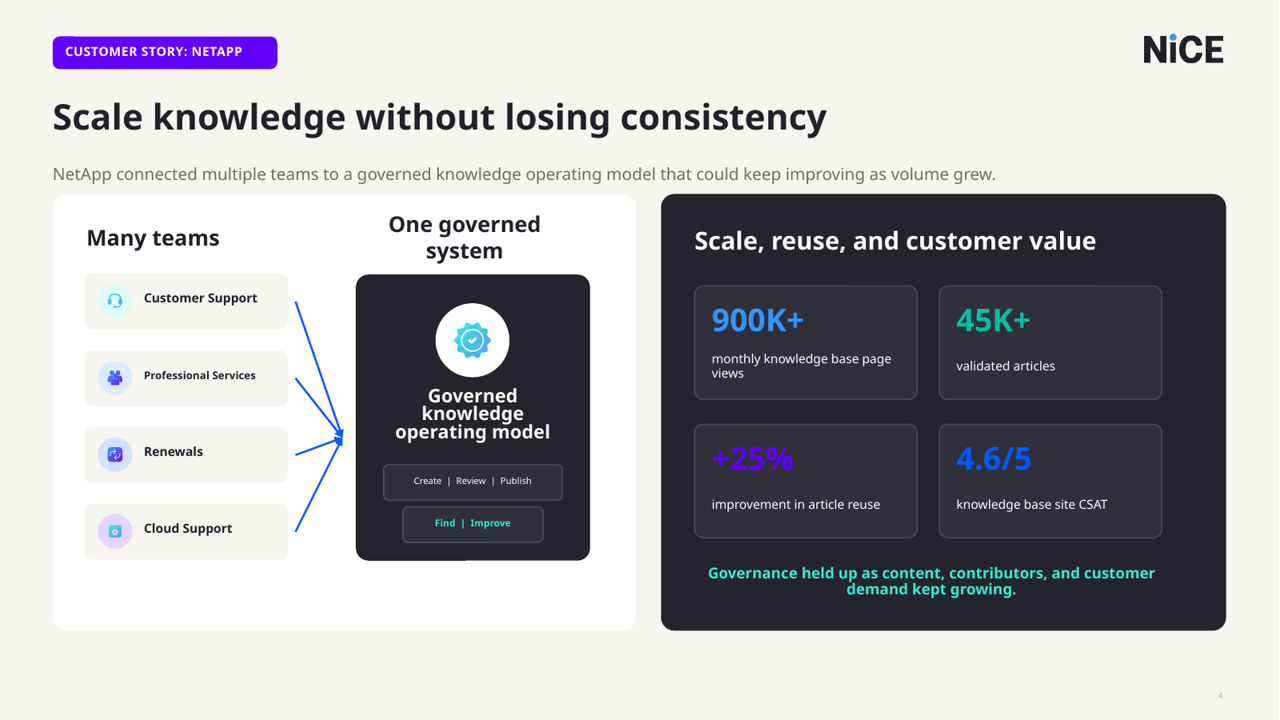
NetApp connected multiple teams to one governed knowledge operating model that supports scale, reuse, and consistent customer value.
That operating model now supports:
- More than 900,000 knowledge-base page views each month
- More than 45,000 validated articles
- An average of 800 new articles and 2,500 article updates each month
- A 25% improvement in article reuse
- A 4.6 out of 5 knowledge-base CSAT score
The scale is significant, and the consistency behind it matters just as much. A broader group of contributors can capture knowledge, while shared structures, permissions, templates, quality reviews, and feedback processes help keep that knowledge usable and reliable.
NetApp scaled by embedding standards into the way knowledge is created, reviewed, published, found, and improved. (NiCE Cognigy)
Different starting points, one operating principle
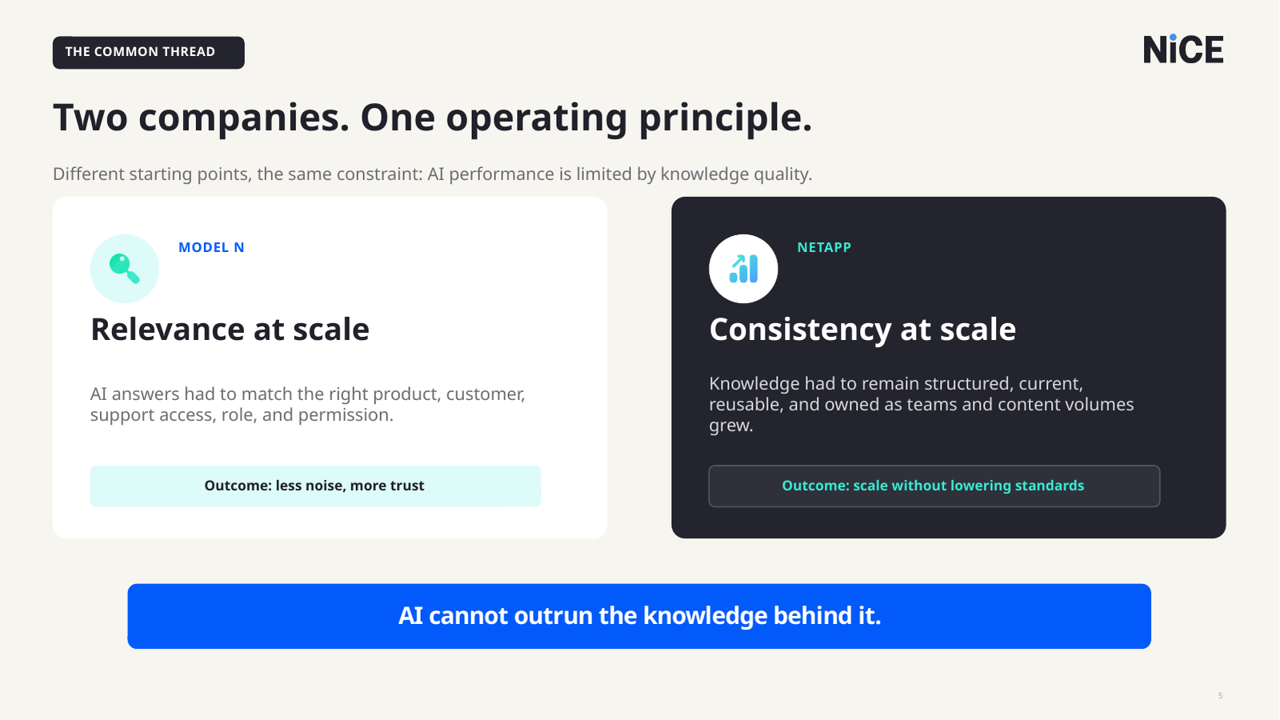
Model N demonstrates relevance at scale. NetApp demonstrates consistency at scale. Both show that AI cannot outrun the knowledge behind it.
Model N needed AI answers to match the right product, customer, role, and permission level.
NetApp needed knowledge to remain structured, consistent, and reusable as the program expanded across teams and rising content volumes.
Model N’s priority was relevance at scale. NetApp’s was consistency at scale. Both point to the same operating principle:
As model capability improves, the enterprise bottleneck increasingly shifts from generating an answer to governing the evidence, context, and authority behind it.
More capable models can compare sources, identify likely conflicts, use more context, and ask better clarifying questions. The knowledge operating model still has to specify which policy is authoritative, who owns it, when it takes effect, and who is entitled to receive it.
Access to more information gives the model a broader working context. It does not identify which source owns the decision. Stronger model judgment can help an AI follow defined authorization boundaries. Explicit entitlements, permissions, and enforcement establish those boundaries.
These requirements belong in the knowledge layer: source hierarchy, content structure, metadata, permissions, governance, and continuous improvement.
A practical path to AI-ready knowledge
Enterprises do not have to reorganize every repository before creating value. A focused implementation can establish the operating model and produce measurable evidence before the program expands.
1. Choose one high-friction customer question or journey
Start where customers struggle to find an answer, agents repeatedly search multiple systems, or inconsistent guidance creates avoidable escalations.
2. Decide which sources AI should trust
Identify the authoritative source, its owner, its review process, its effective date, and the escalation path when sources disagree.
3. Add the context required for safe retrieval
Define the product, version, customer segment, geography, entitlement, role, permission, and effective date that determine whether an answer applies.
4. Deliver knowledge where work already happens
Make the same governed knowledge available across AI Agents, employee copilots, self-service, search, and assisted-service workflows.
5. Use every interaction to improve the knowledge
Review unsuccessful searches, low-confidence responses, customer feedback, escalations, and emerging topics. Convert those signals into prioritized content and governance actions.
The first project should be narrow enough to measure and important enough to matter.
Better CX starts with a trusted answer
Stronger models can detect some conflicts, signal uncertainty, and decline to answer when evidence is insufficient. They still depend on the quality, authority, and context of the knowledge available to them.
The right answer depends on the customer, product, role, permission, and moment. Every search, conversation, and escalation should also help the organization understand where its knowledge needs to improve.
When knowledge is connected across the enterprise, governed with clear accountability, and refined through real interaction signals, AI can do more than answer quickly. It can help customers and employees act with confidence.
With NiCE Knowledge Management, enterprises can turn existing content into a consistent, contextual, and scalable foundation for AI-driven customer experience. That foundation helps AI Agents, human teams, self-service, and connected workflows act from the same trusted knowledge. (NiCE)


.png?length=370&name=Agentic%20Building_Featured%20(9).png)