





Your customers are starting to send AI agents to talk to your business, and they expect results. According to Metrigy, 82.5% of consumers rate their personal AI agent’s ability to finish the job as good or excellent. One in three say they will leave companies that block their AI agents.
For companies, the question is how to welcome these agents while maintaining trust and control.
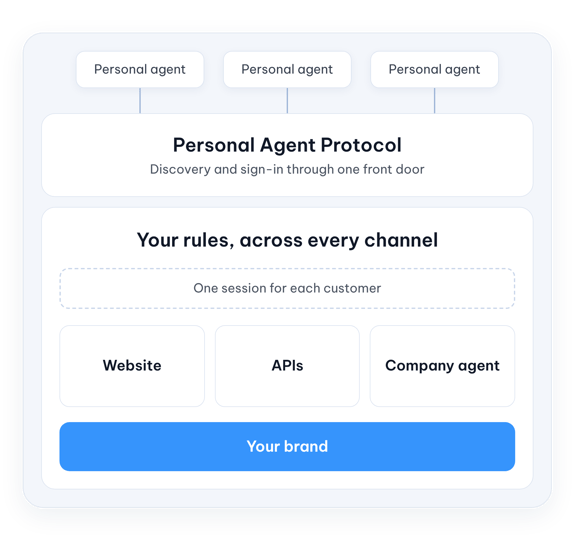
NiCE Cognigy now supports the Personal Agent Protocol, also known as Poppy, so personal agents can find and connect with your CX AI agents. When the customer signs in, your AI agent can identify the account it is working on.
As a design partner, NiCE is helping shape the protocol alongside its partners, giving companies a trusted way to welcome this new kind of customer interaction—on their own terms.
The opportunity: Customers are sending their agents to you
Personal AI agents can do more than suggest what a customer should do next. They can contact a company and carry out tasks on the customer’s behalf.
Behind every one of those contacts is a customer who has chosen a new way to do business with you. That creates three practical questions for your business:
- Which agent is contacting us?
- Which customer account is involved?
- What has the customer allowed the agent to do?
Channels built for people do not reliably answer those questions. Neither does a statement like “I’m an AI assistant calling on behalf of…” That calls for a new kind of front door: one designed for agents and built on trust.
What the Personal Agent Protocol brings: Identity, discovery, and customer permission
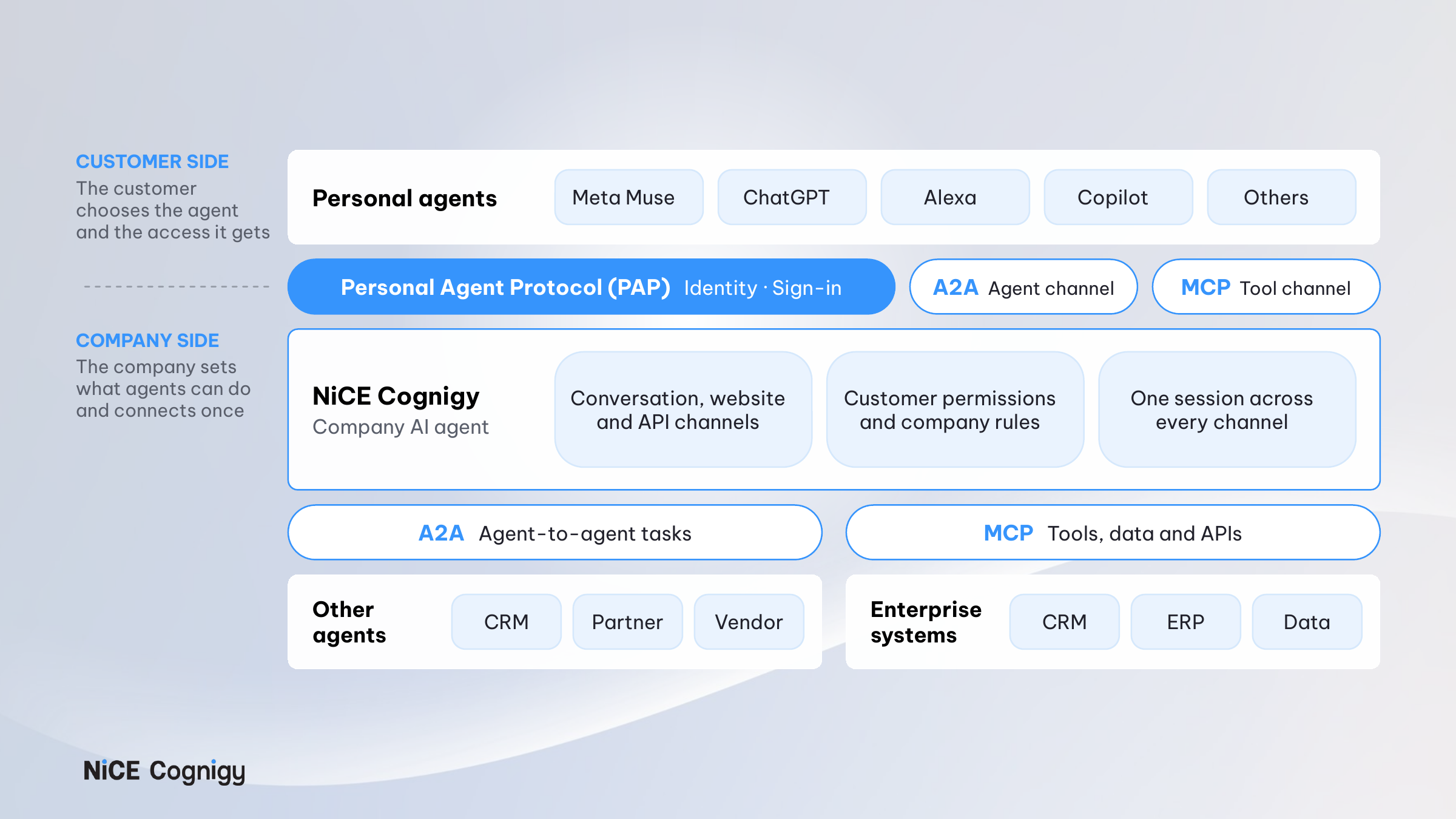
The Personal Agent Protocol gives both sides what they need to work together safely:
- Discovery: Companies publish a discovery file at a standard address on their own domain, so personal agents can find them.
- Identity: Personal agents identify themselves when they connect, so companies can verify who is asking.
- Customer permission: Sign-in builds on OAuth. The customer chooses how much their agent may see and do, while the company defines the boundaries every agent works within.
Companies choose which channels to make available, including web pages, APIs, and conversations with their own AI agents. For a task that benefits from a two-way conversation, such as resolving a damaged delivery or discussing a warranty claim, a personal agent can connect with the company’s AI agent. That is where NiCE Cognigy comes in.
Built for customer trust and company control
Not every request needs the customer’s account. A personal agent can compare delivery options or find a store’s opening hours right away as a guest. Sign-in only comes into play when a task touches the customer’s own data, such as checking an order or moving a delivery.
You set the rules: when to keep the conversation open to guests and when to offer sign-in only when a task needs it. Your AI agent can also prompt for sign-in mid-conversation and ask only for the access that task needs.
Trust stays where it belongs: with your company. Every sign-in runs through your company’s own authorization server, and customers sign in on your own page, on whatever device suits them. A conversation is linked to a customer account only after sign-in. And they can disconnect their agent at any time, so access never goes beyond what they granted.
Example: a delivery change, step by step
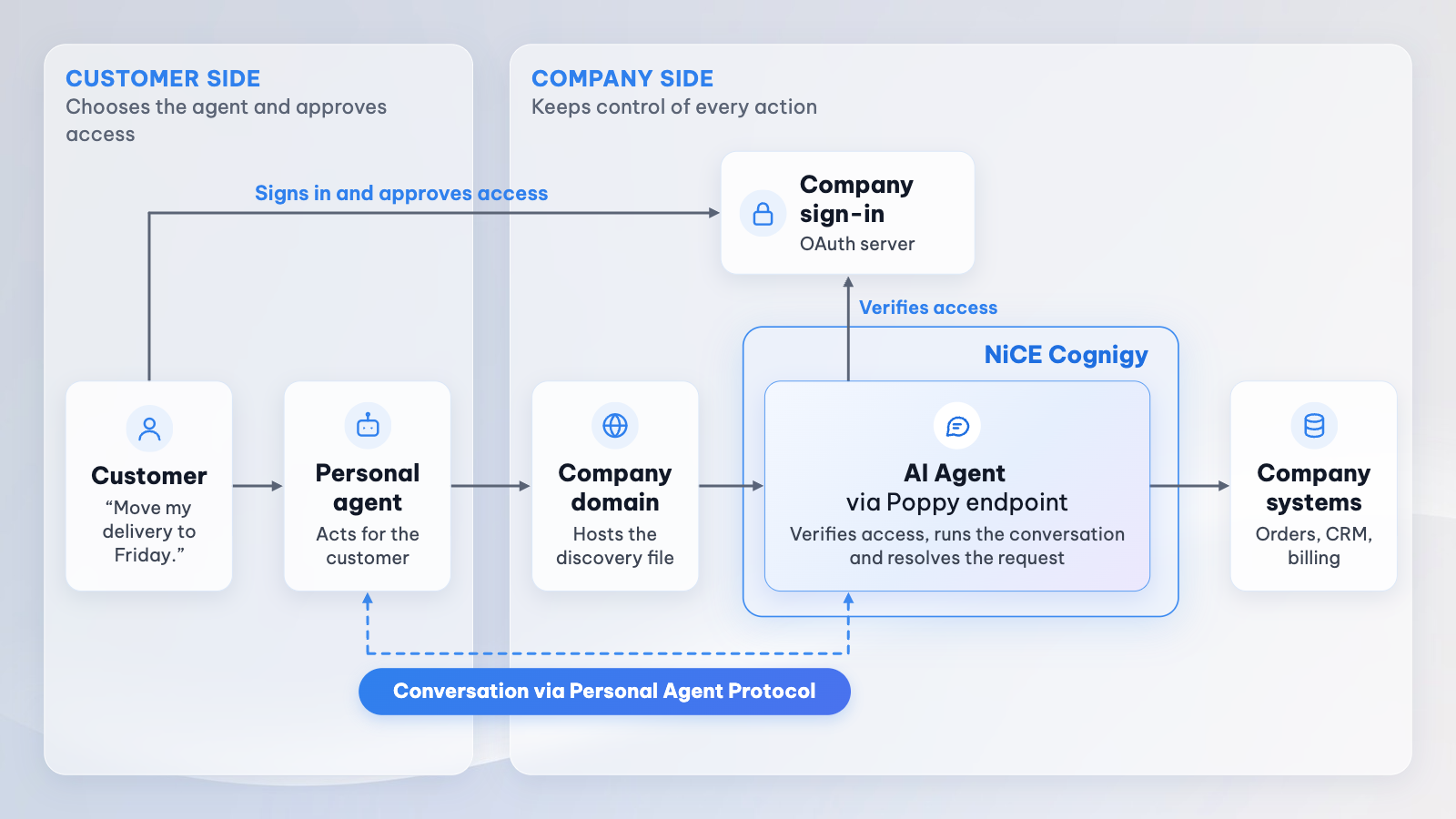
Consider a customer who wants to move a delivery to Friday:
- The customer asks their personal agent for help. The agent finds the company’s available services through information published on its website.
- The personal agent contacts the company’s AI agent. It explains the delivery request.
- The customer signs in and approves access. Because the task involves their account, the customer uses the company’s sign-in page.
- The company’s AI agent handles the request. It checks the available delivery options and applies the company’s rules before confirming the change.
How Personal Agent Protocol fits with MCP and A2A
Poppy works alongside other agent protocols. Each addresses a different part of the interaction.
- MCP — Model Context Protocol: Connect an AI agent to tools and data, such as an order lookup.
- A2A — Agent-to-Agent: Support communication and collaboration between AI agents.
- Poppy — Personal Agent Protocol: Help a personal agent find a company’s services and act for a customer with approved access.
For customer experience teams, the practical distinction is account access: connecting two agents is only part of the task. Your business also needs to establish which customer account is involved and what access the customer has approved.
What this means for CX and AI teams
Together, discovery, customer sign-in, and the context your AI agent receives turn personal agents from an unknown into a channel CX and AI teams can serve with confidence. The impact shows up in three areas:
Verified agents, clear consent: Teams can tell when a personal agent is part of a conversation and, for signed-in requests, verify which agent is acting and what the customer approved. Customers decide what their agent can access, read-only or write, and your company sets what personal agents are allowed to do.
A consistent experience for customers: Customers can hand a task to the assistant they already trust and get it done without switching channels or explaining themselves twice. The protocol supports session continuity across websites, APIs, and conversations. Where implemented, this can help preserve context and reduce the need for customers to repeat information.
A faster path into the agentic ecosystem: Teams open their existing Cognigy Agents to personal agents with one new endpoint and their own OAuth authorization server. Alongside MCP and A2A, the same AI agents can now work with tools, with other agents, and with the agents customers bring with them.
How it works in NiCE Cognigy
Here's how to go from setup to the first conversation in NiCE Cognigy:
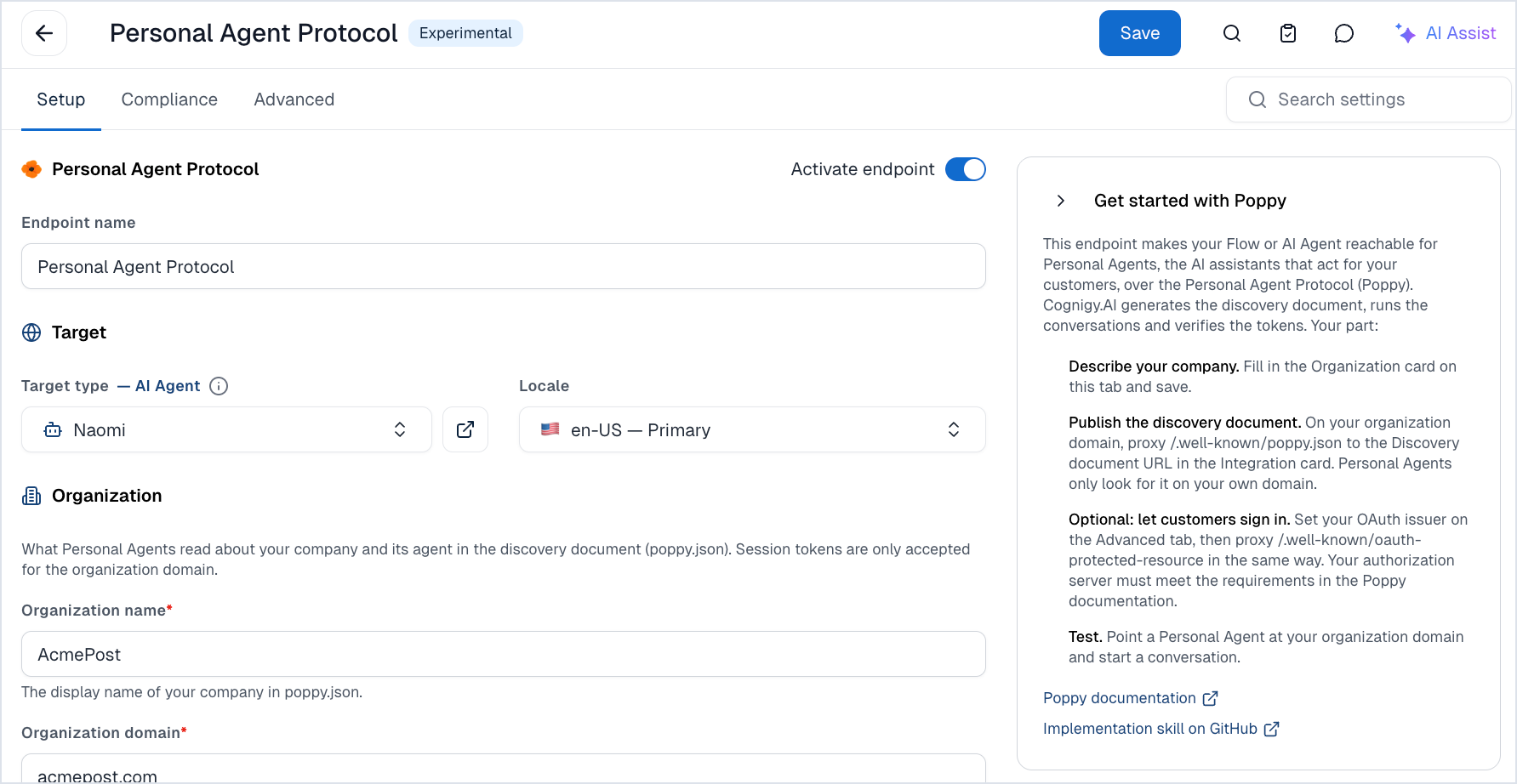
- Create the endpoint: Add the endpoint, connect your AI agent, and describe what it can help with.
- Publish the front door: Cognigy generates the discovery file, poppy.json. Proxy /.well-known/poppy.json on your domain to Cognigy so personal agents can find you.
- Connect sign-in: Optionally, connect your OAuth server. Cognigy verifies its tokens but never issues them.
- Handle the conversation: Your AI agent sees who wrote each message, the customer’s situation and, after sign-in, the account and approved access. Replies go back to the personal agent.
Scope, boundaries, and accountability
Today, the Personal Agent Protocol covers personal agents that identify themselves on digital channels, such as websites, apps, and chat. Phone calls and agents that pose as customers are outside its scope.
Getting started requires an AI agent that responds to text and a company domain where you can route requests to NiCE Cognigy. To offer sign-in, you also need an OAuth authorization server that meets the endpoint’s documented requirements.
Within that scope, the final say stays with you: your business sets which actions to allow, and sensitive changes, such as updating payout details, can require the customer’s explicit confirmation.
Looking ahead: Preparing for agent-to-agent customer service
As personal agents become more common, more customer contacts will begin with an AI agent acting on someone’s behalf. The companies that lead will be the ones that offer a clear, verified way in, decide what each request requires, and keep their own AI agents responsible for resolving the customer’s issue.
The Personal Agent Protocol itself is still young: version 1.0 of the specification was published only recently. As a design partner, NiCE is actively shaping how it evolves, and support in NiCE Cognigy will grow with the protocol.
The front door is there. Your next customer may already be sending their agent.
Available now: The Personal Agent Protocol endpoint is an experimental feature in NiCE Cognigy, starting with release 2026.24.
Visit our documentation to learn more and get started.