
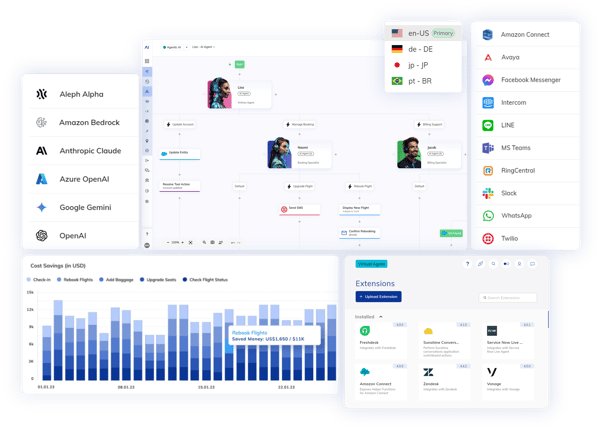






A contact center isn’t just a call center; it’s a central hub for all customer communications. A modern contact center integrates calls, messaging, email, and social media to provide a unified approach to customer service.
As a customer moves between channels, the conversation context and their intent should follow them. For example, a customer starts a web chat but then must call a specific phone number. The contact center agent should be able to access the background, so the customer isn’t frustrated by having to repeat themselves.
AI further enables this process. AI Agents can handle repetitive tasks and provide complete visibility into the journey, enabling faster resolutions and more personalized experiences.
To ensure all channels work together seamlessly, the contact center must be built on robust, cloud-based technology that delivers security and efficiency across the organization. This foundation ensures operational efficiency and scalability, as well as enterprise-grade security and compliance.
When channels are unified on a single platform, organizations gain deeper insights, stronger control, and a more resilient customer service operation.
In this guide, we’ll explore how this all works together in an omnichannel contact center, and how AI can transform an enterprise’s customer service experience in measurable ways.
Key Takeaways
- An omnichannel contact center unifies all customer communication channels into an integrated system, so customers can move seamlessly between touchpoints without having to repeat themselves.
- AI plays a central role in omnichannel environments by automating routine interactions, supporting agents with real-time insights, and enabling personalization at scale.
- Unlike multichannel setups, omnichannel contact centers eliminate data silos, providing a centralized foundation for analytics, governance, and decision-making.
- For enterprise organizations, omnichannel contact centers enable greater scalability, operational efficiency, and compliance while delivering consistent, high-quality customer experiences across languages and time zones.
What is an Omnichannel Contact Center?
An omnichannel contact center is a customer service department where all communication channels are fully integrated and operate as a single system.
Voice, email, chat, and social media are unified across an AI-powered contact center, so customers benefit from a seamless experience with quicker resolutions.
Customers can move seamlessly between channels without losing context or repeating themselves. Conversation history, preferences, and intent are shared in real time across systems, giving agents and AI-powered solutions a complete view of the customer journey. As a result, interactions feel more personal while remaining as efficient as possible.
Unlike multichannel approaches, which often lead to fragmented experiences and data silos, omnichannel contact centers are designed around the customer. They align technology, workflows, and teams to improve resolution times and deliver a cohesive experience at every stage of the journey.
Omnichannel vs. Multichannel Contact Centers
While omnichannel and multichannel contact centers both support multiple communication channels, they differ in *how* those channels are connected.
For enterprises handling high interaction volumes, complex journeys, and strict compliance requirements, this distinction significantly impacts customer experience.
What Is a Multichannel Contact Center?
A multichannel contact center also handles communications from a wide variety of sources, including calls, web chat, apps, and social media.
The key difference between omnichannel and multichannel is that omnichannel typically keeps each channel on a single platform, whereas multichannel typically keeps each channel on separate platforms. This makes transferring customers between channels challenging, as information isn’t automatically shared.
Equally, collecting data is more arduous, as each platform has its own data structures, reporting logic, and analytics capabilities, making it harder to gain a unified view of the customer journey.
Omnichannel vs. Multichannel: The Key Differences
Channel Integration
In an omnichannel contact center, all communication channels are fully integrated into a single platform, enabling seamless orchestration across touchpoints. In contrast, multichannel contact centers manage channels independently, with limited or no integration between systems. Any connection is usually handled manually, which consumes the contact center’s time and resources.
Customer Context
Omnichannel environments maintain a shared, real-time view of customer history across all channels. Multichannel setups isolate context per channel, preventing human agents from accessing a complete interaction history unless it is manually shared.
Customer Journey
Omnichannel contact centers support smooth transitions between channels without restarting conversations. In multichannel environments, customers often need to repeat information when moving from one channel to another. This frustrates both customers and human agents, as it disrupts the process, which is especially difficult if a customer is already in the midst of a complaint.
Agent Experience
Agents in omnichannel contact centers work from a unified desktop with complete visibility into the customer journey. This doesn’t simply make their jobs easier; it also makes their roles more satisfying, as they can channel their effort into helping customers rather than chasing. Meanwhile, multichannel agents typically switch between multiple tools and interfaces to manage interactions, causing confusion and overload for agents working in high-volume contact centers.
Scalability
Omnichannel architectures are designed to scale globally through centralized orchestration and standardized processes, whereas multichannel models become increasingly complex to scale, especially when a new platform emerges or customer preferences shift. This ultimately adds operational overhead as channels and regions grow.
Data Management
Omnichannel contact centers can centralize customer data, enabling advanced analytics, AI-driven insights, and optimization. Enterprises can view data from all platforms in dashboards and drill down into specific areas. All of which comes together to enable data-driven decision-making, eliminating guesswork.
Multichannel environments create data silos that limit reporting accuracy and visibility. So, the data is still there, but it’s harder to get a quick overview, and it may not be updated in real time.
Governance & Compliance
One of the key factors for regulated industries, such as banking, finance, or insurance, is governance. Omnichannel platforms enforce consistent security and compliance governance policies across all channels. Multichannel approaches often apply governance at the channel level, which increases risk.
Automation & AI
In omnichannel contact centers, AI and automation operate across the entire customer journey, leveraging Conversational AI and Generative AI. Conversational AI handles structured, goal-driven interactions such as routing, authentication, and self-service, while preserving context as customers move between channels. Generative AI enhances these flows by understanding unstructured input and generating natural responses.
In multichannel environments, automation is typically channel-specific and lacks shared context. This siloed approach limits scalability and reuse, reducing the overall impact of AI and making it harder to deliver consistent experiences across channels.
Operational Efficiency
It all comes down to how the setup impacts operations and, when implemented correctly, how the omnichannel environment is more efficient. It streamlines workflows and reduces resolution times through connected systems and shared context.
Benefits of Omnichannel Contact Centers
We’ve explored the differences between omnichannel and multichannel contact centers, and it’s clear that omnichannel is the best approach for an enterprise-level organization handling high volumes of interactions, where customers expect seamless transfers between channels and fast resolution times.
Benefits include:
Consistent and Personalized Customer Experience At Scale
For global enterprises, customer expectations are amplified by the complexity of serving customers across multiple time zones, regions, and languages.
Omnichannel contact centers unify channels and customer context in real time, enabling personalized interactions at scale. Shared data and intelligent routing ensure continuity across touchpoints, delivering a seamless experience even in high-volume, global environments.
Enhanced Agent Productivity and Cross-Departmental Collaboration
Omnichannel contact centers enable intelligent routing based on language, intent, and availability, while giving agents full visibility into the customer journey.
With access to real-time data, agents can make faster, more accurate decisions and adapt to changing demand as it happens.
This shared context also supports stronger collaboration across teams and departments, ensuring smoother handoffs and better resource allocation.
Improved Customer Retention For Large Customer Bases
Customer retention depends on delivering consistent, empathetic experiences at every interaction. Omnichannel contact centers reduce friction by preserving context across channels, so customers don’t need to repeat themselves or restart conversations.
By combining real-time data with AI-driven personalization, organizations can resolve issues faster, anticipate customer needs, and proactively address problems. This leads to higher satisfaction and improved long-term retention.
Centralized Data for Actionable, Organization-Wide Insights
Unified, accurate data is at the core of omnichannel contact centers. By centralizing interaction data from every channel in real time, organizations create a single, reliable source of insights covering customer behavior and agent performance.
This unified data, paired with AI-driven insights, allows for accurate reporting across teams and regions. With this data, enterprises can optimize customer journeys, improve forecasting, and make faster, more informed decisions across the organization.
Features for Omnichannel Contact Centers
Now that we’ve explored the differences and benefits of an omnichannel contact center, it’s time to dig into what this setup actually looks like for an enterprise-level organization.
Unified Agent Dashboard
A unified agent dashboard brings all channels, customer context, and interaction history into a single workspace, allowing agents to manage conversations without switching between tools. This ensures full visibility into the customer journey and supports faster, more consistent service across touchpoints.
For AI conversations, the Business Dashboard provides a live insight into all active and previous conversations, covering all of your KPIs, such as ROI, resolution time and volume breakdowns, at both a global and local level.
Integration with Enterprise Systems
Omnichannel contact centers must integrate seamlessly with core enterprise systems, including CRM, ERP, and business intelligence platforms. These contact center integrations ensure that customer interactions are enriched with real-time data from across the organization, giving agents and AI systems immediate access to customer profiles, order status, account details, and service history.
By connecting contact center operations with enterprise data sources, organizations can automate workflows, enable data-driven decision-making, and maintain a consistent view of the customer across departments.
Advanced AI and Automation
Advanced AI and automation are integral to successful omnichannel contact centers. Conversational AI and Generative AI work together to intelligently route interactions based on intent, language, priority, and availability, ensuring customers are connected to the right resource at the right time.
Beyond routing, AI-driven analytics provide real-time visibility into performance, customer behavior, and emerging contact center automation trends. Meanwhile, automation supports workforce optimization by forecasting demand, so managers can make smart, data-informed decisions about resourcing.
This enables contact centers to operate more efficiently at scale without sacrificing service quality.
Enterprise-Grade Security, Compliance, and Data Governance
Robust and up-to-date security and compliance protocols are non-negotiable. Enterprise-grade platforms are designed to protect sensitive customer data through role-based access, encryption, and continuous monitoring.
Centralized data governance is significantly easier with an omnichannel structure, as it enforces security and governance standards across the board, enabling enterprises to scale operations confidently without increasing risk or compromising data integrity.
Best Practices for Implementing Omnichannel Contact Centers
A thriving omnichannel contact center relies on the effective alignment of channels, data, AI and human teams. The following best practices help enterprises design and deploy omnichannel contact centers that succeed and scale.
Map Your Complex, Multi-Touch Customer Journeys
Start by clearly mapping how customers interact with your organization across channels, regions, and stages of the journey. From here, you can identify where conversations begin, how they move between channels, and where context is most often lost or repeated.
This journey mapping should account for different languages and time zones as well as handoffs between AI and human agents. A clear, end-to-end view of customer journeys provides the foundation for designing seamless omnichannel experiences.
Delivering Training and Change Management for Large, Distributed Teams
Equip human agents and managers with the training they need to work confidently in an omnichannel environment. You need to focus not only on tools and workflows, but also on how AI, automation, and shared customer context change day-to-day operations.
For large, distributed teams, structured change management is essential. Standardize processes, provide role-based training, and use ongoing performance insights to reinforce best practices, ensuring consistent adoption across regions, reducing friction during rollout, and enabling teams to truly see the benefits of AI.
Balance Automation with High-Touch, Human Support for VIP and Complex Cases
Automation is effective for handling high-volume, repetitive interactions, but human agents are irreplaceable for complex or sensitive cases that require an empathy-driven approach. Aim to define clear rules for when and how conversations transition from AI to agents, without losing context.
This approach is proven in practice. For example, Personify Health uses automated AI-driven pipelines to resolve routine inquiries end to end, while intelligently routing more complex cases to human agents. By automating resolution paths, they improved resolution times, and allowed agents to focus on more complex conversations.
Break Down Organizational Silos for Unified Customer Data
An omnichannel environment eliminates data silos by connecting customer information across channels. When shifting from a multichannel approach to an omnichannel one, you need to ensure CRM, contact center and backend systems all share a common data foundation.
Frontier Airlines previously operated phone-based customer support separately from its digital channels. This siloed setup created blockers: customers were forced into voice calls for simple requests and agents lacked context from prior digital interactions.
By unifying channels and data, Frontier was able to remove these friction points, streamline resolution paths, and give both AI and human agents full visibility into the customer journey.
Work Towards Continuous Improvement
It’s one thing to implement an omnichannel structure, but it takes continuous effort and tweaking to ensure it works long-term.
Look to establish a culture of continuous improvement by tracking enterprise-level metrics such as resolution times, containment rates, customer satisfaction, and automation performance. Always leverage real-time analytics and historical data to identify gaps and refine AI Agent workflows.
Challenges for Omnichannel Contact Centers
Implementing and scaling an omnichannel contact center at the enterprise level comes with challenges. You must align technology, data, processes, and people to ensure channels work together as the business grows.
Here are some of the challenges enterprises face in the transition from multichannel to omnichannel contact centers:
Integrating Legacy Systems and Overcoming Data Silos
Many enterprises rely on legacy systems that were not designed for the omnichannel structure. These disconnected platforms often store customer data in silos, making it difficult to share context across channels or provide a unified view of the customer journey.
Overcoming this challenge requires integrating existing CRM, voice, and backend systems into a centralized omnichannel architecture. By breaking down data silos and enabling real-time data exchange, organizations can ensure both AI and human agents operate in an optimal way.
Managing Latency, Uptime, and Global Response Times
For global enterprises, there is an added challenge of delivering real-time customer support across regions and time zones. Delays in data synchronization or system response can disrupt conversations, break context, and negatively impact customer experience.
In action, Bayer leverages a cloud-based omnichannel architecture to ensure high availability, reduce latency, and support consistent service delivery worldwide. By modernizing its global support infrastructure, Bayer significantly reduced response times and automated a large share of incoming inquiries.
Ensuring Privacy, Security and Regulatory Compliance (GDPR, HIPAA, etc.)
Regulations such as GDPR, HIPAA, and industry-specific compliance frameworks require organizations to enforce consistent data handling and auditability across every channel.
For example, by implementing an AI-powered omnichannel solution with centralized governance, BVG was able to automate customer interactions securely, and ensure GDPR-compliant data processing.
To succeed at scale, omnichannel contact centers must embed security and compliance into the platform itself. Centralized data governance and continuous monitoring enable enterprises to innovate with AI and automation while maintaining trust.
Driving Adoption and Change Across Departments and Regions
Rolling out an omnichannel contact center impacts more than customer service, it will impact IT, operations, compliance, and regional teams across the organization.
AIOps, the relationship between AI and IT, is particularly key here when it comes to ensuring everything works smoothly. By using AI to monitor performance, detect anomalies, and automate issue resolution, AIOps helps maintain system reliability as omnichannel capabilities scale across regions.
This coordinated approach accelerates adoption, reduces resistance to change, and ensures omnichannel strategies deliver consistent value across regions and departments.
Future Trends for Enterprise Omnichannel Contact Centers
As customer expectations continue to evolve, omnichannel contact centers are advancing beyond channel unification. Emerging trends are shaping how enterprises scale personalization and future-proof customer experience through AI-driven innovation.
Better Automation with Agentic AI
Agentic AI enables a new level of automation in omnichannel contact centers. AI Agents can reason, plan, and act across multiple steps of a customer journey. Instead of handling isolated tasks, Agentic AI can autonomously resolve complex requests across channels and systems, improving resolution rates while reducing handoffs and operational effort at enterprise scale.
AI-driven Personalization and Predictive Analytics
Personalization is evolving beyond reactive support toward predictive, data-led customer experiences. Predictive analytics further enables contact centers to forecast demand, identify potential issues before they escalate, and optimize routing and resource allocation.
Preparing for Evolving Enterprise Customer Expectations
Customers already expect digital-first experiences, instant access to information, and a personalized approach, all across multiple channels and time zones.
To meet these expectations, enterprises must design omnichannel contact centers that are driven by data and AI enabled by default. By continuously adapting journeys, scaling automation intelligently, and maintaining a strong human layer for complex needs, organizations can stay ahead of changing expectations.
Harness the power of AI to transform your omnichannel contact center
For enterprise organizations navigating high interaction volumes, global operations, and rising customer expectations, a multichannel approach simply won’t work.
By unifying channels, data, AI, and human expertise in an omnichannel contact center, enterprises can eliminate fragmentation, improve resolution times, and deliver consistent, personalized experiences.
The true value of omnichannel lies not just in supporting more channels, but in orchestrating complete customer journeys end to end. When combined with advanced AI, real-time data, and enterprise-grade governance, omnichannel contact centers enable organizations to operate more efficiently while remaining resilient as customer needs evolve.
Omnichannel is no longer an option, it’s a necessity. Book a call with Cognigy to discuss the next evolution of your contact center.