
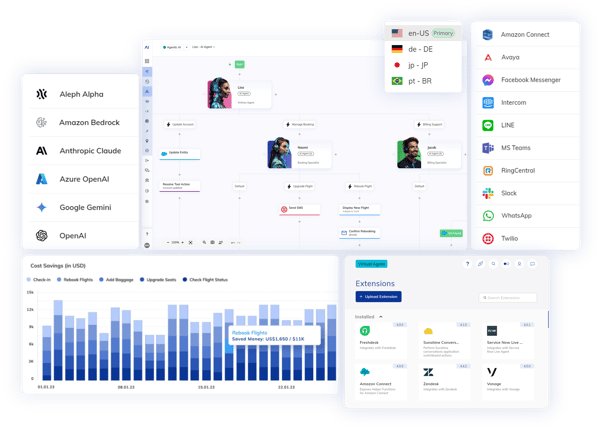







Contact center operations go way beyond the traditional call center, where agents would answer and make customer calls, like inquiries, bookings, and complaints. A contact center is the central hub for all communications, including voice, text, messaging, and social media.
In an AI-powered contact center, human agents and AI Agents work together to deliver the best possible customer service. This is achieved through a combination of Conversational AI, Generative AI, and machine learning to automate routine interactions, support agents with real-time insights, and personalize customer journeys at scale.
As a result, contact center operations become more efficient and resilient to change and growth. Contact center analytics and data allow enterprises to step away from the guesswork and ensure every decision is based on real company data.
Meanwhile, contact center automation and AI support enable agents to focus on complex, high-value conversations that require human expertise.
In this guide, we’ll explore the core metrics, key roles, and best practices that help enterprise contact centers operate effectively in an AI-driven environment.
Key Takeaways
- Modern contact center operations extend far beyond a traditional call center. Now, they cover omnichannel communication, AI Agents, automation, and data-driven decision-making.
- Enterprise contact centers balance people, processes, and technology to deliver consistent customer service at scale.
- AI and automation enhance human agents by reducing repetitive work and enabling focus on complex, high-value interactions.
- Contact center analytics is essential for improving customer experience and enabling proactive optimization.
- To succeed, you need to invest in continuous training, strong integrations, and clear governance, which are critical for long-term success as contact centers evolve.
What Are Contact Center Operations?
Contact center operations encompass people, processes, technology, and performance management practices for any enterprise’s contact center, typically the central hub for all customer communications.
It covers managing customer interactions, supporting agents, monitoring performance, ensuring service quality, and continuously optimizing operations to meet customer and business expectations.
Call Centers vs. Contact Centers
While the terms are often used interchangeably, call centers and contact centers are not the same. A call center traditionally focuses on handling inbound and outbound phone calls.
A contact center supports omnichannel communication, such as voice, live chat, email, messaging apps, social media, and self-service, while maintaining context across interactions.
Modern contact center operations are designed to deliver customers top-quality service. At an enterprise level, contact center operations also involve collaboration between human and AI Agents to support workforce management, quality assurance, analytics, and system integrations.
Optimizing Customer Service Delivery
Ideally, a contact center should deliver fast, consistent service to customers across all channels. Starting from an initial call or message, the contact center’s agents (both human and AI) should work together to efficiently route inquiries, encourage self-service, and enable smooth handoffs, all while maintaining context throughout the customer journey to reduce frustration.
Improving Agent Productivity
When done right, contact center operations should empower agents to perform at their best. AI helps them to streamline workflows, automate repetitive tasks, and provide real-time insights. Ultimately, this should mean issues are resolved faster, handling times are shorter, and human agents can focus on complex, high-value (and more rewarding!) conversations.
Leveraging Data for Continuous Improvement
The biggest change in contact center operations in recent years has been the availability and accuracy of data. Contact centers generate large volumes of data that inform critical decisions.
Both quantitative (e.g., performance metrics, interaction analytics) and qualitative data (e.g., customer feedback, sentiment analysis) are helpful in proactively refining processes and adapting operations as customer needs evolve.
The Role of Technology in Modern Contact Centers
Modern contact centers rely on an integrated technology stack that includes AI, automation, analytics, and CCaaS platforms.
These tools enable organizations to automate routine interactions and intelligently route inquiries, freeing human agents to focus on more complex inquiries.
When implemented correctly, technology enhances both customer satisfaction and agent productivity while giving operations teams the visibility they need to optimize performance continuously.
Toyota: Proactive Customer Engagement with AI Agents
Toyota uses AI Agents to proactively contact customers rather than waiting for inbound inquiries. By analyzing customer data and interaction context, AI Agents can provide timely, relevant information, such as service reminders, reducing inbound call volume and preventing issues before they escalate. This proactive approach improves customer experience while allowing human agents to focus on more complex or high-value interactions.
Lippert: Knowledge AI for Faster, More Accurate Resolutions
Lippert integrated Knowledge AI into its contact center operations to give agents instant access to accurate, contextual answers during customer interactions.
This reduces search time and improves first-contact resolution, which ensures consistent responses across agents. Ultimately, this empowers agents to work more efficiently without sacrificing service quality.
Essent: Intelligent Routing and Collaboration with Microsoft Teams
Essent enhanced its contact center with AI voice integration, intelligent routing, and integration with Microsoft Teams. Incoming interactions are prioritized and routed based on intent and context, while the Teams integration enables seamless collaboration between contact center agents and back-office experts.
This reduced resolution times, improved internal communication, and ensured customers receive accurate support without unnecessary transfers.
Key Components of Contact Center Operations
Successful contact center operations are built on a strong foundation of three factors: people, processes, and technology.
Working together, they support consistent service delivery in a world of rising expectations and higher interaction volume.
People
Even with the rise of AI and automation, people are still central to contact center operations.
It’s all about how your team's humans collaborate with each other and with AI systems. Key roles include contact center managers and supervisors who oversee performance, staffing, and service levels; agents who handle customer interactions and complex inquiries; and quality assurance teams that monitor service quality.
IT teams also support contact centers through AIOps systems and integrations to ensure maximum uptime and security.
Processes
Clear and concise processes ensure contact center operations run smoothly.
Workflow management governs how interactions move across channels and between self-service, AI support, and human agents. Often, a simple inquiry can be handled through self-service, empowering customers to resolve routine issues quickly. AI Agents can support more complex problems and integrate with existing systems, enabling tasks such as locating orders, verifying IDs, and uploading documents.
When it comes to more complex issues that require an empathy-led approach, human agents can step in and take the reins. They’ll receive all information gathered by the AI Agent, so they won’t need to ask the customer to repeat themselves, allowing them to resolve the issue as quickly as possible.
Other processes include quality assurance, which helps maintain consistent service standards, while structured training programs ensure agents and supervisors can adapt to new tools, workflows, and customer expectations over time.
Technology
Finally, technology enables seamless interaction among humans, AI Agents, and broader business operations through smart integrations and data-driven insights.
Core technology components include telephony systems, CRM platforms for customer context, and workforce management tools for forecasting and scheduling. Meanwhile, data analytics platforms enable performance monitoring, and omnichannel solutions unify voice and digital channels.
When these systems are correctly integrated, contact center teams gain better visibility and can deliver faster response times.
Essential Metrics and KPIs for Contact Center Operations
Contact center analytics is integral to an enterprise contact center's success, providing the insights needed to manage performance and improve customer experience.
By analyzing data across voice, digital, and self-service channels, analytics helps teams understand what is happening in the contact center and why.
Performance and Operational Visibility
Real-time dashboards provide contact center leaders with immediate visibility into key metrics, including interaction volumes, service levels, handle times, and resolution rates. Teams can then make faster decisions and address issues before they impact customers.
Customer Experience and Quality Insights
AI-powered analytics also provides qualitative data, like customer sentiment, intent, and interaction quality across channels. These insights support consistent service delivery, more personalized interactions, and ongoing quality assurance and compliance monitoring.
Predictive and Proactive Optimization
Predictive analytics uses historical and real-time data to forecast demand, identify emerging trends, and support proactive staffing and resource planning. This helps enterprises reduce costs without sacrificing service levels.
Read our complete guide to Contact Center Analytics: Key Metrics & Best Practices, to explore essential KPIs, common pitfalls, and proven strategies for turning analytics into measurable contact center improvements.
Best Practices for Optimizing Contact Center Operations
Optimizing contact center operations requires a balanced approach that combines the three factors we’ve already covered: people, processes, and technology.
Here are the best practices to help enterprise teams improve efficiency and scale operations as customer expectations evolve.
Define Clear Roles and Responsibilities
Any contact center needs clearly defined roles and responsibilities to ensure accountability and smooth day-to-day operations. When agents, supervisors, managers, and support teams understand their ownership and decision-making authority, workflows run more efficiently, and issues are resolved faster.
Foster Open Communication and Feedback Loops
Working towards continuous improvement? You need open communication.
Create a process for regular agent feedback to identify operational challenges and training needs. This will also help address any concerns around AI for human agents. Customer feedback also provides insight into service quality and performance.
Optimize Workforce Management and Scheduling
The right resources need to be available at the right time, but you don’t want to risk overspending on staff and other costs during quieter periods, especially now that you have AI Agents to support your contact center operations.
AI enables accurate forecasting, flexible scheduling, and real-time adjustments, helping you maintain service levels, reduce agent burnout, and control operational costs.
Invest Strategically in Technology
Investing in AI, automation, and omnichannel platforms enables contact centers to scale efficiently. But the benefits are only as good as the integration. Choose AI systems that integrate with your existing technology stack to minimize downtime and staff training. Otherwise, you’ll overwhelm contact centers with new systems to learn, increasing the potential for error.
When technology is well integrated and aligned with operational goals, it reduces manual effort, supports agents in real time, and delivers more consistent, personalized service across every touchpoint.
Challenges in Contact Center Operations
Despite advances in AI, contact center operations continue to face a range of challenges. Let’s take a look:
High Agent Turnover
Staff turnover has long been an issue for contact centers, due to repetitive tasks, high interaction volumes, and performance pressures. But AI Agents can lighten the load by handling monotonous work, allowing human agents to focus on the more rewarding parts of their roles.
Managing Peak Interaction Volumes
Contact centers are living, breathing ecosystems. From fluctuating demands to sudden spikes, resources can be easily drained, impacting productivity and customer satisfaction.
Without accurate forecasting and flexible staffing models, contact centers risk long wait times, higher abandonment rates, and increased pressure on agents.
Technology Integration and Complexity
Modern contact centers rely on multiple systems that work together: telephony, CRM, workforce management, instant messaging, analytics, and knowledge bases.
Integrating these technologies can be complex, especially when the AI platforms are not built to work with your legacy systems. Incorrect integration often leads to data silos, inefficient workflows, and limited visibility into performance. Ultimately, this will erode trust and confidence in AI as a technology, and securing stakeholder buy-in for future investment will be challenging without a proven success story.
Compliance and Data Security
Contact centers frequently operate in regulated environments where data protection, privacy, and compliance are critical. You must ensure regulatory compliance as you scale operations and adopt new technologies.
Balancing Cost and Quality
Organizations must continuously balance cost control with delivering high-quality customer service. Over-automation or underinvestment in people and processes can negatively impact customer experience, while inefficient operations can drive up costs. Achieving the right balance is an ongoing operational challenge.
Future Trends: Evolution of Contact Center Operations
What’s next for enterprise contact centers? You might be at the start of your AI journey, looking to upgrade to integrate communications across multiple platforms, or introducing Agent Copilot to support the team. Whatever you’re planning, let’s take a look at the future trends for contact center operations:
Agentic AI and Autonomous Operations
Agentic AI represents a shift in contact center operations. Instead of simply supporting agents, Agentic AI systems can reason, plan, and act independently within defined boundaries.
This enables contact centers to automate decision-making, dynamically adjust workflows, and respond to changing conditions, such as spikes in demand or customer frustration, in real time.
AI Voice Bots and Advanced Automation
AI-powered voice bots are becoming more natural-sounding and better at handling conversations. They are increasingly used to resolve common inquiries, verify customer identities, and route interactions intelligently. This supports the contact center’s goal of reducing wait times. It also frees up human agents to focus on high-value, emotionally complex interactions.
Omnichannel Support as the Standard
Although this is a ‘future trend’, we’re already seeing customers expect omnichannel support.
They want seamless experiences across voice, chat, and messaging with full context carried throughout their journey. Enterprises need to prioritize unifying channels, data, and workflows to ensure consistent service wherever customers choose to engage.
Remote and Hybrid Work Models
Many contact centers are already operating remote and/or hybrid working models. This expands the talent pool and also helps reduce office rental costs. Any remote team needs careful monitoring to ensure performance and collaboration are maintained, regardless of where they work.
Level Up Your Contact Center Operations with AI
Enterprise contact center operations require a platform that brings AI, automation, analytics, and integrations together in a unified way. As customer expectations rise and interaction volumes grow, organizations need to scale efficiently without compromising service quality.
Cognigy enables enterprises to transform contact center operations by seamlessly orchestrating AI Agents and human agents across voice and digital channels. With advanced Conversational AI, Generative AI, and real-time analytics, Cognigy helps organizations automate routine interactions, empower agents with contextual insights, and continuously optimize performance using real data.
Invest in the right AI platform to build a resilient contact center that delivers consistent, personalized customer experiences—now and in the future.