
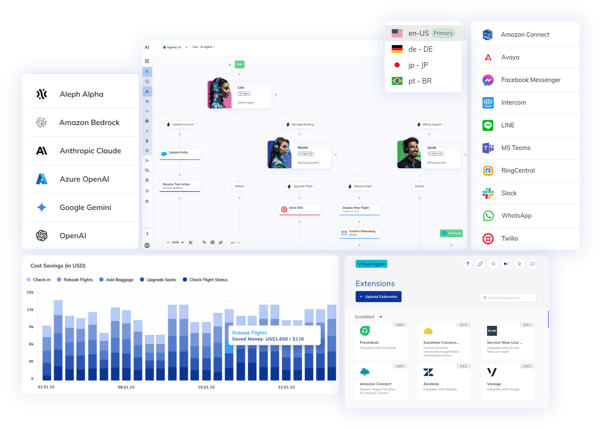




What Is Conversational AI?

Conversational AI refers to a set of technologies that enable computers to understand, process, and respond to human language in a natural, human-like way. Instead of navigating rigid menus or clicking through predefined options, users can interact with systems using everyday language, just as they would with another person.

At its core, conversational AI combines advanced language understanding with machine learning to interpret intent, generate responses, and continuously improve over time. This allows businesses to automate conversations across channels such as chat, voice, messaging apps, and digital assistants.

How Conversational AI Works

Conversational AI systems rely on several core technologies working together:

    • Natural Language Processing (NLP)
      Enables the system to understand human language, including grammar, context, and intent.
    • Machine Learning (ML)
      Allows the system to learn from interactions and improve accuracy over time.
    • Natural Language Understanding (NLU)
      Interprets user intent and extracts meaning from text or speech.
    • Dialogue Management
      Determines how the system responds and guides the conversation flow.
    • Natural Language Generation (NLG)
      Creates human-like responses that feel natural and relevant.

Together, these components allow conversational AI to move beyond simple keyword recognition and deliver contextual, intelligent interactions.

Conversational AI vs Traditional Interfaces

Traditional systems rely on structured inputs such as menus, buttons, and predefined workflows. Conversational AI removes this friction by allowing users to simply say or type what they need.

Key differences include:

    • User Experience
      Conversational AI is intuitive and natural, while traditional systems require navigation and training.
    • Flexibility
      Users can ask questions in multiple ways instead of following strict paths.
    • Efficiency
      Tasks are completed faster with fewer steps.

Scalability
AI can handle thousands of simultaneous conversations without increasing staffing.
 

Common Use Cases for Conversational AI

Conversational AI is widely used across industries to automate and enhance customer and employee interactions.

Customer Service

  • Answering FAQs instantly
  • Resolving common issues without human intervention
  • Routing complex inquiries to the right agent

Sales and Lead Qualification

  • Engaging website visitors in real time
  • Qualifying leads based on intent
  • Recommending products or services

IT and Employee Support

  • Automating internal help desk requests
  • Assisting with onboarding and HR questions
  • Providing instant access to knowledge bases

Voice and Contact Centers

  • Powering virtual agents and voice bots
  • Automating call routing and authentication
  • Supporting agents with real-time assistance

Benefits of Conversational AI

Organizations adopt conversational AI to improve both operational efficiency and user experience.

  • 24/7 Availability
    Always-on support across digital and voice channels
  • Reduced Costs
    Automation lowers the need for large support teams
  • Improved Customer Experience
    Faster responses and personalized interactions
  • Increased Agent Productivity
    Frees agents to focus on complex, high-value tasks
  • Scalable Growth
    Handles spikes in demand without additional resources

Challenges and Considerations

While conversational AI offers significant advantages, successful implementation requires planning and optimization.

  • Understanding Context
    Poorly trained models can misinterpret user intent
  • Data Quality
    AI performance depends on clean, structured data
  • Integration Complexity
    Systems must connect with CRMs, knowledge bases, and backend tools
  • Continuous Training
    Ongoing optimization is required to maintain accuracy and relevance

The Role of Conversational AI in Modern CX

Conversational AI is a foundational component of modern customer experience strategies. It enables organizations to deliver fast, consistent, and personalized interactions at scale.

As customer expectations continue to rise, businesses are shifting from reactive support models to proactive, AI-driven engagement. Conversational AI plays a critical role in this transformation by bridging the gap between human communication and digital systems.

Conversational AI and the Future of Automation

The next evolution of conversational AI goes beyond simple interactions toward more autonomous, goal-oriented systems.

Advancements include:

  • Deeper contextual understanding across conversations
  • Integration with business workflows and decision systems
  • AI agents capable of completing end-to-end tasks
  • Increased personalization based on user history and behavior

These innovations are pushing conversational AI from a support tool to a core driver of digital transformation.

Key Takeaway

Conversational AI enables natural, human-like interactions between people and machines by combining NLP, machine learning, and intelligent automation. It simplifies user experiences, scales operations, and plays a central role in the future of customer and employee engagement.