



UiPath

UiPath is a global enterprise software company specializing in robotic process automation (RPA). Founded in 2005 as a 10-person startup, UiPath has grown to approximately 3,000 employees and is widely regarded as the fastest-growing enterprise software company in history. It is best known for its industry-leading RPA platform, which combines artificial intelligence, machine learning, process mining, and analytics to deliver powerful hyperautomation capabilities.

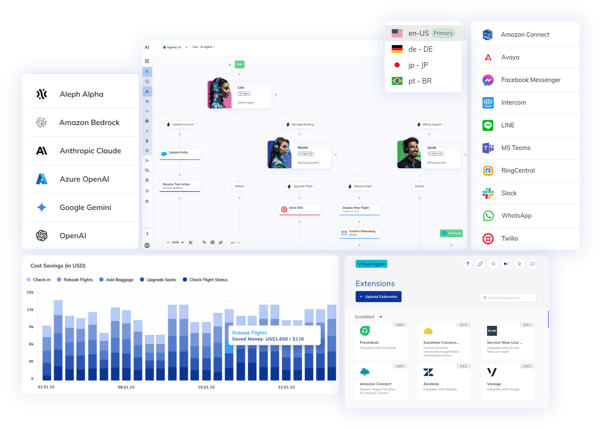
The UiPath platform enables organizations to identify automation opportunities, build bots of varying complexity, manage and deploy them, run tests, and measure performance — all from a unified environment. Cognigy.AI integrates seamlessly with the UiPath technology stack, combining conversational AI with RPA to simplify complex processes and deploy intelligent virtual agents that can trigger and interact with automated back-office workflows. 

Key Points

  • Global leader in robotic process automation (RPA) software
  • Platform leverages AI, machine learning, process mining, and analytics for hyperautomation
  • Enables bot building, deployment, management, testing, and performance measurement
  • Offers UiPath Academy — a free online platform with hundreds of hours of RPA training
  • Cognigy.AI integrates with UiPath to combine conversational AI with back-office automation

Why It Matters

RPA and conversational AI are highly complementary technologies. While Cognigy handles the front-end customer conversation, UiPath can execute the back-end processes triggered by that conversation — such as updating records, processing requests, or retrieving data from legacy systems. Together, they close the loop between customer interaction and business process execution, enabling true end-to-end automation.

Best-Practice Perspective

Cognigy recommends integrating Cognigy.AI with UiPath to build conversational automation workflows where virtual agents handle customer intent and hand off structured instructions to UiPath bots for back-office execution. This eliminates manual handoffs between front-end interactions and back-end processes, accelerates resolution times, and scales automation across the enterprise without custom middleware.