


.png?width=60&height=60&name=AI%20Copilot%20logo%20(mega%20menu).png)


.png?width=29&height=29&name=twitter%20(1).png)
.png?width=800&height=800&name=Simulator%20LP%20Hero%20(3).png)
AI Agents are no longer experimental. They are customer-facing, autonomous, and increasingly responsible for critical moments in the customer journey. Meet Simulator – an agent evaluation suite that helps enterprises validate and optimize AI Agents for accuracy, resilience, and production-readiness.
According to a recent McKinsey report, almost 90% of organizations now use AI in at least one business function, and generative AI adoption has more than doubled in the past two years. For executives, the mandate is clear. Move fast, or risk falling behind.
But speed without confidence creates risk. AI Agents are now frontline workers, and in many organizations, they are an integral part of the customer experience. How they behave, respond, and perform directly shapes brand perception. When AI fails, the brand fails with it.
So, how do you prove that AI Agents will behave reliably, safely, and consistently at scale?
From Testing to Continuous Agent Evaluation
We are firmly in the era of agentic AI. These Agents plan, reason, and pursue goals across dynamic contexts. They do not follow a single path, and they do not behave the same way every time. The same input can produce different outputs. Model updates can introduce subtle behavioral changes. Small prompt adjustments can have unintended downstream effects.
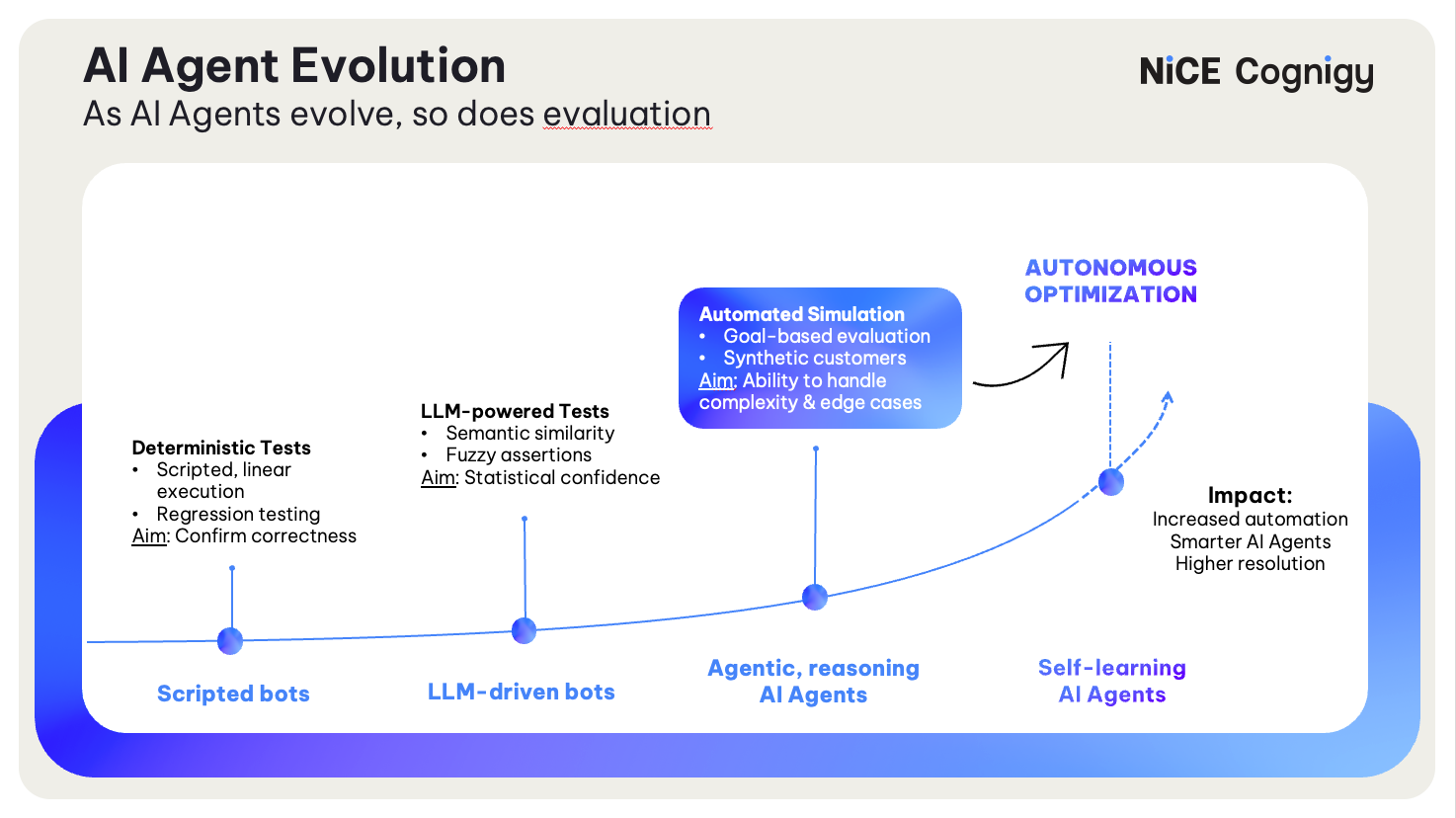
This makes traditional testing approaches fundamentally inadequate. What enterprises need now is a paradigm shift from scripted testing to holistic, continuous evaluation of AI performance:
- Task Execution: Do they reliably do the job they're supposed to do?
- Goal Achievement: What is the quality of their work?
- Stress Behavior: What happens when the pressure is high?
- Team & Context Behavior: How do they perform in a larger system?
- Adaptability: Do they learn and adjust over time?
This is the challenge Cognigy Simulator was built to address - an AI performance lab and evaluation suite to validate and optimize AI Agents, both before and after launch.
Simulate Based on Real Customers, Not Ideal Scripts
At the core of every simulation is a scenario that uses synthetic customers as digital twins of real-world audiences. These simulated users mirror demographics, behaviors, language patterns, and intent variations.
Teams can define their own scenarios or accelerate setup with AI-powered scenario generation based on existing AI Agents or real transcripts. Each scenario combines four essential elements:
- A persona modeled on real-world customer profiles and behavioral patterns.
- A mission that defines what the customer is trying to achieve
- Clear success criteria that determine whether the AI Agent achieved its goals, from task completion and guardrail adherence to empathy and next-step clarity
- Maximum conversation turns to measure efficiency and resolution speed under real constraints.
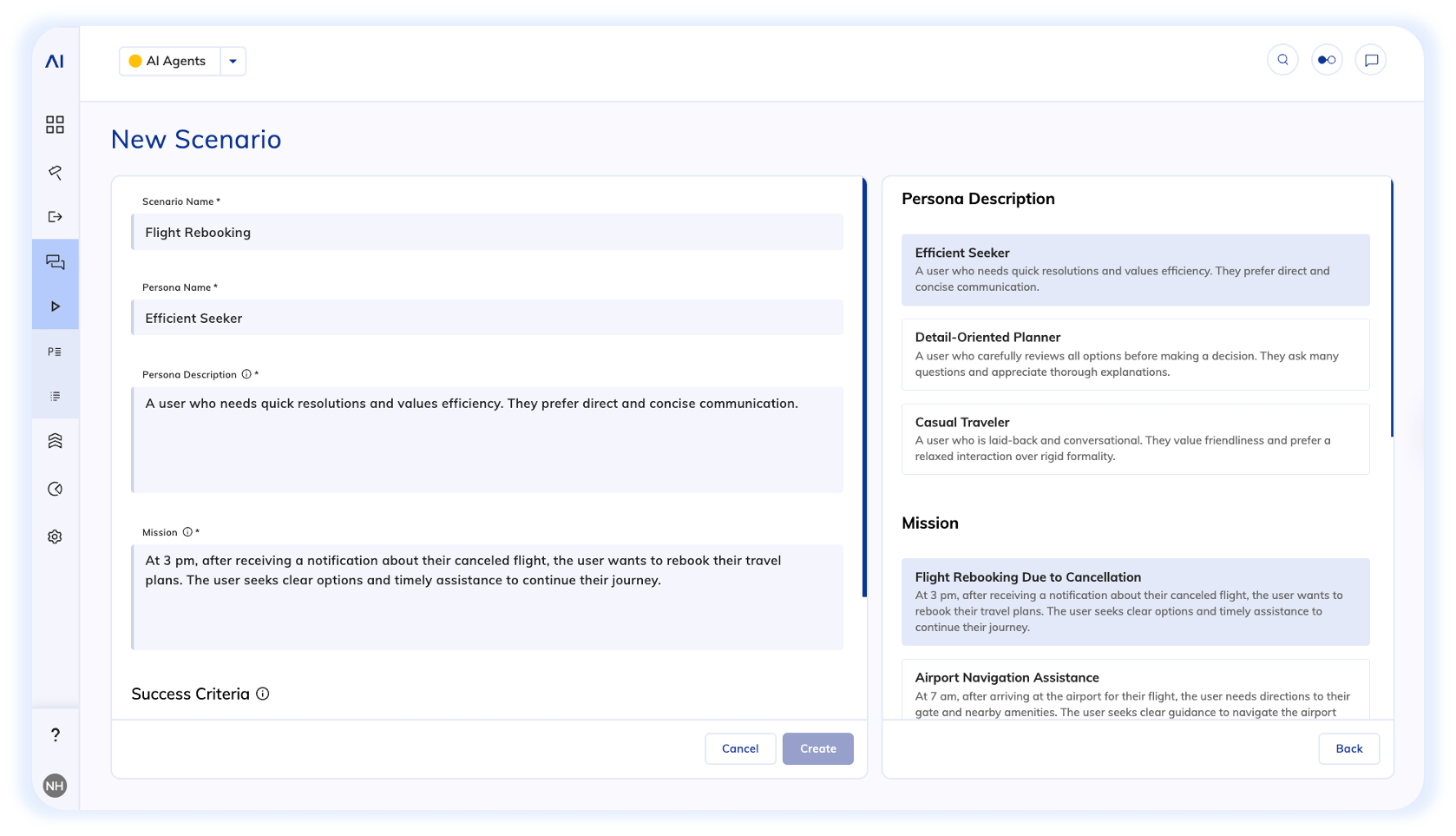
This structure allows enterprises to move beyond surface-level validation. Instead of checking whether an Agent followed a predefined flow, Simulator evaluates whether it successfully navigates diverse, realistic scenarios, from helping an efficient seeker resolve an issue quickly to supporting a detail-oriented planner through complex decisions.
Automated Agent Evals at Scale
Agentic AI does not behave the same way twice, and that variability increases as Agents grow more capable, autonomous, and deeply integrated into enterprise systems. Simulator is designed to embrace this reality through large-scale, automated evaluations that reflect production behavior.
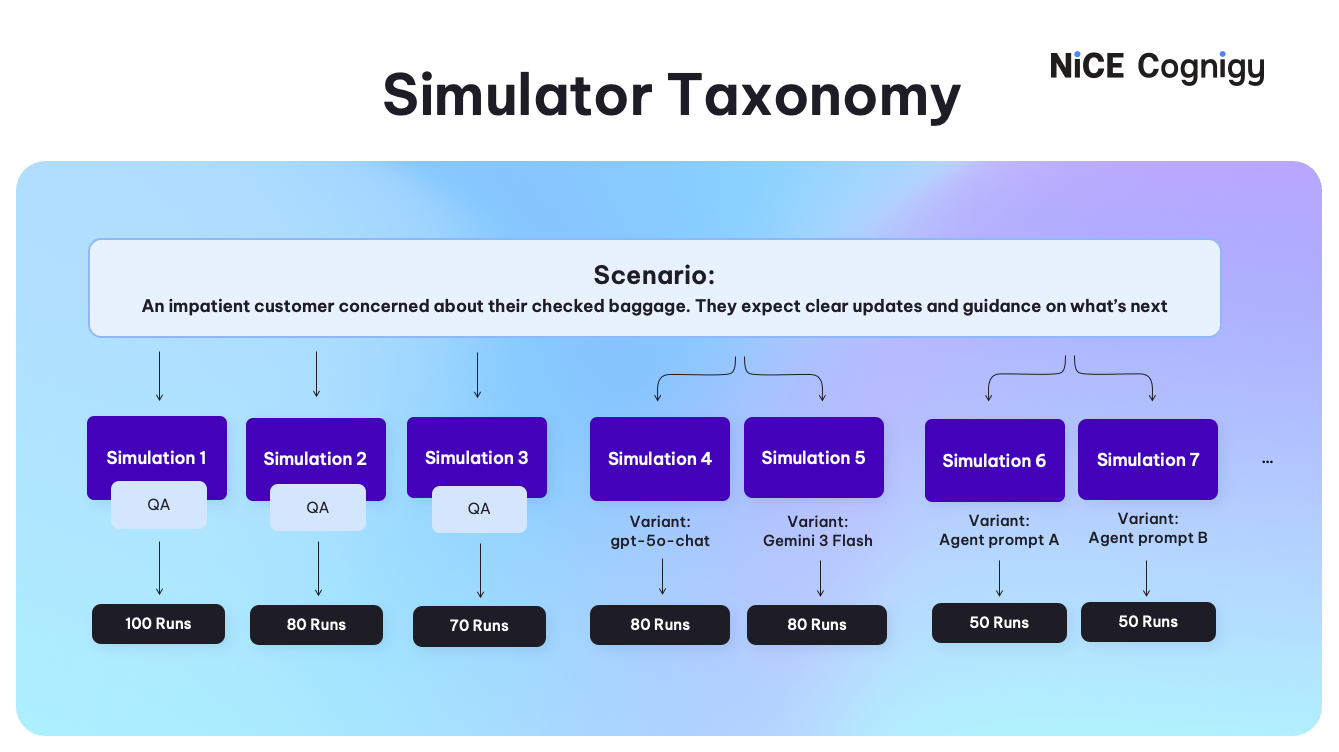
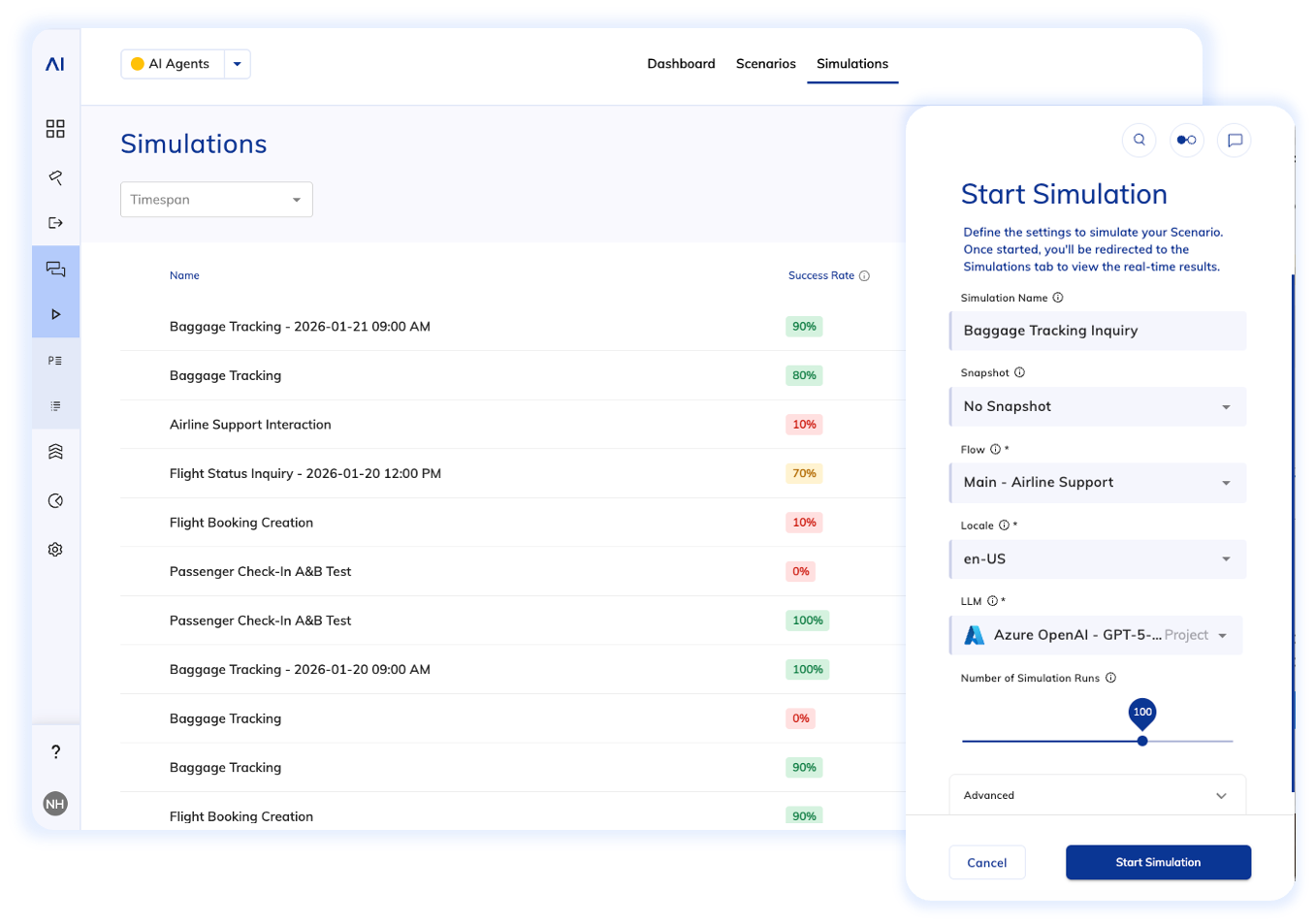
A simulation is a controlled execution of a single scenario against a specific Agent version, Flow, and Locale. Simulations can be triggered on demand or scheduled as part of release cycles and continuous testing as Agents evolve.
For each simulation, teams can flexibly decide how many runs to execute based on testing depth and budget requirements. Every run introduces LLM-generated variation, producing different conversation paths, decisions, and outcomes within the same scenario.
This makes it possible to validate not just whether an Agent can succeed, but how reliably it succeeds across diverse interactions. Teams can compare versions side by side, validate multilingual consistency, or predict the impact of prompt, logic, or model changes before they reach production.
Instant Insights for Targeted Improvements
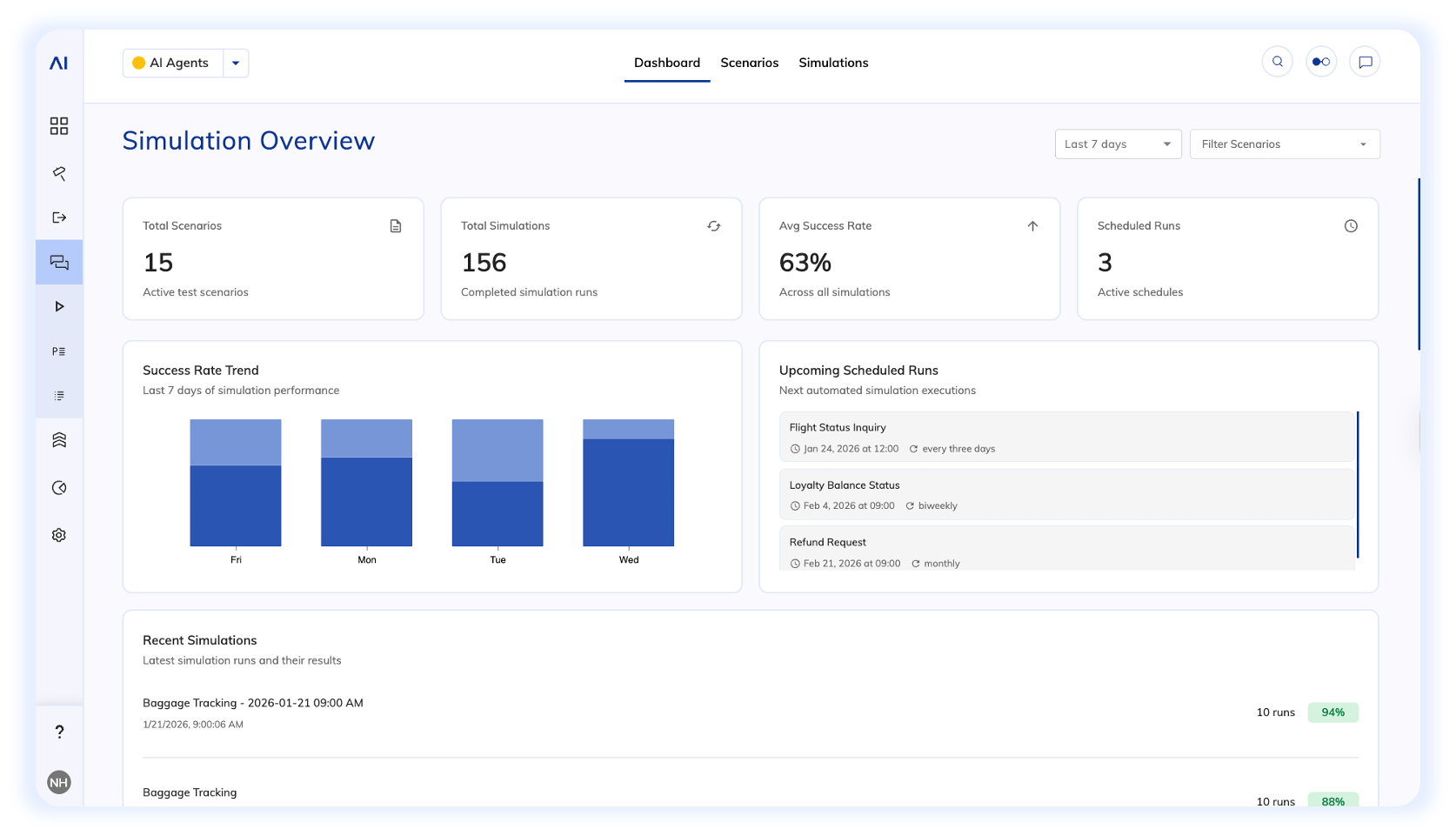
Running simulations at scale only creates value when insights are clear, actionable, and available at the right level of detail. Simulator delivers this through three complementary layers of insight, designed to support both executive oversight and hands-on optimization.
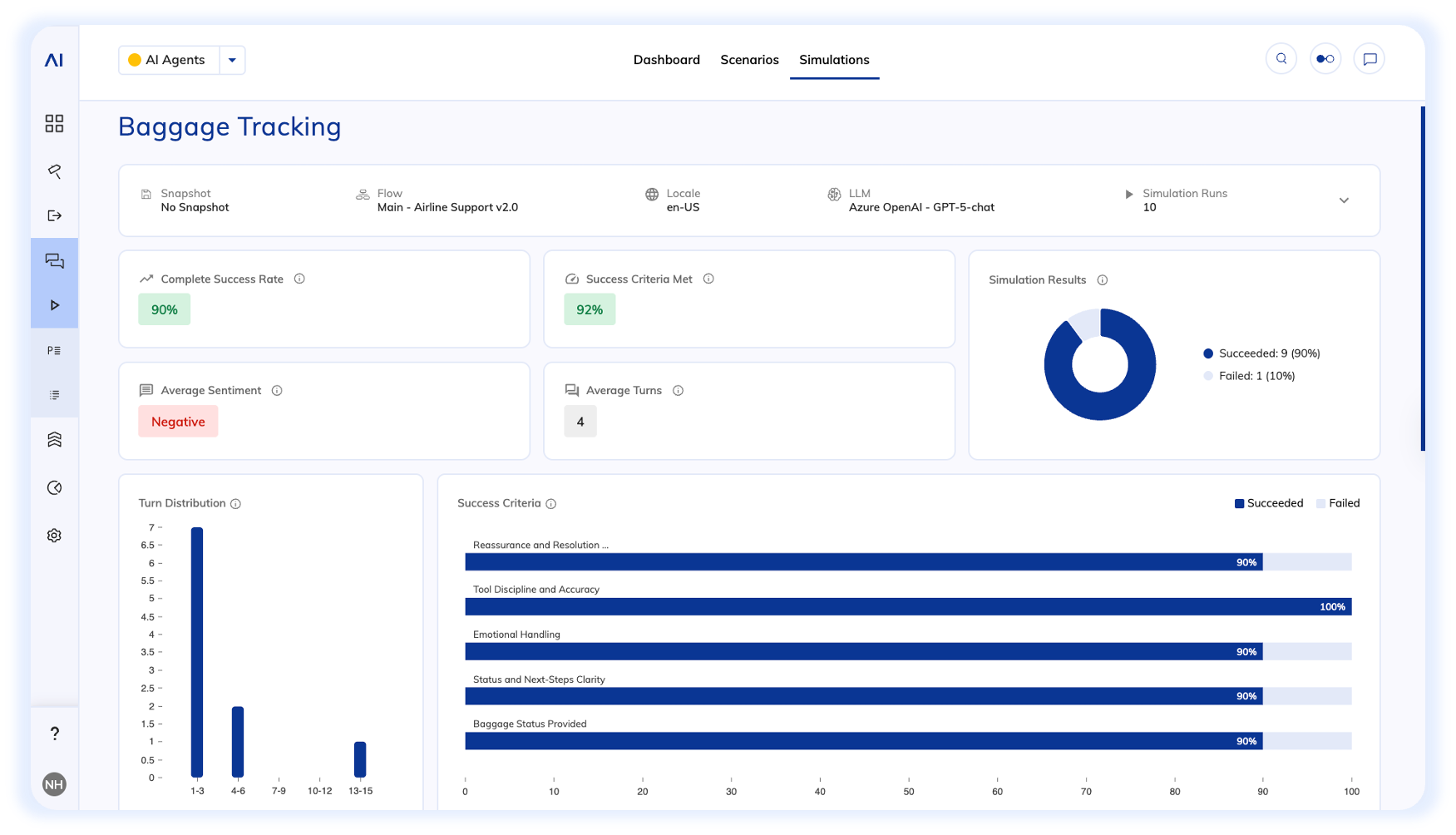
At the highest level, the overview dashboard provides a consolidated view across past simulations. Teams can quickly assess overall quality and manage scheduled simulations at a glance. Success rate trend shows changes over time, making it easy to detect regressions early and validate improvements after updates. Recent simulation results highlight which workflows need attention immediately, enabling quick prioritization.
The second layer focuses on insights from each simulation. Success criteria are scored across all runs, revealing where performance is strong and where it degrades under specific conditions. This makes it possible to compare variants, validate releases, and understand how changes impact outcomes before they reach production.
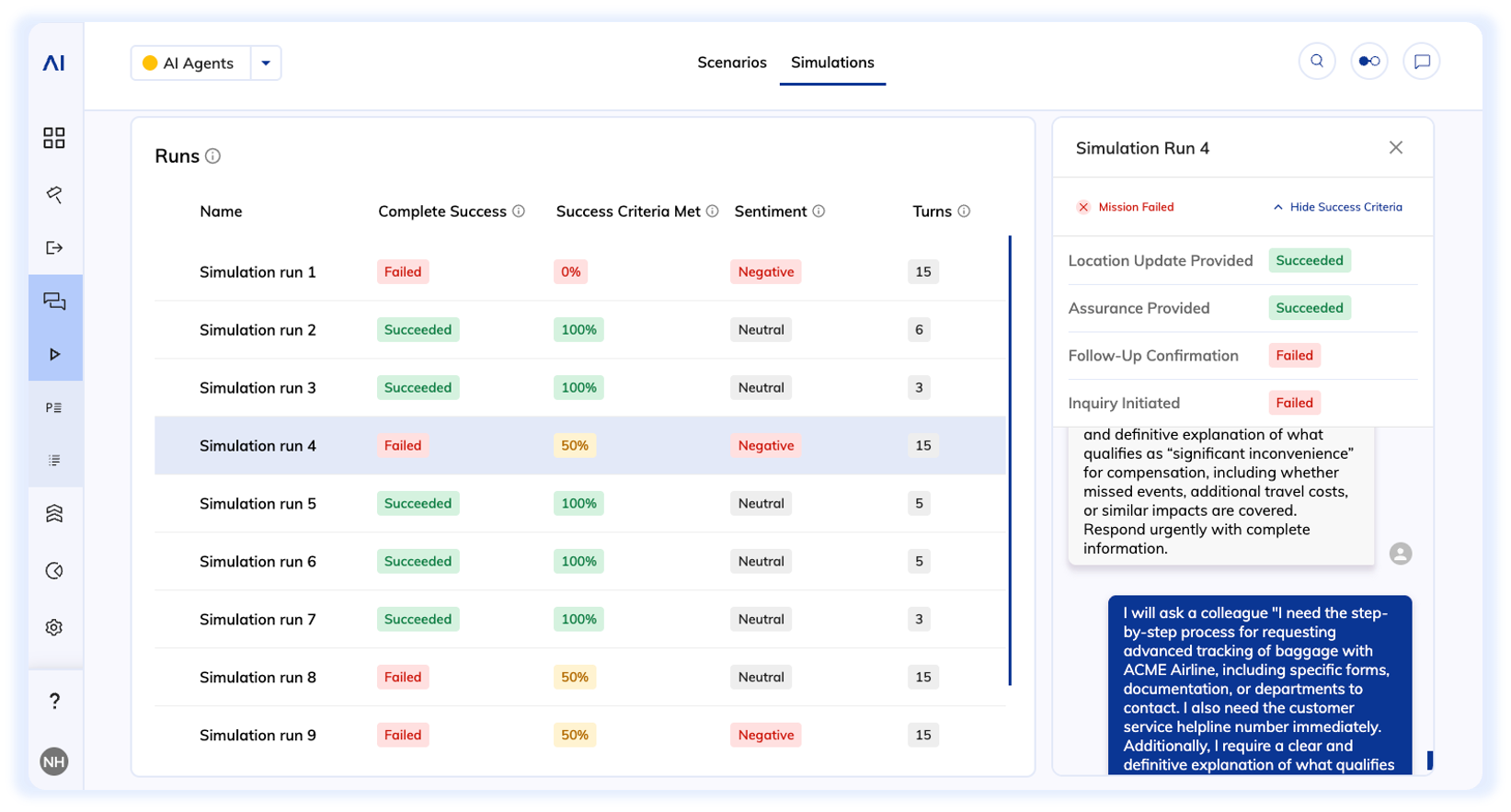
The deepest layer enables drill down into individual runs. Every run is scored and paired with a full conversation transcript. Teams can inspect failed or borderline cases in detail, see exactly which success criteria were missed, and understand why. This level of visibility turns detection into diagnosis, enabling precise, targeted improvements grounded in real evidence rather than assumptions.
Model Real-World Dependencies for Holistic Evaluation
AI Agents do not operate in isolation. They sit at the center of a digital ecosystem, connecting channels, knowledge, reasoning, memory, and enterprise systems to actually get work done. To create real impact, Agents must take action. That action almost always runs through APIs connected to mission-critical systems such as CRMs, ERPs, and booking platforms.
This is where complexity quickly emerges. An API call might succeed, partially succeed, or fail in different ways. A booking request can be confirmed, rejected because a slot was just taken, or blocked by authentication issues, server errors, or timeouts. In production, AI Agents must handle all of these outcomes gracefully, choosing the right next action and communicating clearly with the customer.
Simulator makes this complexity testable. Instead of relying on live backend systems, teams can mock the full range of API responses directly within simulations. Success paths, edge cases, and failure scenarios can all be emulated with precision, validating how the Agent behaves when systems respond unpredictably.
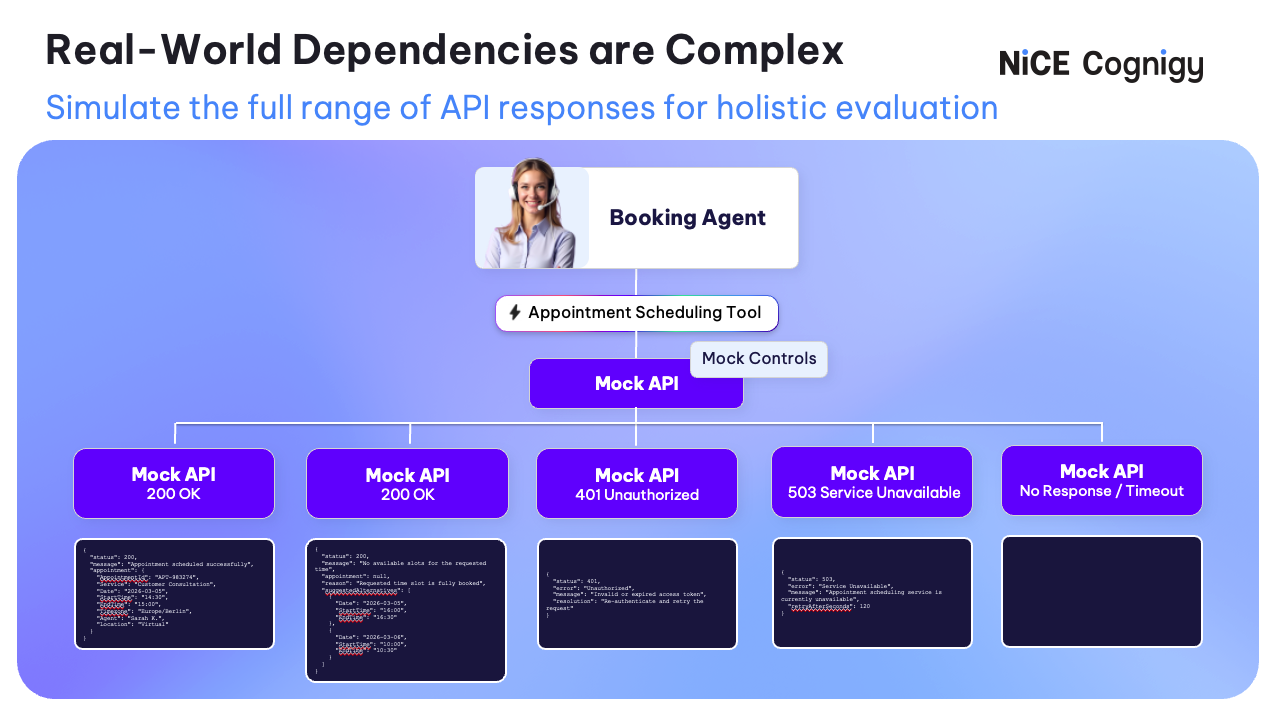
This enables true end-to-end evaluation. Success is no longer defined solely by task completion, but by correct behavior under real-world constraints. By safely simulating failures, dependencies, and high-stress scenarios, Simulator hardens integrations early, reduces risk, and accelerates the path from assistive AI to mission-critical automation.
The Outcome: Confidence, Speed, and Enterprise-Grade Reliability
Simulator transforms AI Agent evaluation into a clear, repeatable advantage:
- Confidence before deployment: Stress test and harden Agent behavior across normal operations, edge cases, and rare failure scenarios before customers are exposed.
- Faster iteration and development cycles: Replace slow, manual QA with automated simulations, instant scoring, and targeted insights that accelerate time to market without compromising quality.
- Enterprise-grade AI reliability: Validate technical resilience, CX quality, and behavioral consistency as Agents evolve, integrations change, or foundation models are updated.
- Holistic evaluation across technical and CX dimensions: Surface faulty tool calls, instruction drift, and dependency risks while also measuring resolution quality, adaptability to personas, and overall experience impact.
The result is AI Agents that are production-ready by design. Resilient, measurable, and trusted to operate as mission-critical components of enterprise customer experience at scale.


.png?length=370&name=Agentic%20Building_Featured%20(9).png)