


.png?width=60&height=60&name=AI%20Copilot%20logo%20(mega%20menu).png)


.png?width=29&height=29&name=twitter%20(1).png)
AI Agents are evolving rapidly. What began as conversational assistants is quickly becoming a network of systems that can reason, collaborate, and execute tasks across services. The next phase of AI will not be defined by individual Agents operating in isolation, but by interconnected agent ecosystems capable of orchestrating tools, workflows, and applications across platforms.
At NiCE Cognigy, we believe open standards are essential to unlocking this future. One of the most promising developments in this direction is the Model Context Protocol (MCP), a standard for connecting AI Agents to tools and services in a consistent way.
NiCE Cognigy has already embraced MCP by enabling Agents to consume external MCP tools. Today, we are taking the next step. With the Cognigy MCP Server, we now enable external AI systems to access Cognigy capabilities directly. This turns Cognigy from a consumer of tools into a provider of governed services within the broader agent ecosystem.
From Conversations to Action: The Role of Tools & MCP
Tools enable AI Agents to move beyond answering questions and perform actions in real systems. Each tool defines a capability with a name, description, and structured parameters that allow the Agent to invoke it during a conversation. In Cognigy, tools are configured as part of the agent orchestration layer, enabling AI Agents to dynamically choose and execute the right capability based on context.
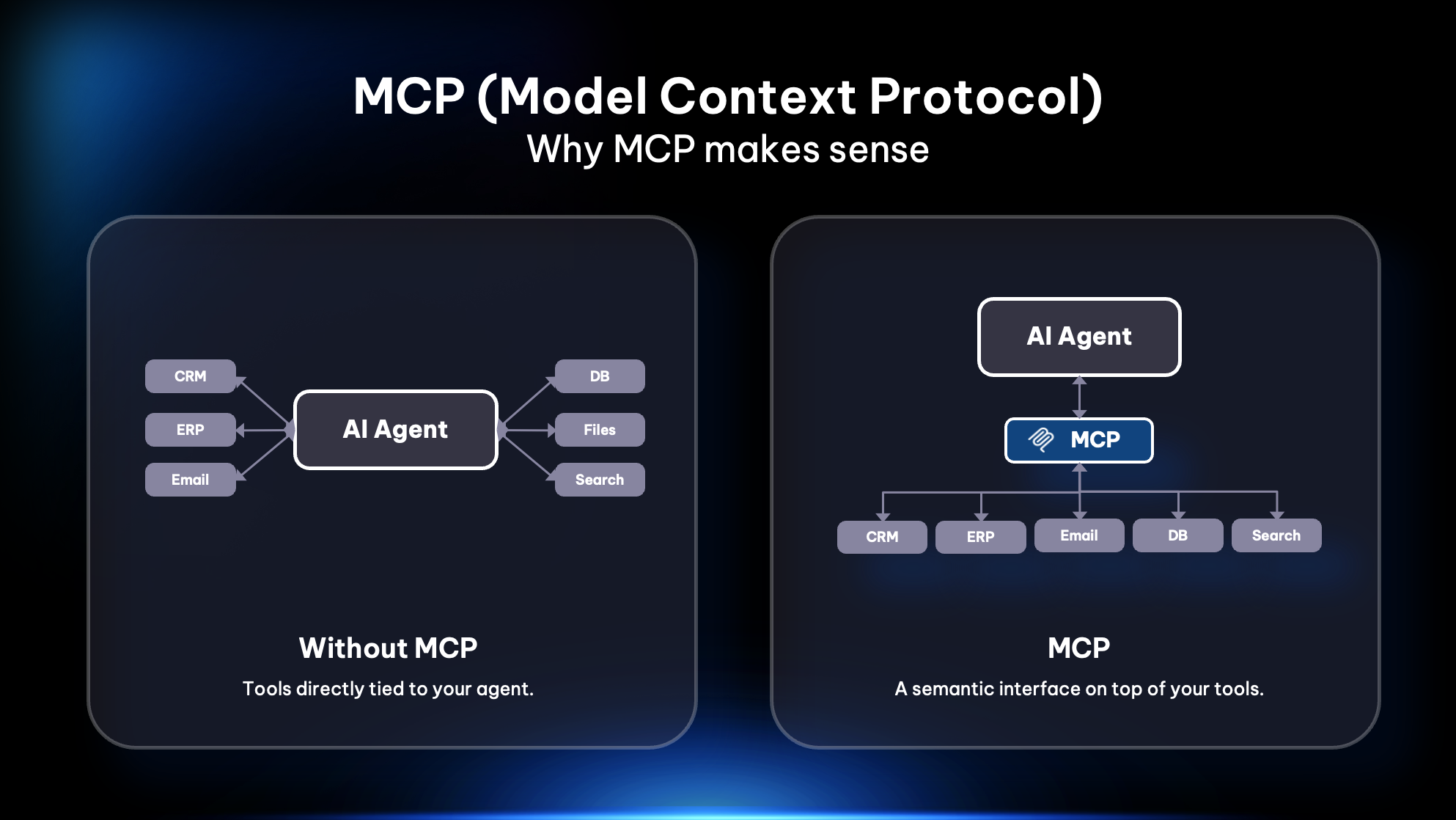
As AI ecosystems quickly expand, the need for a streamlined, standardized layer to connect Agents with external information and functionality emerges. The Model Context Protocol (MCP) addresses this by introducing an open architecture where AI Agents act as MCP clients that connect to MCP servers exposing capabilities as tools, creating a consistent way for AI systems to access services across platforms.
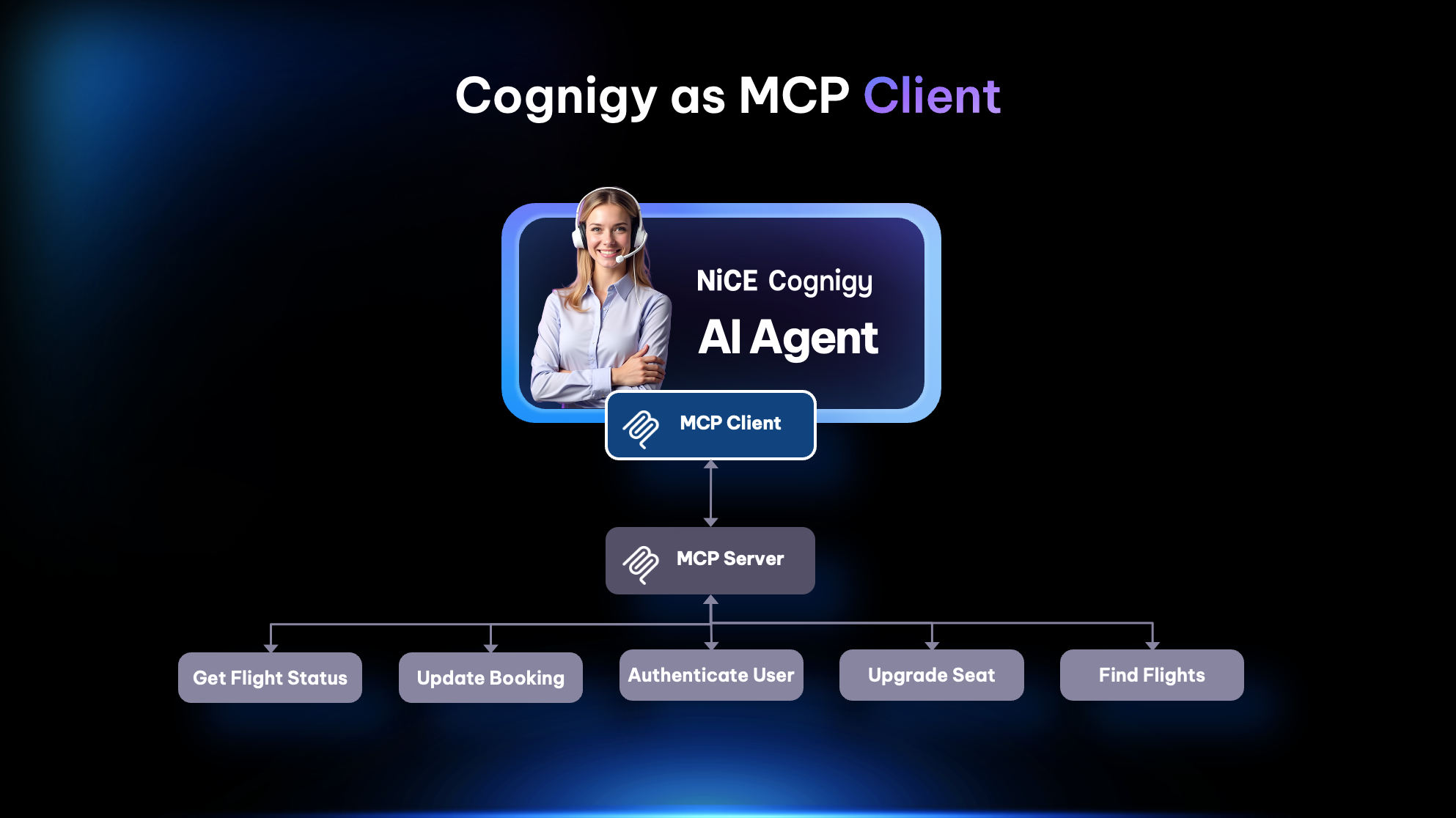
Cognigy as an MCP Client: Integrating External Tools
Cognigy already supports MCP by acting as an MCP client, allowing our AI Agents to connect to external MCP servers and consume standardized tools exposed by other services. These MCP tools become available directly within Agent Flows and can be orchestrated alongside native tools inside the platform.
By connecting to an MCP server, AI Agents can quickly gain access to external capabilities without requiring custom integrations for every service.
A single MCP server can expose its tools to many AI Agents at once, simplifying how capabilities are shared and reused. In addition, the abstraction layer provided by MCP means that when an underlying API changes, only the MCP server needs to be updated while the agent configurations remain stable.
Introducing the Cognigy MCP Server
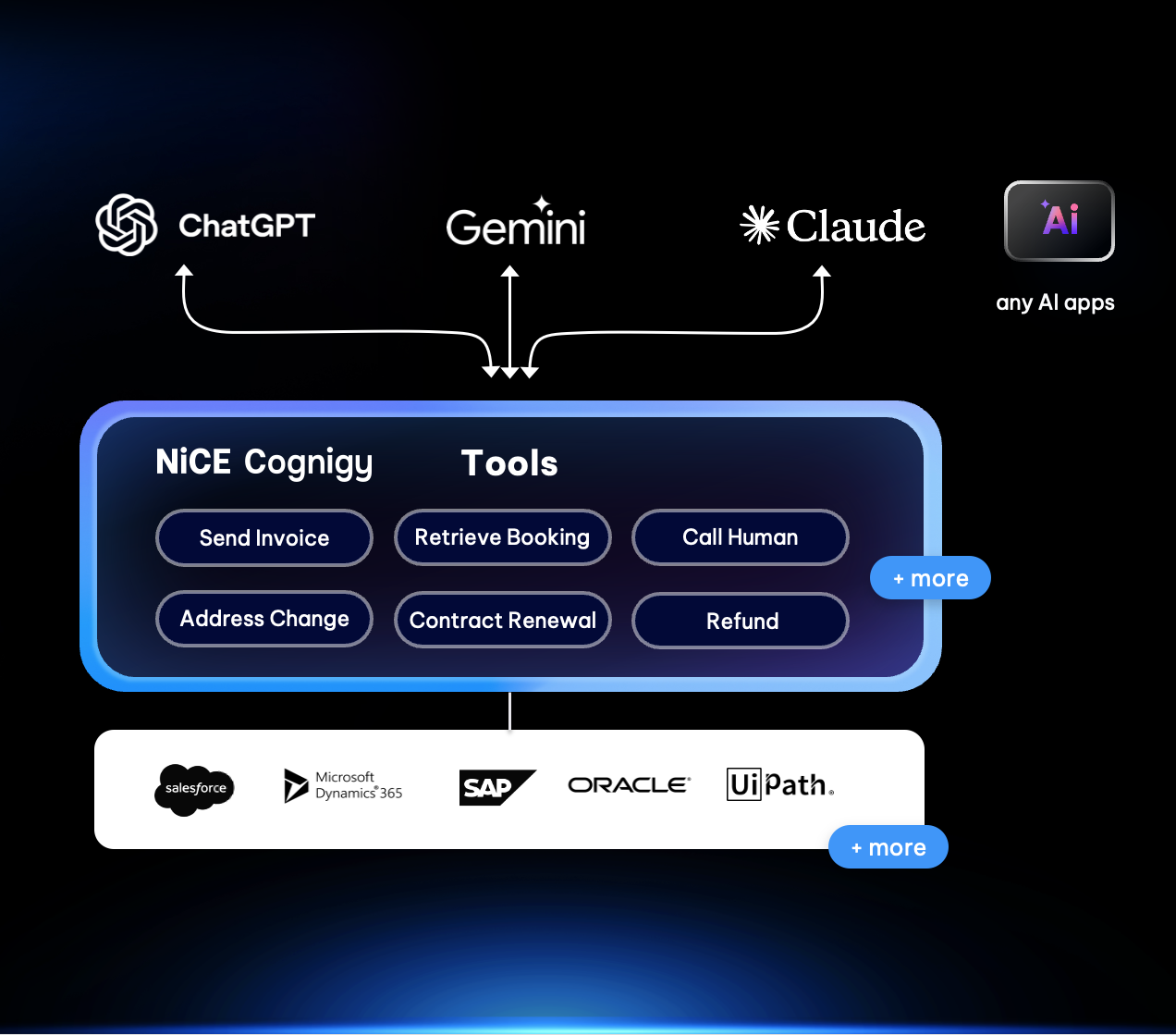
With the Cognigy MCP Server, Cognigy expands its role in the MCP ecosystem beyond consuming tools. In addition to acting as an MCP client, Cognigy can now also operate as an MCP server, exposing agent capabilities to other AI systems via a standardized interface.
Through a native MCP Server Endpoint, agent tools defined in Cognigy can be exposed as MCP tools. External MCP clients can discover these capabilities, understand their structure, and invoke them directly. Because this follows the MCP standard, a wide range of clients such as Claude, Cursor, or ChatGPT can seamlessly connect and interact with Cognigy-powered services.
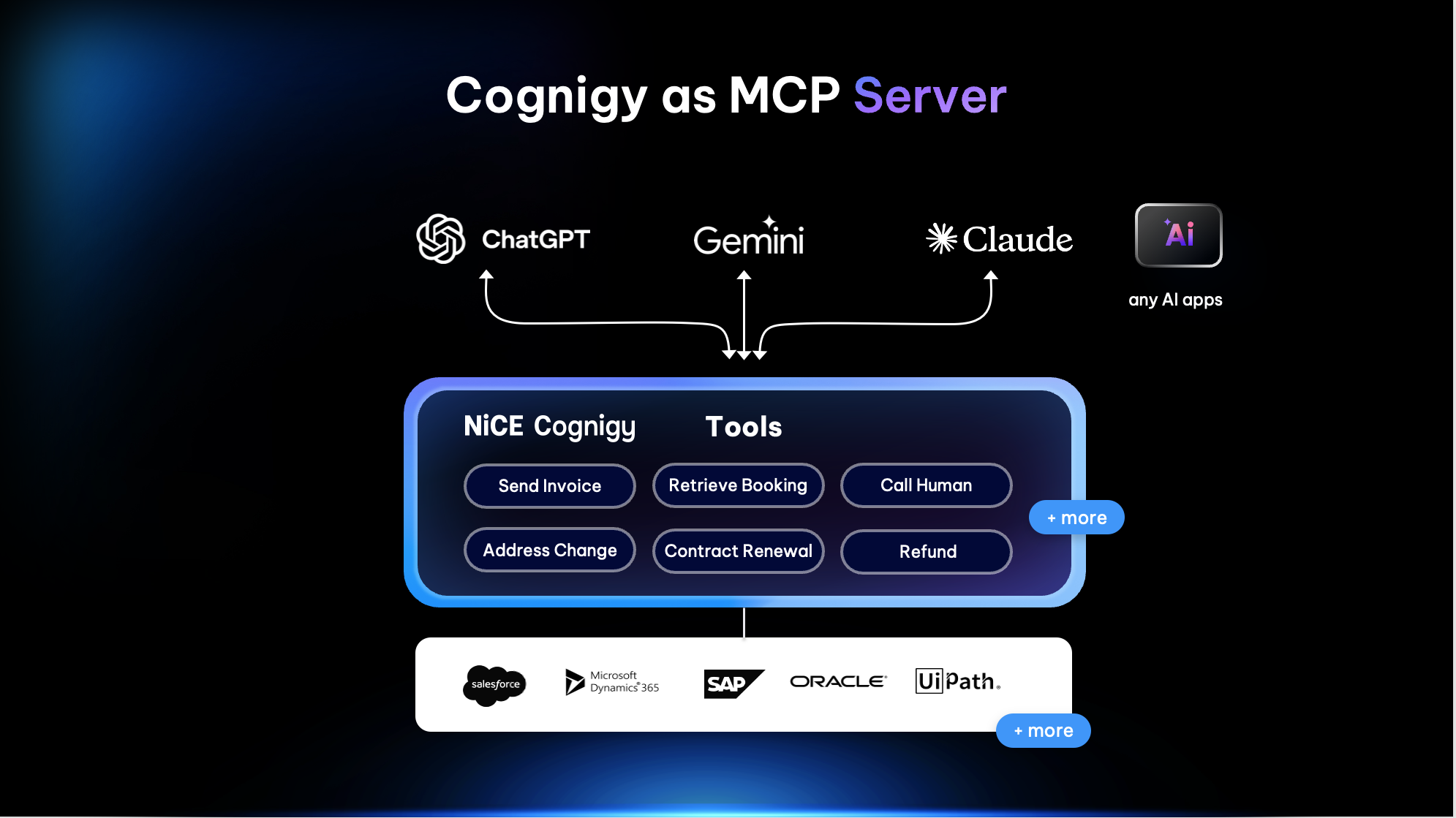
What makes this especially powerful is that existing Cognigy capabilities instantly become reusable across the MCP ecosystem. Workflows, integrations, and orchestration logic that were previously confined to a single agent experience can now be accessed programmatically by other AI applications. In other words, what you build once in Cognigy can be consumed efficiently by multiple AI systems without additional integration work.
The MCP Server Endpoint comes with:
-
A clear, structured overview of available tools based on the selected Agent Flows
-
A built-in MCP Explorer to test tools and validate configurations
This positions Cognigy as more than just an agent platform. It becomes a bridge between conversational AI and the broader agent ecosystem, enabling external systems to tap into Cognigy’s strengths in orchestration, automation, and enterprise integrations.
At the same time, it is important to note that the MCP Server is currently experimental, designed to explore emerging patterns in agent interoperability as the MCP standard and ecosystem continue to evolve.
Enterprise Implications: Unlocking the Machine Channel
As AI Agents increasingly act on behalf of users, enterprises must prepare for the next fundamental shift: your next customer might not be human. Gartner predicts that by 2028, 70% of customer service journeys will begin and be resolved in conversational, third-party assistants built into mobile devices.
The introduction of the Cognigy MCP Server positions enterprises for an emerging world of machine-to-machine interactions, where AI Agents transact and coordinate across services. In this model, they become first-class consumers of business capabilities, redefining how organizations engage with their customers.
At the same time, existing workflows, integrations, and logic developed in Cognigy can be reused, allowing enterprises to extend their CX investments into this new interaction paradigm. This enables them to cater to AI-customer interactions effectively and handle growing volumes without linear cost increases.
Outlook: From Tools to Agent-Native Applications
Looking ahead, the MCP ecosystem points toward a broader shift in how AI systems interact with software and services. While MCP tools establish the foundational building blocks for agent actions, the next step could involve higher level applications built on top of interoperable tools. In this model, tools remain reusable capabilities, while application layers orchestrate them into structured workflows with richer interactions and guided user experiences.
At the same time, the wider industry is beginning to explore concepts that extend these ideas even further. Early proposals envision a future where websites or digital services could expose structured capabilities directly to AI Agents, enabling Agents to interact with systems through defined tool interfaces rather than traditional graphical user interfaces.
Although these ideas are still evolving, they point toward a potential future in which the web becomes increasingly AI accessible, allowing Agents to discover and invoke capabilities across services in a standardized way. In such an environment, open protocols and interoperable platforms will play a crucial role in enabling collaboration between agents, applications, and digital services.


.png?length=370&name=Agentic%20Building_Featured%20(9).png)